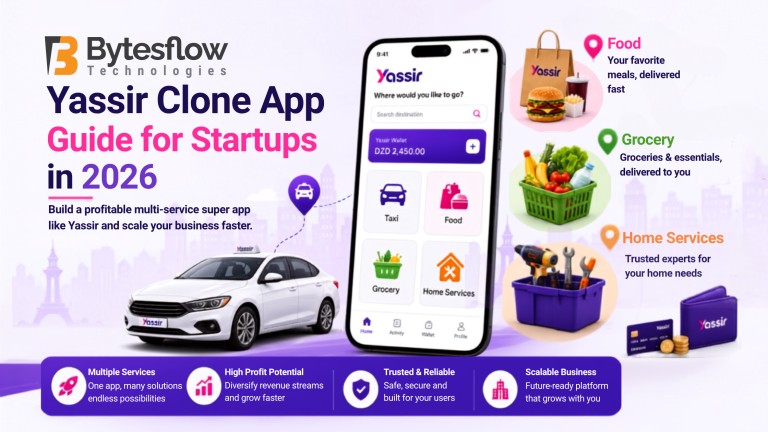
Yassir Clone App Guide for Startups in 2026
Published: August 1, 2026 | Category: Beginner’s Guide | Read time: ~10 min
Introduction
Startups building for 2026 no longer want a single-purpose app. They want a platform that rides, delivers, ships, and pays all under one brand. A Yassir clone makes that possible without years of in-house engineering.
This guide walks through the features, architecture, and launch roadmap founders need before they commit budget to a multi-service platform.
What Is a Yassir Clone?
A Yassir clone is a ready-made, white-label version of Yassir’s super-app model. It bundles ride-hailing, food and grocery delivery, courier services, and digital payments into a single customer-facing app, plus companion apps for drivers, vendors, and admins.
Instead of coding each module separately, founders customize an existing Yassir clone script, brand it, and go live in weeks rather than months. If you’re new to the concept, What Is an App Clone and How Does It Work? breaks down the model in more depth.
Why Founders Are Choosing This Model in 2026
The timing matters. According to Grand View Research, the global super apps market is expanding rapidly as single-service platforms evolve into multi-service ecosystems, driven by embedded payments and AI-led personalization.
Meanwhile, mobility and mobile-money adoption across Africa and the Middle East continue climbing:
Market Signal | Data Point |
Africa ride-hailing market | Growing steadily through 2030, per Mordor Intelligence |
Mobile money in Africa | Projected to expand sharply by 2034, per IMARC Group |
Payment method mix | Mobile money already processes the majority of ride-hailing transactions in Africa |
These numbers explain why a multi-service clone app one that combines mobility, delivery, and payments consistently outperforms standalone apps in retention and revenue per user.
Core Features Every Yassir Clone Needs
Before development starts, founders should lock in a feature list that covers every side of the marketplace:
Customer App
- Ride booking with live tracking
- Food, grocery, and parcel ordering in one interface
- In-app wallet and multiple payment options
- Order scheduling and saved addresses
Driver/Delivery Partner App
- Flexible availability toggles
- Ringtone order alerts
- Earnings and ratings dashboard
Vendor/Store Panel
- Inventory and menu management
- Coupon and offer creation
- Real-time order status updates
Admin Dashboard
- Centralized control over users, commissions, and payouts
- Analytics across every service vertical
You can also read our Top 25 Features Every Gojek Clone App Must Have in 2026 to see how feature depth stacks up across multi-service platforms.
On-Demand All-in-One Delivery App Clone: What to Bundle
An on-demand all-in-one delivery app clone succeeds when it bundles services people already use daily, rather than trying to cover everything at launch. A practical rollout order looks like:
- Ride-hailing (core traffic driver)
- Food delivery (highest order frequency)
- Grocery and pharmacy delivery (repeat customers)
- Parcel and courier services
- In-app wallet and bill payments
Launching in phases keeps your Yassir clone script lean while you validate demand city by city.
Multi-Service Clone App Architecture
A scalable multi-service clone app relies on modular architecture so each vertical (rides, food, grocery, payments) can scale independently. Key components include:
Layer | Recommended Approach |
Backend | Microservices architecture for independent scaling |
Payments | Embedded wallet plus card, mobile money, and cash-on-delivery |
Real-time tracking | GPS-based live location APIs |
AI layer | Demand prediction, fraud detection, dynamic pricing |
Infrastructure | Cloud-native, auto-scaling servers |
Yassir Clone Script vs Building From Scratch
Factor | Yassir Clone Script | Custom Build From Scratch |
Time to launch | 4–8 weeks | 8–14 months |
Upfront cost | Lower, fixed-scope | Higher, variable |
Customization | 100% white-label editable | Fully custom, slower |
Risk | Proven, tested modules | Higher technical risk |
For most founders, a Yassir clone script removes the guesswork of building a marketplace engine from zero, letting the team focus budget on branding, marketing, and local partnerships instead. If you’re still weighing build vs. buy, Understanding the App Cloning Business: Pros and Cons lays out the tradeoffs in detail.
Step-by-Step Launch Roadmap
- Define your service mix – decide which verticals launch first
- Choose white-label vs custom development
- Customise UI/UX to match your brand and local market
- Integrate local payment gateways (cards, wallets, mobile money)
- Test with a pilot city before wider rollout
- Onboard drivers and vendors ahead of the public launch
- Launch marketing campaigns timed with go-live
Mistakes to Avoid
- Skipping local market research before customizing features
- Launching every service vertical simultaneously instead of phasing them
- Ignoring regional payment preferences like mobile money
- Underestimating driver and vendor onboarding time
- Choosing a rigid platform that can’t add new verticals later
Not sure what can go wrong? Read our DoorDash clone app mistakes guide before making your investment.
Conclusion
The super-app race isn’t slowing down, and startups that wait too long to launch usually end up chasing a market someone else already owns. A Yassir clone gives you a tested, revenue-ready foundation, so the real work becomes execution: picking the right service mix, the right city, and the right payment rails for your users.
Bytesflow has helped founders take that exact path, from first feature list to a fully white-labeled, multi-service platform in market.
Ready to see what that looks like for your business?
view a live demo or book a free consultation with our team, and we’ll map out a launch plan built around your target market.
Frequently Asked Questions
1. How can I build a ride-hailing app similar to Yassir?
Start with a proven Yassir clone script rather than coding from scratch. Customize the ride-hailing module first, integrate local payment methods like mobile money, add live GPS tracking, and onboard a small group of drivers for a pilot launch before expanding citywide.
2. What are the key features for a successful multi-service mobile application?
The essentials are live tracking, an in-app wallet with multiple payment options, vendor and driver management panels, order scheduling, ratings, and a centralized admin dashboard that gives visibility across every service vertical from one place.
3. How long does it take to launch a Yassir clone app?
With a white-label script, most startups go live in four to eight weeks, compared to eight months or more for a fully custom build.
4. Is a Yassir clone app profitable?
Yes, when it earns from multiple streams: commissions, delivery fees, subscriptions, and payment processing rather than relying on a single revenue source.
5. Can a Yassir clone be customized for a specific country or region?
Yes. A good Yassir clone script is white-label and fully editable, so you can adapt currency, language, payment gateways, and service verticals to match local demand.