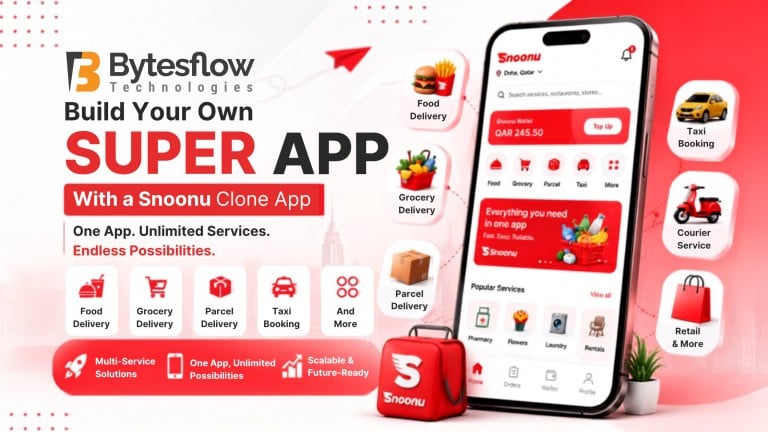
Build Your Own Super App With a Snoonu Clone App
Published: July 31, 2026 | Category: Launch Guide | Read time: ~10 min
Introduction
Running five different delivery apps to cover five different customer needs no longer makes sense. Users want one app for food, groceries, medicine, and parcels; that shift is exactly what built Snoonu into Qatar’s leading super app. If you are exploring a similar business, a Snoonu clone app offers the fastest, most cost-effective route to market. Instead of hiring a full development team and spending a year in build mode, you get a tested framework you can customize, brand, and launch.
In this guide, we’ll break down what a Snoonu clone app actually includes, why the super app model is booming, what it costs, and how to launch one the right way.
What Is a Snoonu Clone App?
A Snoonu clone app is pre-built software, engineered to mirror the core functionality of Snoonu: food ordering, grocery shopping, pharmacy delivery, parcel sending, and service bookings all inside a single customer-facing app. Unlike custom development, a Snoonu clone script already includes the customer app, vendor/store panel, delivery partner app, and admin dashboard, so entrepreneurs are not starting from a blank page.
In short:
- It is not a copy-paste duplicate; it’s a customizable framework.
- It follows the proven on-demand all-in-one delivery app structure.
- It’s built to be white-labeled with your own branding, city, and vendor network.
Why the Super App Model Is Growing So Fast
The numbers explain why so many entrepreneurs are moving toward this model instead of single-service apps. According to Grand View Research, the global super apps market was valued at USD 121.10 billion in 2025 and is projected to reach USD 968.77 billion by 2033, growing at a CAGR of over 30%.
Locally, the proof is even clearer. Snoonu itself evolved from a single-service food and grocery app into what The Peninsula Qatar describes as one of the country’s most complete digital ecosystems, now spanning delivery, marketplace, loyalty, and lifestyle services under a single interface.
Market Metric | 2025/2026 Value | Projected Value | Growth Rate |
Global super apps market | $121.10 Bn (2025) | $968.77 Bn by 2033 | 30.1% CAGR |
Hyperlocal delivery app market | $3.26 Bn (2026) | $7.27 Bn by 2030 | 22.2% CAGR |
Asia Pacific super app share | — | ~48–52% global share | Fastest growing region |
Consequently, businesses are no longer asking “should we go multi-service” instead they’re asking how fast they can get there. As Snoonu’s founder explained at Web Summit Qatar, localisation and service depth, not just app features, is what separates a super app from a basic delivery tool, according to Gulf Times.
Core Features of a Snoonu Clone App
A strong Snoonu clone app needs more than a food delivery module. Here’s what should be included:
Customer App
- Multi-vertical ordering (food, grocery, pharmacy, parcels)
- Real-time order tracking
- In-app wallet and multiple payment gateways
- Loyalty points and cashback rewards
- Scheduled and instant delivery options
Vendor/Store Panel
- Menu and inventory management
- Order acceptance and dispatch controls
- Sales and performance analytics
Delivery Partner App
- Route optimization
- Earnings dashboard
- Order batching for multiple pickups
Admin Dashboard
- Commission and payout management
- Zone-based service control
- Promotions and campaign management
Because it is built as an on-demand all-in-one delivery app, every module talks to the same backend, so adding a new vertical (say, laundry or flowers) doesn’t mean building a separate app.
How a Multi-Service Delivery App Makes Money
Understanding the revenue model matters just as much as the tech stack. A multi-service delivery app typically earns through:
- Commission per order – a percentage cut from vendors on every completed order
- Delivery fees – charged to customers, sometimes tiered by distance or speed
- Subscription plans – premium memberships offering free or discounted delivery
- In-app advertising – vendors paying for featured placement
- Surge or peak-hour pricing – dynamic fees during high-demand periods
Furthermore, because a multi-service delivery app serves multiple categories from one customer base, average revenue per user tends to be significantly higher than single-vertical competitors: customers order food today, groceries tomorrow, and a pharmacy item the day after, all within the same app.
Step-by-Step: Launching Your Snoonu Clone Script
Launching doesn’t have to be complicated. Here’s the realistic path:
- Define your service verticals – start with 2–3 (e.g., food + grocery + pharmacy) rather than all eleven at once
- Choose a ready-made Snoonu clone script instead of custom development
- Customize branding – logo, colors, app name, and onboarding flow
- Onboard local vendors and delivery partners in your target city
- Set up payment gateways relevant to your region
- Run a soft launch in one zone before scaling citywide
- Monitor analytics and adjust commission or delivery zones based on real data
Because the core platform is already built and tested, this entire process can realistically take a few weeks rather than the 8–12 months a from-scratch build would require.
Snoonu Clone App vs Building From Scratch
Factor | Snoonu Clone App | Custom Development From Scratch |
Time to launch | 2–6 weeks | 8–14 months |
Upfront cost | Lower, fixed pricing | High, variable pricing |
Feature set | Pre-built, tested | Built feature by feature |
Risk | Lower, proven model | Higher, unproven flow |
Customization | Moderate to high | Fully open-ended |
Best for | Fast market entry | Highly unique business models |
For most entrepreneurs, a Snoonu clone app hits the sweet spot between speed and flexibility, you’re not locked into a rigid template, but you’re also not reinventing infrastructure that’s already been solved.
What Affects the Cost of a Snoonu Clone App
Pricing isn’t one-size-fits-all. Key cost drivers include:
- Number of service verticals included (food, grocery, pharmacy, parcels, etc.)
- Platform choice – Android, iOS, or both
- Level of UI/UX customization
- Third-party integrations (payment gateways, maps, SMS/OTP)
- Post-launch support and maintenance plans
Generally, opting for a Snoonu clone script rather than ground-up development brings costs down substantially, since the core engineering work is already complete.
Common Mistakes to Avoid When Launching a Snoonu Clone App
Even with a ready-made platform, execution still matters. Here are the mistakes that most often slow down a Snoonu clone app launch:
- Launching too many verticals at once – spreading vendor onboarding across food, grocery, pharmacy, and parcels simultaneously often dilutes service quality in all four. Most successful multi-service platforms, including Zepto’s clone-driven growth model, started narrow and expanded gradually.
- Ignoring hyperlocal vendor onboarding – a super app is only as strong as its local restaurant, pharmacy, and store partnerships. Weak vendor density in launch zones is a common reason early growth stalls, a lesson also seen in Talabat’s regional expansion approach.
- Underestimating delivery logistics – route optimization and delivery partner incentives need to be right from day one, not patched in later. Feature planning guides like the Delivery Hero clone feature breakdown cover this in more depth.
- Skipping a soft launch phase – rolling out citywide before testing in one zone increases operational risk significantly.
- Overlooking loyalty and retention features – cashback, streak rewards, and subscription perks are what turn one-time users into repeat customers, as outlined in the ChowNow clone buyer’s guide.
Avoiding these pitfalls early makes the difference between a super app that scales smoothly and one that stalls after launch.
Conclusion
The shift toward super apps isn’t slowing down, and businesses that combine convenience with local relevance are the ones winning customer loyalty. A Snoonu clone app gives you that same multi-service foundation without the time, cost, or risk of building from zero. The only thing standing between you and launch is the first step.
Don’t just read about it, see it working.
View a live demo of the platform right now, or book your free consultation today and walk away with a clear roadmap, timeline, and cost estimate to launch your own super app.
Frequently Asked Questions
1. What is a Snoonu clone app?
It’s a ready-made, white-label platform that replicates Snoonu’s multi-service delivery model, covering food, grocery, pharmacy, and parcel delivery within one branded app.
2. How long does it take to launch a Snoonu clone script?
Most businesses go live within 2–6 weeks, compared to 8–14 months for custom development from scratch.
3. Can I start with fewer services and add more later?
Yes. Most entrepreneurs launch with 2–3 verticals like food and grocery, then expand into pharmacy, parcels, or lifestyle services once the vendor and delivery network stabilizes.
4. How does a multi-service delivery app generate revenue?
Primarily through order commissions, delivery fees, subscription plans, in-app advertising, and peak-hour pricing.
5. Is a Snoonu clone app customizable to my brand and region?
Yes. While the core architecture is pre-built, branding, service categories, payment gateways, and city-specific configurations are fully customizable.