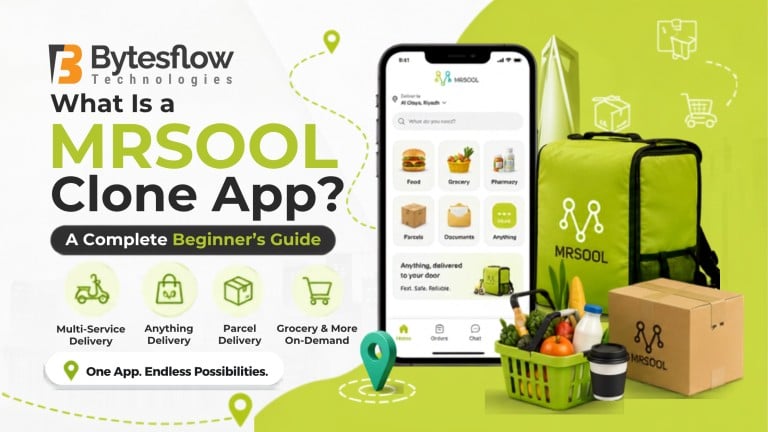
What Is a Mrsool Clone App? A Complete Beginner’s Guide
Published: July 30, 2026 | Category: Beginner’s Guide | Read time: ~10 min
Introduction
A Mrsool clone is a ready-made, white-label delivery app that replicates Mrsool’s multi-service, courier-bidding model, letting you launch a similar on-demand delivery business for food, groceries, parcels, and more without building software from scratch.
The on-demand delivery space in the Middle East has grown fast, and Mrsool sits right at the center of that growth. If you are exploring how to enter this market, a Mrsool clone gives you a practical shortcut. Instead of spending months on custom development, you get a working, multi-service delivery platform that you can rebrand and launch under your own name.
What Does “Mrsool Clone” Actually Mean?
A Mrsool clone is a pre-built software solution that mirrors the core workflow, features, and revenue model of Mrsool, the Saudi Arabia-based on-demand delivery platform founded in 2015. According to Wikipedia, the original app grew from a simple courier-request tool into a full multi-service marketplace covering food, groceries, and documents across Saudi Arabia, Egypt, and Bahrain.
Rather than coding a delivery platform from zero, businesses use this kind of solution to:
- Launch in weeks instead of months
- Cut upfront development costs significantly
- Offer a proven, tested user experience from day one
- Rebrand the entire platform, including the app, website, and admin panel, under their own identity
Because the underlying logic already works, founders can focus on operations and growth instead of engineering. If you are still weighing whether a ready-made approach fits your goals, this breakdown of the pros and cons of the app cloning business covers the trade-offs in detail.
How Does a Mrsool Clone App Work?
At its core, the platform connects three groups: customers, independent couriers, and local stores. Here is the typical order flow:
- A customer opens the app and either browses listed stores or types out exactly what they need.
- Nearby couriers view the request and bid with their proposed delivery fee.
- The customer picks a courier based on price, rating, and estimated time.
- The courier collects the item and delivers it while the customer tracks progress in real time.
- The app settles payment automatically once the delivery is confirmed.
This bidding-style workflow is what separates a Mrsool clone from typical single-vendor delivery apps, where prices and couriers are fixed rather than competitive.
Core Features Every Mrsool Clone Script Should Have
Before choosing a Mrsool clone script, check whether it includes these must-have modules. Missing even one can weaken your app’s competitive edge in a crowded delivery market.
Feature | Why It Matters |
Courier bidding system | Lets riders compete on price, keeping delivery costs flexible |
Multi-service catalog | |
Real-time GPS tracking | Builds customer trust and reduces support queries |
In-app chat and calling | Speeds up order clarification between customer and courier |
Multiple payment gateways | Supports cash, card, and wallet options across regions |
Admin and vendor dashboards | Gives full visibility into orders, commissions, and payouts |
If any of these modules are missing, the platform will struggle to match what users already expect from established multi-service apps. For a deeper look at building for growth rather than just launch day, see this guide on creating a scalable food delivery clone app.
Business Models You Can Launch With a Mrsool Clone
A Mrsool clone is not limited to food delivery. Because it supports multiple categories under one roof, you can shape several business models from the same foundation:
- A multi-service delivery marketplace combining food, groceries, pharmacy items, and parcels
- A hyperlocal courier and errand-running service
- An on-demand grocery or quick-commerce platform, built on an all-in-one delivery script
- A dedicated document and parcel delivery service
Many entrepreneurs also position their all-in-one delivery app clone as a direct alternative to established players like Careem in the GCC region, competing on flexibility rather than scale.
Mrsool Clone vs Single-Service Delivery Apps
Understanding how this model differs from a typical food-only app helps clarify why so many founders choose it first.
Factor | Mrsool Clone (Multi-Service) | Single-Service App (Food-Only) |
Service scope | Food, grocery, parcels, pharmacy, and more | Restaurant food only |
Revenue streams | Multiple commission sources | Single commission source |
Courier utilization | Riders serve several verticals, reducing idle time | Riders often idle between food orders |
Market positioning | Broader appeal, harder for competitors to copy quickly | Easier to launch, but easier to replicate too |
Unlike a food-only app, this model lets a single courier fleet serve several verticals at once, which improves rider utilization and lowers the cost per delivery.
Who Should Invest in an All-in-One Delivery App Clone?
An all-in-one delivery app clone suits businesses that want to launch quickly and diversify revenue instead of depending on one vertical alone. It typically fits:
- Existing courier or logistics businesses looking to add a customer-facing app
- Startups entering the on-demand economy for the first time
- Grocery or retail chains that want an online ordering channel
- Regional aggregators aiming to compete across multiple delivery categories at once
If your goal is speed to market plus flexibility to expand later, this model generally outperforms a narrow, single-service build.
Cost and Timeline Snapshot
Building from scratch and buying a ready-made script lead to very different outcomes in both time and budget.
Approach | Typical Timeline | Typical Cost Range |
Custom build from scratch | 6 to 12 months | $50,000 and above |
White-label Mrsool clone script | 2 to 6 weeks | $3,000 to $15,000 (varies by customization) |
A ready-made Mrsool clone script cuts that timeline down to weeks, not months, which matters in a market moving as quickly as this one. For context, the global online food delivery market is projected to grow from $355.6 billion in 2026 to $505.5 billion by 2030, according to Grand View Research. That pace of growth rewards businesses that launch sooner rather than later. For a cost comparison against a similar single-service model, this breakdown of UberEats clone app costs in 2026 is a useful reference point.
Final Thoughts
A Mrsool clone offers a fast, cost-effective way to enter the multi-service delivery space without reinventing the wheel. It combines a proven business model with the flexibility to adapt features, branding, and services to your own market.
Ready to see it in action?
View a live demo of Bytesflow’s Mrsool clone and explore every feature covered in this guide firsthand.
Prefer to talk it through first?
Get a free consultation with our team, and we will map out the exact features, timeline, and cost for your launch.
Frequently Asked Questions
1. What is a Mrsool clone app?
It is a ready-made, white-label delivery platform that copies Mrsool’s multi-service, bidding-based model so you can launch your own on-demand delivery business quickly.
2. How much does a Mrsool clone cost?
Costs generally range from $3,000 to $15,000 for a customizable, white-label script, compared with $50,000 or more for a fully custom build.
3. Is building a Mrsool clone legal?
Yes. Replicating a business model and app features is legal as long as you use original branding, code, and assets rather than copying Mrsool’s trademarks or proprietary source code.
4. Can it support food, grocery, and parcel delivery together?
Yes, that is the main advantage. A well-built script includes separate modules for each service category within a single app and admin panel.
5. How long does it take to launch one?
Most white-label scripts go live within two to six weeks, depending on how much customization and branding work you need.