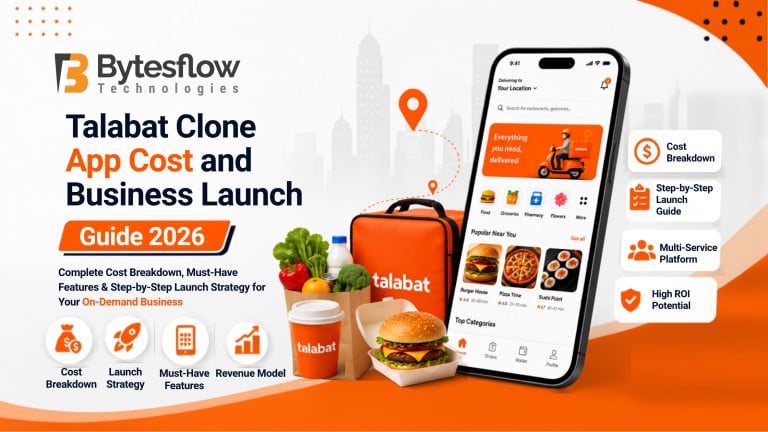
Talabat Clone App Cost and Business Launch Guide 2026
Published: July 18, 2026 | Category: Launch Guide | Read time: ~10 min
Introduction
The online food delivery industry is not slowing down. The global online food delivery market is projected to grow from USD 355.6 billion in 2026 to USD 505.5 billion by 2030, according to Grand View Research. A large share of that growth is happening in the Middle East and South Asia, the exact regions where Talabat dominates.
If you are an entrepreneur eyeing this space, building from scratch is expensive and slow. A Talabat clone app lets you launch a fully functional, branded food delivery platform in weeks instead of years. This guide breaks down the real cost, the business model, and the steps to launch one in 2026.
What Is a Talabat Clone App
A Talabat clone app is a ready made, white label food delivery software solution built to replicate the core functionality of Talabat. It includes:
- Customer app for browsing restaurants and ordering food
- Restaurant/vendor panel for managing menus and orders
- Delivery partner app with real time GPS tracking
- Admin dashboard to manage commissions, payouts, and analytics
Unlike building from zero, a clone script is pre-tested, already covers the core food delivery script features, and only needs branding and customization before launch.
Why Entrepreneurs Are Choosing Talabat Clone Scripts in 2026
Short and simple reasons founders are picking this route:
- Faster time to market. Launch in 4 to 8 weeks instead of 6 to 12 months.
- Lower upfront risk. No need to hire a full development team from scratch.
- Proven business model. Talabat’s own model, refined over two decades, already validates demand.
- Scalable architecture. Most scripts support adding grocery, pharmacy, or parcel delivery later, similar to how Bytesflow’s all in one delivery script expands across verticals.
- Regional relevance. Strong fit for GCC and MENA markets where Talabat already has brand recall, a segment Mordor Intelligence highlights as one of the faster growing regions for platform based delivery.
Talabat Clone App Cost Breakdown 2026
Cost depends on customization depth, features, and platforms (Android, iOS, web). Here is a general breakdown:
Component | Typical Cost Range |
Base white label script (customer + vendor + delivery app) | $2,000 to $6,000 |
UI/UX branding and customization | $500 to $2,500 |
Payment gateway integration | $300 to $1,000 |
Advanced features (live tracking, AI recommendations, loyalty) | $500 to $3,000 |
App store deployment and testing | $200 to $800 |
Annual maintenance and support | 10% to 20% of project cost |
Most businesses can launch a functional MVP for $3,000 to $8,000, while a fully custom, feature-rich platform can range from $10,000 upward. Cost always depends on the vendor, region, and the level of white labeling required.
Factors That Influence the Final Price
- Number of platforms. Android, iOS, and web all add cost individually.
- Custom features. AI-based recommendations, multi-language support, and loyalty programs increase price.
- Third party integrations. Payment gateways, SMS APIs, and map services carry their own licensing costs.
- Support and maintenance. Ongoing updates, bug fixes, and server maintenance are recurring costs, not one-time.
- Vendor reputation. Established providers charge more but reduce long-term risk.
Core Features Your Talabat Clone App Needs
Keep this list in mind while evaluating any script provider:
- Real time order tracking with live GPS
- Multiple payment options including cash, card, and wallets
- Multi-restaurant and multi-cuisine support
- Ratings and reviews system
- Push notifications for order updates and offers
- Admin panel with sales, commission, and performance reports
- Scalable backend to expand into grocery delivery, parcel delivery, or other verticals
Revenue Models for a Talabat Clone Business
Short list of proven monetization paths:
- Commission per order from partner restaurants, typically 15 percent to 30 percent
- Delivery fees charged to end customers
- Subscription plans for restaurants wanting premium visibility
- Featured listing fees for placement on the app home screen
- Advertising from brands and restaurants within the app
Step by Step Launch Process
- Define your market. Pick a city, region, or country to launch first.
- Choose a script provider. Compare features, support, and pricing.
- Customize branding. Logo, colors, and app name aligned to your business identity.
- Onboard restaurants. Sign up local restaurants before public launch to ensure supply.
- Recruit delivery partners. Build a reliable fleet before marketing to customers.
- Test thoroughly. Run a soft launch in one area before scaling city-wide.
- Market and scale. Use local SEO, social media, and referral programs to grow demand.
Ready to Launch Your Own Talabat Clone App?
The food delivery market is only getting bigger, and every month you wait is market share going to someone else. You do not need a massive budget or a year of development to compete. You need the right script, the right partner, and a launch plan that works.
If you want to see how a ready made solution actually works before committing, you can view a live demo of our Talabat clone app.
If you are still weighing costs, features, or timelines, our team is happy to walk you through it, feel free to get a free consultation with Bytesflow to plan your launch.
Frequently Asked Questions
1. How much does a Talabat clone app cost in 2026?
A basic MVP typically costs between $3,000 and $8,000, while a fully custom platform with advanced features can go beyond $10,000, depending on features and platforms chosen.
2. How long does it take to launch a clone app?
Most businesses launch within 4 to 8 weeks using a ready made script, compared to 6 to 12 months for custom development from scratch.
3. Is a clone app legal to build and sell?
Yes. A clone app replicates functionality and business logic, not Talabat’s trademark, code, or branding. It is a common, legal software category used across the delivery industry.
4. Can a clone app support multiple cities or countries?
Yes, most modern scripts are built with scalable architecture that supports multi-city and multi-currency operations from a single admin panel.
5. What ongoing costs should I expect after launch?
Expect annual maintenance, server hosting, third party API costs, and periodic feature updates, generally 10 percent to 20 percent of the initial project cost per year.