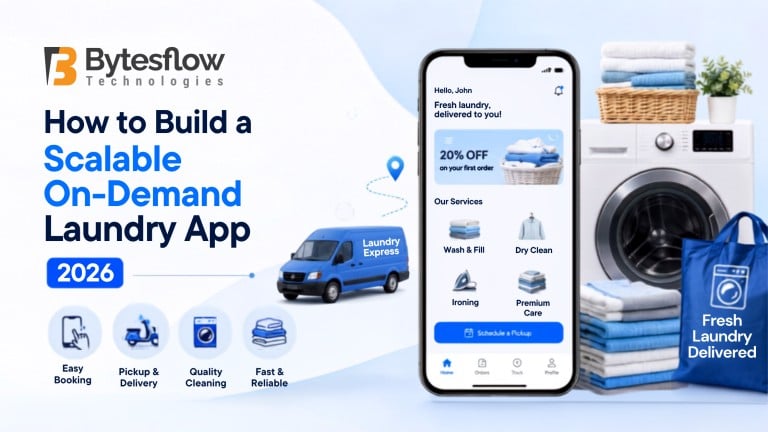
How to Build a Scalable On-Demand Laundry App 2026
Published: August 28, 2026 | Category: Startup Guide | Read time: ~10 min
Why the Laundry Business Is Booming in 2026
Urban households have less time and higher expectations than ever, and laundry is one of the first chores people outsource. According to Grand View Research, the global online laundry service market was valued at over 58 billion dollars in 2026 and continues to grow rapidly through 2030. Consequently, entrepreneurs across cities are exploring how an on-demand laundry app can turn this everyday chore into a scalable, recurring revenue business.
However, building an app that works for 500 orders is very different from building one that works for 50,000. That’s where the right architecture makes the real difference.
What Makes an On-Demand Laundry App Scalable
A scalable on-demand laundry app isn’t just about handling more users. It’s about handling more complexity without breaking.
- Modular architecture – separate customer, vendor, and delivery modules that scale independently
- Cloud-native hosting – auto-scaling servers instead of fixed infrastructure
- Multi-vendor support – onboarding new laundry partners without rebuilding the backend
- Real-time order routing – smart allocation of pickups to the nearest available partner
- API-first design – easy integration with payment gateways, SMS, and logistics tools
In short, scalability is a design decision made on day one, not a patch added later.
Core Features Your Laundry App Needs
Module | Key Features |
Customer App | Scheduling, live tracking, in-app payments, order history |
Vendor Panel | Inventory management, pricing control, order queue |
Delivery App | Route optimization, pickup/drop confirmation, earnings dashboard |
Admin Dashboard | Analytics, dispute resolution, commission management |
Additionally, features like loyalty points, subscription plans, and eco-friendly service tags help differentiate your laundry app in a crowded market.
Tech Stack for Long-Term Scale
Most scalable on-demand laundry app platforms today rely on a similar foundation:
- Frontend: Flutter or React Native for cross-platform speed
- Backend: Node.js or Django with microservices architecture
- Database: PostgreSQL or MongoDB depending on data structure
- Cloud: AWS or Google Cloud for auto-scaling infrastructure
- Payments: Stripe, Razorpay, or region-specific gateways
Choosing this stack early prevents costly rewrites later, especially once your app crosses its first few thousand active users.
Steps to Build a Scalable On-Demand Laundry App
- Validate demand in your target city before writing a single line of code
- Choose build or buy – custom development versus a ready laundry app script
- Design for multi-vendor and multi-city from the start, not as an afterthought
- Test with a soft launch in one zone before expanding
- Monitor performance metrics like order completion time and server load
Notably, skipping step three is the single biggest reason laundry startups need a costly rebuild within their first year.
Custom Build vs Ready Laundry App Script
Factor | Custom Development | Laundry App Script |
Time to launch | 4 to 6 months | 2 to 4 weeks |
Cost | Higher upfront | Lower upfront |
Customization | Full control | Configurable within framework |
Best for | Unique business models | Fast market entry |
If speed to market matters most, a proven laundry app script removes months of backend work while still allowing branding and feature customization.
Common Scaling Challenges and Fixes
- Server overload during peak hours – solve with auto-scaling cloud infrastructure
- Delayed pickups as demand grows – solve with AI-based route optimization
- Inconsistent service quality across vendors – solve with standardized SLAs in the vendor panel
Furthermore, according to Future Market Insights, express delivery windows under 24 hours are becoming a competitive baseline, not a premium feature. This makes backend scalability non-negotiable rather than optional for any serious laundry app.
Conclusion
Building a scalable on-demand laundry app in 2026 requires more than just developing a mobile application. A reliable solution needs a scalable architecture, seamless order management, efficient pickup and delivery workflows, secure payments, and the flexibility to expand across multiple locations. With the right technology and development partner, you can turn your laundry business idea into a platform built for long-term growth.
Ready to launch your own on-demand laundry app?
Launch a powerful on-demand laundry app with Bytesflow and give your customers a faster, smarter, and more convenient way to schedule pickups, manage orders, and receive laundry at their doorstep.
View Live Demo | Get a Free Consultation
Frequently Asked Questions
1. How do you build a scalable on demand laundry app in 2026?
Start with cloud-native infrastructure, a modular backend, and multi-vendor support built in from day one. Choose a proven laundry app script or custom stack designed for growth, then validate with a soft launch before expanding across cities.
2. What makes an on demand laundry app scalable?
Scalability comes from auto-scaling servers, API-first architecture, and real-time order routing. An app becomes scalable when it can add vendors, cities, and users without a backend rebuild each time demand spikes.
3. How long does it take to build a scalable laundry app?
Custom development typically takes four to six months. A ready laundry app script can go live in two to four weeks, since the core infrastructure and features are already built and tested.
4. How can a laundry app handle thousands of orders simultaneously?
It relies on cloud auto-scaling, load-balanced servers, and a microservices backend that isolates high-traffic modules. Real-time order routing also prevents bottlenecks by distributing pickups evenly across available vendors.
5. How do you scale a laundry app from one city to multiple cities?
Multi-city scaling needs city-specific vendor onboarding, localized pricing, and a backend that treats each city as an independent operational zone. Testing thoroughly in one city first reduces risk before wider expansion.
6. Why consider choosing Bytesflow for laundry app development?
Bytesflow offers scalable on-demand laundry app development solutions designed for startups and growing businesses. With customizable features, modern technologies, secure architecture, and multi-vendor capabilities, Bytesflow helps businesses streamline laundry pickup, processing, and delivery operations. Its flexible approach supports seamless expansion across cities while delivering a user-friendly experience for customers, laundry partners, and delivery agents.