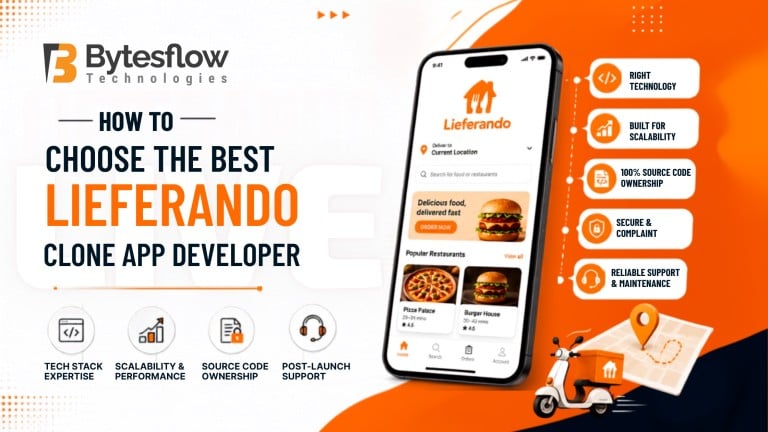
How to Choose the Best Lieferando Clone App Developer
Published: August 27, 2026 | Category: Startup Guide | Read time: ~10 min
Introduction
Picking the right partner to build your food delivery platform is the single biggest decision you’ll make before launch. A good developer turns your idea into a stable, scalable business tool. A poor one costs you time, money, and market opportunity. Here’s a practical, no-fluff guide to choosing the best Lieferando clone app developer for your business.
Why the Right Developer Matters More Than the Price Tag
Many first-time founders shortlist vendors purely on cost. However, the cheapest quote often means outdated technology, no post-launch support, or shared source code that limits your growth later. Instead, evaluate developers the way you’d evaluate any long-term business partner based on expertise, transparency, and proven delivery.
The online food delivery market is projected to grow at a CAGR of 9.4%, reaching $505.5 billion by 2030, according to Grand View Research. So, choosing a capable developer today directly affects how well you can capture this growth tomorrow.
Key Factors to Evaluate Before Hiring
Before signing any contract, run every shortlisted vendor through these checkpoints:
- Portfolio and case studies – Ask for live examples of a similar on-demand food delivery app clone they’ve built, not just mockups.
- Technology stack transparency – A reliable team will clearly explain the frameworks, databases, and APIs behind their food ordering script.
- Customization flexibility – Confirm whether the app can be tailored to your branding, currency, language, and local payment gateways.
- Source code ownership – Always clarify whether you own the code outright or are locked into a subscription.
- Scalability testing – Ask how the platform performs under high order volumes and multiple concurrent vendors.
- Support and maintenance – Understand what happens after launch, not just during development.
- Client reviews and references – Independent reviews often reveal more than a sales pitch.
Comparing Developer Types at a Glance
Developer Type | Cost | Customization | Speed to Launch | Ownership |
Freelancer | Low | Limited | Moderate | Often unclear |
In-house team | High | Full | Slow | Full |
Established clone app company | Moderate | High | Fast | Full (varies by vendor) |
For most entrepreneurs entering the food delivery space, an established company offering a ready Lieferando clone script with customization options strikes the best balance between speed, cost, and control.
Questions to Ask Before You Sign
- Can you show a live demo of a similar Lieferando-style platform?
- What’s included in the base package versus paid add-ons?
- How do you handle scalability as order volume grows?
- What’s your average development and delivery timeline?
- What kind of support is available after the app goes live?
Getting clear, specific answers here – not vague reassurances – is often the strongest signal of a trustworthy partner.
Red Flags to Watch Out For
- Vague answers about the tech stack or architecture
- No willingness to share references or past client feedback
- Pressure to sign quickly without a discovery phase
- Hidden costs for “customization” revealed only after payment
- No clear post-launch support plan
What a Strong Evaluation Process Looks Like
Once you’ve narrowed your list, score each developer against the same criteria side by side rather than judging them in isolation – it’s far easier to spot a weak answer when it’s placed next to a strong one. It also helps to look beyond the base ordering flow. Modern food delivery platforms increasingly rely on personalisation, smarter search, and demand forecasting to stay competitive, so ask how a vendor’s platform handles these areas. Our breakdown of AI-powered smart features in a Lieferando clone is a useful reference for what “future-ready” actually looks like, beyond just the checkout flow.
Finally, treat the discovery call itself as a test. A developer who asks detailed questions about your target market, order volume expectations, and growth plans is signalling a consultative process. One who jumps straight to a quote without understanding your business is signalling the opposite.
Final Thoughts
Choosing the right Lieferando clone app developer can significantly impact your app’s performance, scalability, user experience, and long-term growth. Instead of focusing only on development cost, evaluate the provider’s food delivery expertise, technology stack, customization capabilities, security standards, scalability, source-code ownership, and post-launch support.
The right development partner should be able to turn your food delivery concept into a reliable, market-ready platform while giving you the flexibility to adapt it to your target market and business model. Take the time to compare providers, review their portfolio, understand their development process, and choose a partner that aligns with your goals.
Ready to launch your own Lieferando-style food delivery platform?
Explore a live demo to see how the solution works in practice, or get a free consultation with our team to discuss your requirements and discover how Bytesflow can help you launch your food delivery app.
Frequently Asked Questions
1. How do I choose the best Lieferando clone app developer?
Evaluate their portfolio, tech stack transparency, and client reviews first. Ask for a live demo, confirm source code ownership, and check scalability claims. Avoid vendors who dodge technical questions or rush you into signing without a clear discovery and planning phase.
2. What technology stack should a Lieferando clone developer use?
A reliable developer uses modern, scalable frameworks with secure APIs, cloud hosting support, and real-time database architecture. Ask them to explain their stack in plain terms. If they can’t justify their technology choices clearly, treat it as a warning sign.
3. How can I check whether a Lieferando clone app will be scalable?
Ask how the platform has performed under peak order loads for existing clients. Request data on concurrent users, response times, and multi-vendor handling. A capable developer will readily share performance benchmarks rather than only theoretical claims.
4. Will I get complete source code ownership of my Lieferando clone app?
This depends entirely on the vendor and contract terms. Always clarify ownership before signing. Some providers offer full code ownership, while others retain rights under a subscription model, which can limit your long-term flexibility and control.
5. What kind of post-launch support should I expect from a Lieferando clone developer?
Expect bug fixes, security updates, and feature enhancements as standard. A trustworthy developer outlines support terms upfront, including response times and costs, rather than leaving you to figure things out after the app has already gone live.
6. Why consider Bytesflow for Lieferando clone app development?
Bytesflow offers full source code ownership, flexible customization, and dedicated post-launch support, matching every criterion serious founders should look for. Our proven portfolio and transparent process make it easier to evaluate us confidently against other vendors.