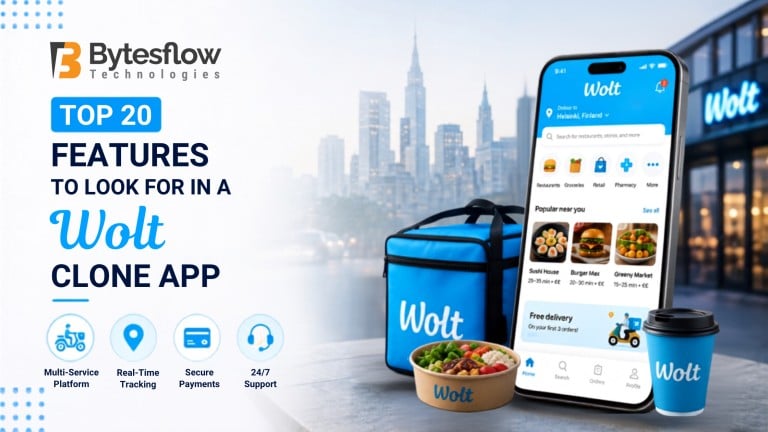
Top 20 Features to Look for in a Wolt Clone App
Published: August 25, 2026 | Category: Features Guide | Read time: ~10 min
Introduction
Launching a delivery startup today means competing with apps that customers already trust. So, the features you choose can make or break your platform. A well-built Wolt clone does more than replicate an interface; it delivers speed, reliability, and a seamless experience across every panel. Below is a practical, no-fluff breakdown of the top 20 features to look for before you invest in a Wolt clone script.
Why Feature Selection Matters for a Wolt Clone
Every successful Wolt clone app balances customer convenience, vendor efficiency, and delivery accuracy. Skipping a core feature early on often means costly rebuilds later. Therefore, founders should map features against their business model before development begins. According to Business of Apps, the food delivery sector continues to expand rapidly, which means feature gaps get exposed fast once competitors move ahead.
Customer App Features
- Location-based store discovery – shows nearby restaurants and stores instantly
- Smart search and filters – cuisine, rating, price, and delivery time
- Real-time order tracking – live rider location on a map
- Multiple payment options – cards, wallets, UPI, and cash on delivery
- Order scheduling – book orders for a later time slot
- Push notifications – order updates, offers, and reminders
- Ratings and reviews – for vendors and delivery partners
- Loyalty and rewards program – repeat-order incentives
Vendor Panel Features
- Menu and catalog management – add, edit, or mark items unavailable
- Order accept or reject controls – with instant alerts
- Sales and performance dashboard – track revenue and best-sellers
- Store timing and holiday scheduling
- Multi-outlet management – ideal for chains and franchises
Delivery Partner Features
- Optimized route navigation – reduces delivery time
- Earnings dashboard – per-order breakdown and incentives
- Availability toggle – online or offline status control
- Document verification module – for compliance and safety
Admin Panel Features
- Centralized dashboard – orders, revenue, and users in one view
- Commission and payout automation
- Zone and geofencing management
Feature Comparison Table
Panel | Must-Have Feature | Business Impact |
Customer | Real-time tracking | Builds trust and reduces support queries |
Vendor | Sales dashboard | Improves inventory and menu decisions |
Rider | Route optimization | Cuts delivery time and fuel cost |
Admin | Commission automation | Saves manual payout effort |
Advanced Features That Set You Apart
Beyond the basics, an on-demand all-in-one delivery app clone can also include AI-driven personalization, dynamic pricing, and voice search. These additions are no longer optional extras; they are quickly becoming standard expectations. Platforms that integrate smart recommendations, similar to what McKinsey’s insights on personalization highlight, tend to see stronger customer retention over time.
If you are exploring a broader platform beyond food, an all-in-one delivery script lets you add grocery, pharmacy, or parcel verticals under one app. This flexibility future-proofs your investment and opens multiple revenue streams from a single codebase.
MVP vs Full-Feature Launch: What to Prioritize First
Not every feature needs to go live on day one. Founders on a tight budget or timeline should separate “must-have at launch” from “add-on later” to control cost and speed to market. Here is a simple way to prioritize:
Launch Stage | Focus Features | Reason |
MVP | Store discovery, ordering, payments, basic tracking | Covers the core transaction loop |
Phase 2 | Loyalty program, ratings, scheduling | Improves retention once user base grows |
Phase 3 | AI recommendations, dynamic pricing, multi-vertical expansion | Adds competitive edge after market validation |
This phased approach also applies if you plan to scale into other verticals later. For instance, a platform that starts as a Food Ordering Script can expand into an All in One Delivery Script once the core food business proves stable, without rebuilding the entire system from scratch.
Security and Compliance Considerations
Feature selection is not only about convenience; security shapes user trust just as much. A reliable Wolt clone should include encrypted payment processing, role-based access for admin and vendor accounts, and GDPR-aligned data handling where applicable. Following the PCI Security Standards Council guidelines for payment data is a baseline requirement, not an optional add-on, especially as regulators tighten scrutiny on fintech-adjacent apps.
Conclusion
Choosing the right features is the single biggest factor in a successful launch. A feature-rich Wolt clone saves you time, builds user trust, and positions your platform for long-term growth.
Ready to launch your own Wolt clone app?
A feature-rich Wolt clone can provide the foundation for a modern, scalable delivery business. When customer convenience, vendor efficiency, delivery performance, and intelligent administration come together in one platform, businesses can create a smoother experience while building opportunities for sustainable growth.
👉 View a Live Demo | Get a Free Consultation | Launch Your Wolt Clone App with Bytesflow
Frequently Asked Questions
1. What is a Wolt clone app?
A Wolt clone app is a ready-made, customizable software solution that replicates the core functionality of Wolt, including multi-vendor listings, real-time tracking, and secure payments. It lets entrepreneurs launch a food or grocery delivery business quickly without building from scratch, saving both time and development cost.
2. How does a Wolt clone app work?
A Wolt clone app connects customers, vendors, and delivery partners through one platform. Customers browse stores and place orders, vendors manage and fulfill them, and riders handle delivery using optimized routes. An admin panel oversees commissions, payouts, and overall platform operations in real time.
3. What are the must-have features of a Wolt clone app?
Must-have features include real-time order tracking, multiple payment options, vendor menu management, rider route optimization, and an admin dashboard. Push notifications, ratings, and commission automation are equally important. Together, these features ensure smooth operations across customer, vendor, and delivery experiences.
4. Can AI-powered recommendations be added to a Wolt clone?
Yes, AI-powered recommendations can be integrated into a Wolt clone to suggest restaurants, dishes, or offers based on user behavior. This personalization boosts order frequency and customer retention. Many modern delivery platforms now treat AI-driven suggestions as a standard feature rather than an optional upgrade.
5. What payment features should a Wolt clone app have?
A Wolt clone app should support multiple payment methods, including credit and debit cards, digital wallets, UPI, and cash on delivery. Secure, PCI-compliant payment gateways are essential to protect user data and build trust, which directly impacts conversion and repeat usage.
6. Which is the best Wolt clone script?
Delicart by Bytesflow Technologies is widely regarded as one of the best Wolt clone scripts available. It offers a fully customizable, white-label solution with real-time tracking, multi-vendor support, and secure payments, making it a reliable choice for entrepreneurs launching an on-demand delivery business.