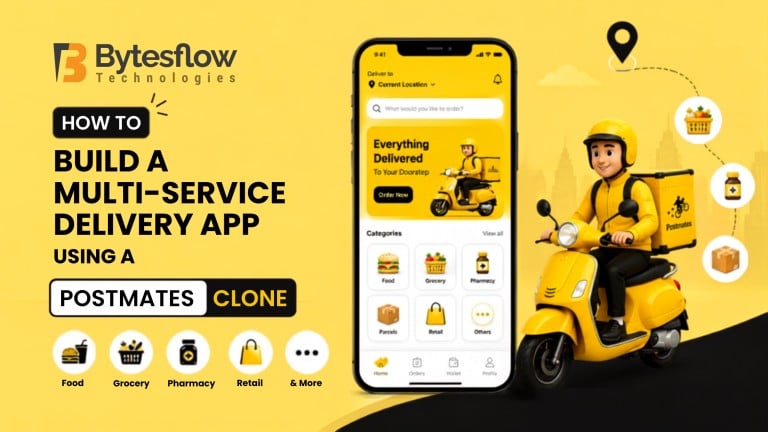
How to Build a Multi-Service Delivery App Using a Postmates Clone
Published: August 21, 2026 | Category: Startup Guide | Read time: ~10 min
Introduction
Customers no longer want five different apps for five different needs. They want one app that delivers food today, groceries tomorrow, and medicines by evening. This shift is exactly why a Postmates clone has become the fastest way for entrepreneurs to launch a full-scale, multi-service delivery business without writing code from scratch.
In this guide, we’ll break down what a Postmates clone is, how it works, and the exact steps to turn it into a thriving multi-service platform.
What Is a Postmates Clone and Why It Suits Multi-Service Delivery
A Postmates clone is a ready-made, white-label software solution that replicates the core business model of Postmates, connecting customers, vendors, and delivery agents on one platform. Unlike single-purpose apps, a Postmates clone script is built with a modular architecture, meaning new service categories can be added without rebuilding the entire system.
Here’s why that modularity matters:
- Single codebase, multiple vertical: food, grocery, pharmacy, and courier services run on one backend.
- Faster go-to-market: since the core app is pre-built, you skip months of development.
- Lower long-term cost: one platform to maintain instead of separate apps for each vertical.
- Unified customer experience: users order everything through a single login and wallet.
Single-Service vs Multi-Service Delivery App
Factor | Single-Service App | Multi-Service App (Postmates Clone) |
Revenue streams | 1 category | Multiple (food, grocery, parcel, pharmacy) |
Customer retention | Lower, niche use case | Higher, daily-use habit |
Development cost | Repeated for each app | One-time, shared infrastructure |
Market positioning | Category player | Super app / aggregator |
Scalability | Limited | High, city and vertical expansion |
Step-by-Step Guide to Build a Multi-Service Delivery App Using a Postmates Clone
Turning a Postmates clone into a multi-service platform isn’t complicated when the foundation is right. Here’s how it works, step by step.
- Choose a modular Postmates clone script: Start with a script built for verticals, not a single-purpose app. This lets you plug in new categories like grocery or parcel later without disrupting existing operations.
- Define your core service categories: Decide the first two or three verticals you’ll launch with food and grocery are the most common starting combination.
- Set up vendor and category management: A strong admin panel lets you onboard restaurants, stores, and pharmacies under separate categories while managing them from one dashboard.
- Configure delivery logistics per vertical: Grocery orders need different handling than food orders (temperature control, larger baskets). Configure delivery rules, time slots, and rider assignment accordingly.
- Enable flexible payment and commission structures: Each vertical may need its own commission rate, payout cycle, or promotional structure.
- Test with a pilot city before scaling: Launch in one location, gather feedback, then expand using the all-in-one delivery script foundation to add cities and categories.
Core Modules Needed for a Multi-Service App
Module | Purpose |
Customer App | Browsing, ordering, tracking across categories |
Vendor Panel | Inventory, order acceptance, category management |
Rider App | Route optimization, multi-vertical delivery assignment |
Admin Dashboard | Commission control, analytics, category-wise reporting |
Key Features Your App Should Not Miss
- Multi-category home screen with smart search
- Real-time order and rider tracking
- In-app wallet and multiple payment gateways
- Category-specific filters (dietary tags for food, prescription upload for pharmacy)
- Push notifications and personalized offers
- Multi-language and multi-currency support for regional expansion
Delivery is no longer a side feature of retail; it’s a category of its own. The global online food delivery market, valued at USD 288.8 billion in 2024, is projected to grow to USD 505.5 billion by 2030 at a CAGR of 9.4%, according to Grand View Research. Beyond food, McKinsey’s consumer research shows shopping behavior itself is shifting toward AI-assisted, convenience-first decisions, reinforcing why an on-demand all-in-one delivery app clone that bundles multiple services under one roof, rather than a single-category app, is better positioned to capture this growth. If you want a closer look at where this is headed, we’ve covered how AI is powering the next generation of on-demand delivery apps in more detail.
An all-in-one delivery script also gives you the flexibility to test new verticals with minimal risk, since the infrastructure investment is already made. Instead of commissioning a new app for every idea, you simply extend the existing platform. This is precisely why more entrepreneurs comparing grocery delivery script against building from scratch are choosing a Postmates clone script as their base.
Conclusion
A Postmates clone isn’t just a shortcut to launch it’s a foundation built to grow with your business, from a single delivery category into a full multi-service platform.
Ready to Launch Your Postmates Clone?
Turn your delivery business idea into a scalable multi-service platform with Bytesflow’s Postmates Clone. Explore the platform in action, understand how each module works, and discuss your business requirements with our experts.
👉 View the Live Demo to experience the customer, vendor, rider, and admin workflows.
👉 Get a Free Consultation to discuss customization, service categories, monetization, and your launch strategy.
Frequently Asked Questions
1. What is a Postmates clone app?
A Postmates clone app is a ready-made, white-label solution that follows the Postmates business model. It connects customers, vendors, and delivery riders through one platform. Moreover, entrepreneurs can customize the app with their branding, services, and business rules. This approach helps businesses launch faster while reducing development time and costs.
2. How does a Postmates clone app work?
A Postmates clone app connects customers, vendors, riders, and administrators through dedicated interfaces. First, customers browse products, place orders, and track deliveries. Meanwhile, vendors manage products and orders through their panel. Next, riders accept delivery requests and complete pickups. Finally, administrators manage users, vendors, commissions, orders, and platform operations from one dashboard.
3. How to build a multi-service delivery app using a Postmates clone?
First, choose a modular Postmates clone script that supports multiple delivery categories. Then, define services such as food, grocery, pharmacy, or parcel delivery. Next, configure vendors, delivery workflows, commissions, and service areas. After that, launch in a focused market and monitor demand. As your business grows, add new services without rebuilding the entire platform.
4. How can a Postmates clone generate revenue?
A Postmates clone can generate revenue through multiple channels. For example, you can charge delivery fees and collect commissions from vendors. Additionally, you can offer subscription plans, surge pricing, featured listings, and in-app advertising. You can also create promotional packages for vendors. Therefore, a multi-service platform can generate income from several delivery categories simultaneously.
5. Which is the best Postmates clone script?
Delicart by Bytesflow Technologies offers a strong option for businesses planning a multi-service delivery platform. It provides a customizable, white-label solution that supports food, grocery, pharmacy, and parcel delivery. Furthermore, businesses can adapt the platform to their branding and operational needs. This flexibility helps entrepreneurs launch faster and expand their delivery services.