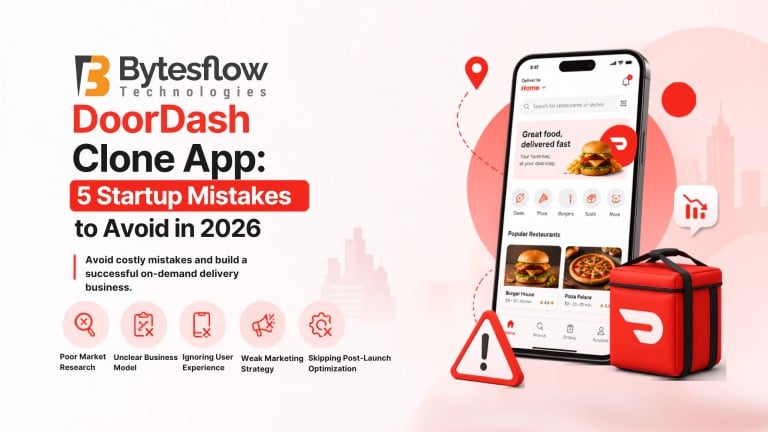
DoorDash Clone App: 5 Startup Mistakes to Avoid in 2026
Published: July 10, 2026 | Category: Startup Guide | Read time: ~10 min
Introduction
The on-demand delivery space is booming, with the online food delivery services market projected to grow from roughly $199 billion in 2026 to $315 billion by 2030 (Research and Markets). A DoorDash clone app is one of the fastest ways to enter this market but speed only pays off if the foundation is right.
Buying a ready-made script doesn’t guarantee success. Poor product-market fit and running out of capital remain the two leading causes of startup failure across industries (CB Insights), and the same patterns show up in food delivery clone launches.
Here are the 5 most common mistakes startups make when launching a DoorDash clone app, and what to do instead.
Mistake 1: Choosing the Cheapest Clone Script Over the Right One
Founders often pick a vendor purely on price, without checking source code ownership, scalability, or after-sales support.
- Cheap scripts are frequently unlicensed, poorly coded, or built on outdated frameworks
- No access to source code means you can’t customise or scale later
- Hidden costs appear later: API integrations, third-party gateway fees, and update costs
What to do instead:
- Compare a white-label vs custom food delivery app before deciding
- Insist on full source code ownership in your contract
Ask for a working demo before payment, not just screenshots
Mistake 2: Ignoring the Business Model Before Building the App
Many founders build the app first and figure out monetisation later. This is backwards.
- Commission-only models can collapse in low-order-volume cities
- Subscription and hybrid models are increasingly common in mature markets
- Without a clear model, investors and restaurant partners hesitate to commit
What to do instead:
- Map your monetization strategy (commission, subscription, delivery fee, surge pricing) before development starts
- Study proven approaches from an established Swiggy clone business model as a benchmark
- Validate pricing with at least 10–15 potential restaurant partners before launch
Mistake 3: Underestimating Logistics and Route Optimization
Treating delivery logistics as an afterthought instead of a core product feature.
- Late deliveries are the #1 driver of customer churn in food delivery apps
- Manual dispatching doesn’t scale past a handful of daily orders
- Weak routing directly increases fuel cost and delivery partner attrition
What to do instead:
- Prioritize apps built with proven route optimization algorithms from day one
- Test dispatch logic under simulated peak-hour load before going live
Build in real-time tracking and automated reassignment for delayed orders
Mistake 4: Skipping Local Market Validation
Launching city-wide (or nation-wide) on day one, assuming demand will simply appear.
- Startup failure data consistently shows lack of market need as the single biggest cause of shutdown, accounting for roughly 42% of failures across sectors.
- Food delivery is hyperlocal, success in one neighbourhood doesn’t guarantee success three miles away
- Over-expansion before proving unit economics drains cash fast
What to do instead:
- Launch in a single, dense pilot zone first
- Track order frequency, repeat customer rate, and average delivery time weekly
Only scale to new zones once your pilot area is profitable or breakeven
Mistake 5: Weak Marketing and Retention Strategy Post-Launch
Treating the app launch as the finish line instead of the starting point.
- Customer acquisition cost is rising across nearly every delivery vertical
- Apps without loyalty or retention mechanics see high one-time-user drop-off
- Founders often forget restaurant-side marketing entirely, focusing only on end customers
What to do instead:
- Build in a loyalty program from day one, not as a “phase 2” feature
- Use push notifications strategically for cart recovery and reorder nudges
- Apply the same marketing strategies that make clone apps stand out to build both customer and restaurant-partner demand simultaneously
Why These Mistakes Matter More in 2026
The on-demand delivery software market alone is expected to cross $632 million in 2026, with over 600 million users engaging with delivery platforms globally. As competition intensifies, the founders who succeed are the ones who plan logistics, monetisation, and retention before writing a single line of code.
Ready to Launch Your Own DoorDash Clone App?
Avoiding these five mistakes starts with choosing the right development partner. At Bytesflow, we’ve helped founders across food delivery, quick commerce, and on-demand logistics launch scalable, revenue-ready platforms without the guesswork.
👉 View a Live Demo of our DoorDash clone solution and see the features, dashboards, and logistics engine in action.
👉 Get a Free Consultation with our team to map out your business model, budget, and launch timeline before you spend a single rupee on development.
Frequently Asked Questions
Is a DoorDash clone app legal to launch as a business?
Yes. As long as you’re using a properly licensed script or custom development, launching your own branded delivery platform is completely legal.
How much capital do I need to avoid the “running out of cash” mistake?
This varies by city and scale, but founders should budget for at least 6–9 months of operating runway beyond the initial development cost, covering delivery partner incentives, marketing, and customer support not just the app build itself.
Can I start with a single city before scaling nationally?
Yes, and it’s strongly recommended. Hyperlocal validation in one pilot zone helps you fix logistics, pricing, and retention issues before they multiply across multiple cities.
What’s the biggest difference between a cheap clone script and a proper one?
Source code ownership, scalability architecture, and after-sales support. Cheap scripts often lack all three, leading to expensive rebuilds within the first year.
How long does it typically take to launch a DoorDash clone app?
With a proven, pre-built solution, most businesses can go live in 30–45 days, compared to 6–9 months for a fully custom build from scratch.