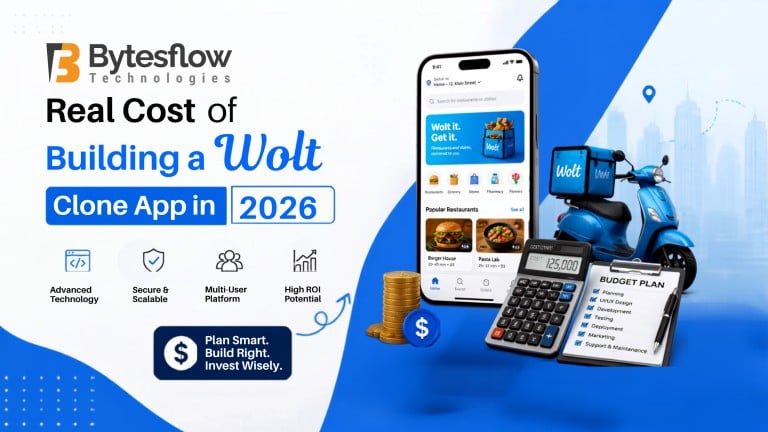
Real Cost of Building a Wolt Clone App in 2026
Published: July 01, 2026 | Category: Pricing Guide | Read time: ~10 min
Introduction:
Wolt has grown from a Helsinki startup into one of Europe’s most recognisable on-demand delivery brands, now covering food, grocery, and retail in 30+ countries. Naturally, entrepreneurs everywhere want a piece of that model. But before you commit budget, you need one number: what does it actually cost to build a Wolt clone app in 2026?
This guide breaks it down: no vague ranges, no sales pitch. Just the real numbers, the real hidden costs, and how to plan smart.
Quick Answer
A Wolt clone app in 2026 costs anywhere from $8,000 to $150,000+, depending on:
- White-label vs custom build
- Number of features and integrations
- Development team location
- Post-launch scaling needs
Here’s the tier-by-tier breakdown.
Cost by Build Type
Build Type | Cost Range | Timeline |
|---|---|---|
White-label Wolt clone (basic) | $8,000 – $25,000 | 2 – 4 weeks |
Custom MVP | $25,000 – $60,000 | 8 -12 weeks |
Full custom platform | $60,000 – $150,000 | 4 – 6 months |
Enterprise multi-city platform | $150,000 – $350,000+ | 6+ months |
White-label scripts save 60-80% upfront and get you live fastest, ideal for testing a city or region before scaling. Custom builds cost more but give full control over branding, architecture, and long-term differentiation.
What Drives the Cost Up or Down
1.Number of apps in the ecosystem:
A Wolt clone isn’t one app, it’s four connected systems: customer app, courier app, merchant/restaurant panel, and admin dashboard. Each adds engineering time.
2. Feature complexity:
- Must-have: live GPS tracking, order management, multiple payment gateways, push notifications
- High-value: in-app chat, scheduled delivery, promo codes, multi-language support
- Growth-stage: AI-based route optimisation, dynamic pricing, demand forecasting
- Enterprise: analytics dashboards, ERP/POS integrations, white-label merchant tools
Each advanced feature typically adds 2-4 weeks of development time.
3.Development team location:
- US/Western Europe developers: $100–$200/hr
- Eastern Europe/Latin America: $40–$80/hr
- South Asia (India, etc.): $20–$50/hr
Same output, very different invoices. This is the single biggest lever on total cost.
4. Platform choice:
Cross-platform frameworks (Flutter, React Native) cut costs by 30-50% compared to separate native iOS and Android builds, with virtually no UX difference for most delivery use cases.
5. Multi-vertical support:
Since Wolt operates across food, grocery, and retail, a true “Wolt clone” needs flexible catalog and inventory systems, this adds complexity compared to a food-only app.
Hidden Charges Most Agencies Don’t Mention
These are the costs that quietly inflate your budget after the “sticker price”:
- Third-party API fees: Maps, SMS/OTP, push notification services, and payment gateways all carry per-use or subscription fees
- App store fees: Apple ($99/year) and Google Play ($25 one-time), plus review delays
- UI/UX design: Often 15-20% of total budget, frequently underestimated
- Annual maintenance: Budget 15-25% of your initial development cost every year for updates, security patches, and OS compatibility
- Server & hosting scaling: Costs rise sharply as order volume grows
Source code ownership: Some white-label vendors charge extra for full source code transfer; always clarify this before signing
White-Label vs Custom: Which Should You Choose?
Go white-label to test a city fast with limited capital. Go custom if you’re scaling across 10+ cities or need deep POS/ERP integrations. Many founders start white-label and migrate later. We cover this trade-off in our white-label vs custom food delivery app comparison.
Why the Wolt Model Is Worth the Investment
The online food delivery market keeps growing, and multi-vertical players like Wolt are capturing a bigger share of it, according to Fortune Business Insights. Its continued expansion under DoorDash, as covered by TechCrunch, shows demand for hyperlocal delivery isn’t slowing, which is exactly why founders want to replicate the model affordably.
For comparable builds, see our DoorDash clone guide and Careem clone tech stack breakdown.
Ready to Build Your Wolt Clone App?
Pricing is only half the picture, the real question is whether your build partner can scale with you past launch day. At Bytesflow, we’ve architected on-demand delivery platforms that go from first order to multi-city operations without a rebuild.
👉 View a Live Demo 👉 Get a Free Consultation
Talk to our team today and get a transparent, no-obligation quote for your Wolt clone app.
FAQs
1.How much does it cost to build a Wolt clone app in 2026?
Between $8,000 for a white-label launch and $150,000+ for a fully custom, enterprise-scale platform.
2. Is a white-label Wolt clone cheaper than a custom build?
Yes. White-label saves 60-80% upfront and launches in weeks, not months, though it offers less flexibility for unique branding.
3. What hidden charges should I expect?
API fees, app store charges, annual maintenance (15-25% of dev cost), hosting scale-up costs, and source code ownership terms.
4. How long does it take to launch a Wolt clone app?
2-4 weeks for white-label; 4-6 months for a full custom build.
5. Does a Wolt clone app support grocery and retail delivery?
Most modern scripts do, Wolt itself operates across food, grocery, and retail, so a true clone should support multi-vertical catalogs from the start.