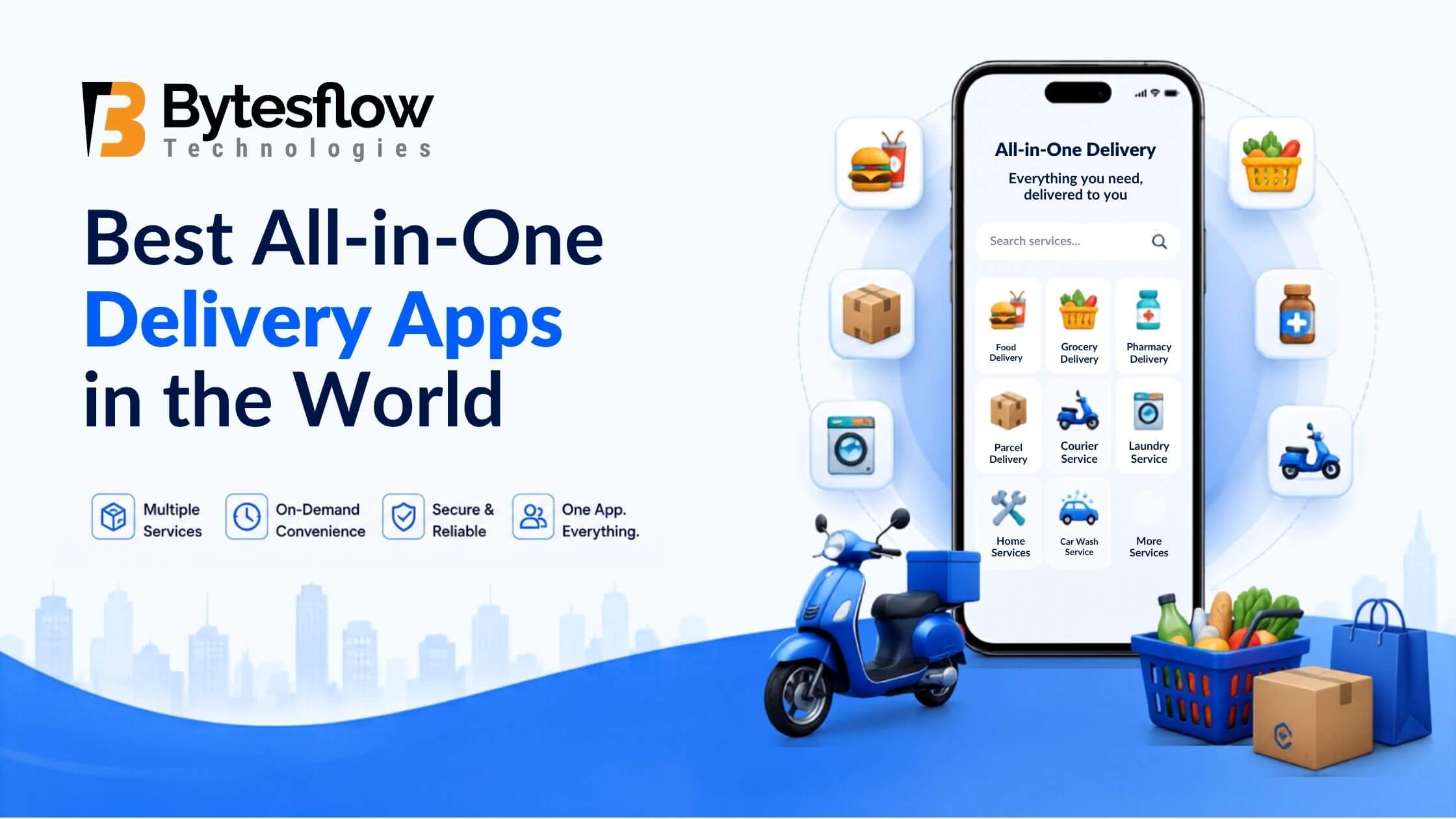
Best All-in-One Delivery Apps in the World (2026 Guide)
Published: August 01, 2026 | Category: On-Demand App Development | Read time: ~10 min
There was a time when you needed one app for food, another for groceries, and a third for sending a parcel across town. That’s changed fast. Today’s leading delivery platforms handle all three and often rides, pharmacy runs, and bill payments too — from a single app, a single wallet, and a single delivery fleet. This guide walks through the platforms doing it best around the world, why the model works, and what it takes to launch one yourself.
What Is an All-in-One Delivery App?
An all-in-one delivery app is a platform built around one shared logistics and payments layer that serves multiple categories — restaurants, grocery stores, pharmacies, retail, and parcels — instead of specializing in just one. The user opens one app, uses one saved card or wallet, and the same courier network fulfills every order type. For the business, it means one fleet, one ops team, and far more orders per active user than a single-category app can generate.
The World’s Leading All-in-One Delivery Apps
Glovo (Europe, Africa, Central Asia)
Glovo built its name on ultra-fast courier delivery before expanding into restaurants, supermarkets, pharmacies, and even “anything” requests where a courier picks up whatever the customer asks for. It now operates across dozens of countries spanning three continents.
Gojek / GoTo (Indonesia)
Gojek is one of the clearest all-in-one success stories, combining ride-hailing, food delivery, courier services, and grocery under GoFood, GoSend, and GoMart, all running through the same GoPay wallet.
Careem (Middle East)
Careem expanded from ride-hailing into food delivery (Careem Food), grocery and quick commerce (Careem Quik), and bike/parcel delivery, all inside one app across the Middle East and North Africa.
Swiggy (India)
Swiggy grew from restaurant delivery into Instamart for quick grocery delivery and Genie for parcel pickup and drop, making it one of the most category-diverse delivery platforms in South Asia.
Postmates (United States)
Postmates pioneered the “deliver anything” model in the U.S. — restaurants, groceries, alcohol, and retail goods from local stores — a positioning later folded into Uber Eats but still widely used as the blueprint for all-category delivery apps.
Snoonu (Qatar)
Snoonu operates as Qatar’s go-to super delivery app, covering food, groceries, retail shopping, and even ride and taxi booking, tailored specifically to the Gulf market.
Wolt (Europe)
Wolt started with restaurant delivery in Finland and expanded into retail and grocery delivery across more than 25 countries, known for tight delivery-time performance and clean app design.
Yassir (North Africa)
Yassir combines ride-hailing, food delivery, and grocery/express delivery in one app, built specifically for North African markets including Algeria, Morocco, and Tunisia.
Mrsool (Saudi Arabia)
Mrsool‘s model lets customers request delivery of literally anything from any store, alongside dedicated food and grocery ordering, making it a flexible all-in-one option in Saudi Arabia.
Chowdeck (Nigeria)
Chowdeck focuses on food and grocery delivery across major Nigerian cities, expanding into errand-style deliveries as it scales — a fast-growing example of the model taking hold in West Africa.
Comparing the Category Coverage
App | Food | Groceries | Courier/Parcel | Rides |
|---|---|---|---|---|
Glovo | Yes | Yes | Yes | No |
Gojek/GoTo | Yes | Yes | Yes | Yes |
Careem | Yes | Yes | Yes | Yes |
Swiggy | Yes | Yes | Yes | No |
Postmates | Yes | Yes | Yes | No |
Snoonu | Yes | Yes | Yes | Yes |
Yassir | Yes | Yes | Yes | Yes |
Why the All-in-One Model Beats Single-Category Apps
The economics are straightforward: acquiring a delivery customer is expensive, so the more order types a platform can serve per user, the better that acquisition cost is spread out. A customer who orders dinner through the app is far more likely to also use it for a grocery run or a same-day parcel if the option is already sitting one tap away, with the same saved payment method and address.
This is reflected in how big the underlying market has become. The online food delivery market alone is worth roughly $284.73 billion in 2026 and is projected to reach $468.51 billion by 2031, and worldwide online food delivery revenue is projected to hit $1.51 trillion in 2026. With mobile firmly the default ordering channel — mobile and tablet apps already account for over 82% of online food delivery orders — the platforms winning are the ones giving users more reasons to keep the app open, not fewer.
Customer expectations are also getting tighter around speed. Over half of consumers now expect their delivery to arrive in 40 minutes or less, which pushes all-in-one platforms toward shared, category-agnostic courier fleets that can be routed to whichever order is closest and fastest, rather than siloed fleets per vertical.
Conclusion
The world’s leading delivery platforms have transformed far beyond food delivery. Today, they connect customers with groceries, pharmacy products, parcels, retail items, and much more through a single app. As a result, they increase customer retention, boost order frequency, and create multiple revenue streams.
Instead of focusing on just one service, successful platforms like Glovo, Gojek, Careem, Swiggy, and Wolt continuously expand into new delivery categories. Consequently, they become the preferred choice for millions of users. If you want to build a scalable delivery business, adopting this multi-service approach gives you a strong competitive advantage from day one.
Ready to Launch Your Own Multi-Service Delivery App?
Bytesflow provides powerful, white-label delivery app solutions designed for startups and enterprises. Whether you want to launch a Glovo Clone, Swiggy Clone, Gojek Clone, or Careem Clone, our ready-to-deploy platforms help you enter the market faster.
Moreover, every solution includes modern features, complete source code, multi-category support, and easy customization. This means you can start with food delivery and later expand into grocery, pharmacy, parcel, courier, or retail services without rebuilding your platform.
Explore Bytesflow’s delivery clone solutions today and launch a scalable on-demand delivery app that grows with your business.
👉 View Live Demo | Get a Free Consultation
Frequently Asked Questions
1.What is an all-in-one delivery app?
It’s a delivery platform that serves multiple categories — food, groceries, pharmacy, parcels, and sometimes rides — through one app, one payment method, and one shared courier network, instead of specializing in a single vertical.
2. Which delivery app does the most things in one place?
Gojek/GoTo and Careem are among the broadest, combining rides, food, groceries, and parcel delivery, though category coverage varies significantly by country and market.
3. How do all-in-one delivery apps make money?
Primarily through delivery fees, commission on vendor orders, subscription memberships for free/discounted delivery, and advertising placements for restaurants and retailers within the app.
4. What’s the difference between a delivery app and a delivery super app?
A standard delivery app usually focuses on one category, like food; a delivery super app extends the same account, wallet, and courier network across multiple categories such as groceries, parcels, and sometimes rides.
5. Can one app really deliver food, groceries, and parcels?
Yes — platforms like Glovo, Swiggy, and Snoonu already do this at scale by routing different order types through a shared courier network rather than maintaining separate fleets per category.
6. What features should an all-in-one delivery app have?
Multi-vendor listings, real-time order tracking, flexible courier assignment across categories, in-app wallet/payments, and a rating system are the core building blocks.
7. How much does it cost to build a delivery app like Glovo?
Building this kind of multi-category architecture from scratch is a significant investment; launching with an established delivery clone platform is typically far faster and more cost-effective for getting to market.
8. Which countries have the most advanced delivery apps?
Indonesia, India, the Gulf states, and parts of Europe currently have some of the most category-diverse delivery platforms, largely because ride-hailing or food delivery incumbents there expanded aggressively into adjacent categories.