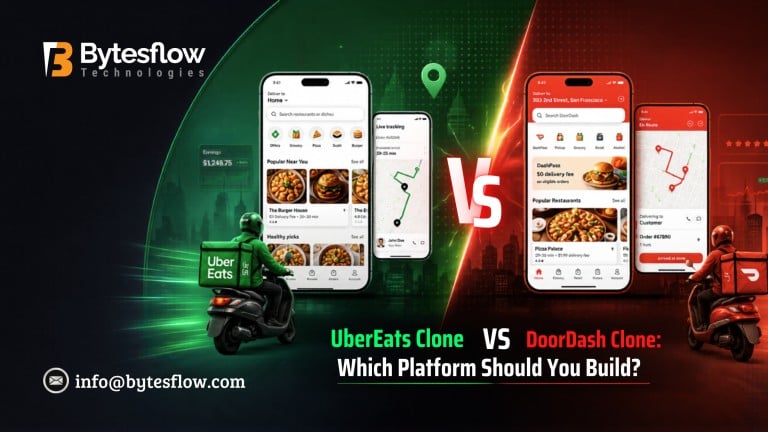
UberEats Clone vs DoorDash Clone: Which Platform Should You Build?
Quick Answer If you are targeting India, APAC, or any global market, build an UberEats Clone. If you are targeting the US suburban market with high-volume logistics, build a DoorDash Clone. Read the full breakdown to find what suits your specific business case. |
Two names dominate the global food delivery conversation: UberEats and DoorDash. Together they hold more than 60% of the US food delivery market, and UberEats alone operates across 45+ countries worldwide. Both have proven that the model works at scale.
For entrepreneurs building a food delivery startup in 2026, the question is not which platform is better — it is which model fits your market, your budget, and your growth plan. An UberEats clone and a DoorDash clone are both powerful tools. They just solve slightly different problems.
This guide breaks down every meaningful difference between the two — features, business model, revenue streams, tech stack, market fit, and cost so you can make the right decision before you invest a single dollar in development.
Understanding the Two Platforms
What Is an UberEats Clone?
An UberEats clone is a pre-built, white-label food delivery platform that replicates UberEats’ three-way marketplace: customers, restaurants, and delivery partners. It is architected for global deployment — built with multi-currency, multi-language, and multi-region support from the ground up.
UberEats generated $13.7 billion in revenue in 2024 and processed $74.6 billion in gross bookings. The model monetises through restaurant commissions (20–25%), delivery fees, the Uber One subscription, and in-app advertising. An UberEats clone replicates this entire revenue engine under your own brand.
What Is a DoorDash Clone?
A DoorDash clone replicates DoorDash’s logistics-first, US-centric food delivery model. In Q1 2026, they reported total orders of 933 million — a 27% year-over-year increase — and revenue of $4.0 billion. they hold approximately 65% of the US food delivery market in 2026.
It’s model differs from UberEats in a key way: it goes beyond food delivery into a full commerce and logistics platform. DashMart (their dark store grocery operation), DashPass (their subscription programme), and their white-label logistics service for enterprise clients make DoorDash a more complex but potentially more diversified business model to replicate.
A clone replicates this ecosystem — tiered restaurant commissions (6% pickup to 30% delivery), subscription programme, grocery/convenience integration, and advanced franchise management tools.
UberEats Clone vs DoorDash Clone: Full Comparison
Here is a side-by-side comparison across every dimension that matters for a startup decision in 2026:
Criteria | UberEats Clone | DoorDash Clone |
|---|---|---|
Primary Market | Global — 45+ countries | US-dominant, expanding internationally |
Business Model | Multi-restaurant marketplace + ride-sharing integration | Commission marketplace + DashMart + logistics-as-a-service |
Subscription Feature | Uber One (global membership) | DashPass (US-focused loyalty) |
Restaurant Commission | 20–25% per order | 15–30% tiered (6% pickup, 30% delivery) |
Best For | Global scale, dense urban markets, AI-first UX | US suburban markets, high-volume logistics, franchise models |
Tech Complexity | Higher — multi-region, multi-currency built-in | Medium — US-optimised, scaling internationally |
Launch Cost | $10,000 – $30,000 (white-label) | $8,000 – $25,000 (white-label) |
Time to Launch | 4 – 8 weeks | 3 – 6 weeks |
Scalability | Excellent for multi-city, multi-country | Excellent for multi-city, US markets |
Revenue Streams | Commission, delivery fees, Uber One, ads, Uber Eats Pro | Commission, delivery fees, DashPass, DashMart, ads |
Niche Expansion | Groceries, pharmacy, alcohol, flowers | Groceries (DashMart), convenience, alcohol |
India / APAC Fit | Strong — UberEats exited India, opportunity is open | Moderate — less brand recognition outside US |
Feature-by-Feature Breakdown
Both platforms share a core feature set. The differences lie in depth, global readiness, and secondary monetisation tools:
Feature | UberEats Clone | DoorDash Clone | Why It Matters |
|---|---|---|---|
Real-time GPS tracking | Yes | Yes | Core feature — non-negotiable |
Multi-restaurant support | Yes | Yes | Needed for marketplace model |
Subscription plan (loyalty) | Uber One style | DashPass style | Drives repeat orders & retention |
AI recommendations | Strong — global data | Moderate | Increases average order value |
DashMart-style dark store | Limited | Yes | Enables grocery/convenience expansion |
Multi-currency support | Built-in | Add-on | Critical for non-US markets |
Multi-language support | Built-in | Add-on | Critical for India, APAC, MENA |
Driver earnings dashboard | Yes | Yes | Driver retention depends on this |
Franchise / chain support | Moderate | Strong | DoorDash built for franchise logistics |
In-app advertising | Yes | Yes | High-margin revenue stream |
Scheduled delivery | Yes | Yes | Growing customer expectation |
Contactless delivery mode | Yes | Yes | Post-pandemic essential |
Business Model Comparison
UberEats Clone Revenue Streams
- Restaurant commission: 20–25% per order placed through the platform
- Delivery fees: Variable based on distance, time of day, and demand
- Uber One-style subscription: Monthly/annual membership for free delivery and discounts
- In-app advertising: Promoted restaurant listings and sponsored placements
- Surge pricing: Dynamic delivery pricing during peak demand windows
DoorDash Clone Revenue Streams
- Restaurant commission: Tiered — 6% pickup, 15–30% delivery depending on plan
- Delivery and service fees: Customer-facing charges per order
- DashPass-style subscription: Monthly membership for reduced fees and priority delivery
- DashMart-style dark store: Direct grocery/convenience fulfilment with full margin
- Enterprise logistics: White-label delivery services for large restaurant chains
- In-app advertising: Sponsored listings and banner placements
Key Insight The DoorDash clone offers more diversified revenue streams — particularly DashMart-style grocery and enterprise logistics. The UberEats clone offers simpler but globally scalable monetisation. For a first-time operator, UberEats’ model is easier to execute; DoorDash’s model has higher ceiling revenue per market. |
Market Fit: Which Clone Works Where?
Build an UberEats Clone If…
- You are targeting India, Southeast Asia, Middle East, Africa, or any non-US market
- Multi-language and multi-currency support is required from day one
- You want AI-powered personalised recommendations built into the platform
- Your city has dense urban ordering patterns — frequent, smaller orders
- You want to capitalise on the UberEats brand gap in markets like India where they exited
- You are building a niche vertical (vegan delivery, tiffin services, cloud kitchen platform)
Build a DoorDash Clone If…
- You are targeting the US market — suburban cities, mid-sized markets, or franchise restaurant chains
- High-volume logistics management is your core operational challenge
- You want to build a DashMart-style dark store grocery operation alongside food delivery
- Your restaurant partners are primarily large chains or franchise operators
- You plan to offer white-label logistics services to enterprise restaurant groups
- You want a subscription programme (DashPass-style) as your primary retention engine
Cost Comparison: UberEats Clone vs DoorDash Clone
Solution Type | UberEats Clone | DoorDash Clone | Time to Launch |
|---|---|---|---|
Clone Script | $5,000 – $12,000 | $4,000 – $10,000 | 2 – 3 weeks |
White-Label Solution | $10,000 – $30,000 | $8,000 – $25,000 | 4 – 8 weeks |
Customised White-Label | $30,000 – $60,000 | $25,000 – $50,000 | 8 – 14 weeks |
Custom Built | $80,000 – $200,000+ | $80,000 – $200,000+ | 4 – 12 months |
Uber Eats clones typically cost slightly more due to the additional complexity of multi-currency, multi-language, and global infrastructure. The price difference at the white-label level is usually $2,000 to $5,000 — a minor consideration relative to the total investment.
Conclusion: Our Verdict
Neither the UberEats clone nor the DoorDash clone is universally superior. The right choice depends entirely on your target market, your operational focus, and your growth timeline.
UberEats clone wins for global markets, India, APAC, and AI-first platforms. DoorDash clone wins for US suburban markets, franchise-heavy restaurant ecosystems, and businesses planning grocery/dark store expansion.
For most entrepreneurs reading this in 2026 — especially those based in or targeting India and Southeast Asia — the UberEats clone is the stronger starting point. The market gap left by UberEats’ India exit is real, the infrastructure is proven, and Bytesflow’s Deliware platform is built to fill it.
Start with a Free Demo from BytesflowBytesflow Technologies builds fully customised UberEats clone and DoorDash clone apps for startups and enterprises. Get a free demo and expert consultation — we will tell you which platform is right for your market before you spend a rupee. |
Frequently Asked Questions
1. What is the main difference between an UberEats clone and a DoorDash clone?
An UberEats clone is built for global, multi-region deployment with strong AI personalisation and multi-currency support while the other is optimised for high-volume logistics in the US market, with franchise management tools and DashMart-style grocery capabilities.
2. Which is better for startups — UberEats clone or DoorDash clone?
For startups in India, Southeast Asia, or MENA, an UberEats clone is the better choice. For US-focused startups targeting suburban markets, a DoorDash clone offers faster deployment and proven logistics architecture. Both are viable for well-executed startups in their respective markets.
3. How much does it cost to build an UberEats clone vs a DoorDash clone?
An UberEats clone white-label solution costs $10,000 to $30,000 with a 4 to 8 week launch timeline. A DoorDash clone white-label solution costs $8,000 to $25,000 with a 3 to 6 week timeline. Custom builds for both range from $80,000 to $200,000+.
4. Which food delivery clone is better for the Indian market?
An UberEats clone is the stronger choice for India in 2026. UberEats exited India in 2020, leaving an opportunity in Tier 2 and Tier 3 cities. Built-in UPI payment integration, Hindi and regional language support, and a lower commission structure than Zomato make an UberEats clone the right vehicle for the Indian market.
5. Can Bytesflow build both UberEats clone and DoorDash clone apps?
Yes. Bytesflow Technologies builds both platform types with full white-label customisation, real-time tracking, multi-payment gateway integration, AI features, and dedicated post-launch support. Contact us to discuss which platform fits your market and get a free demo.