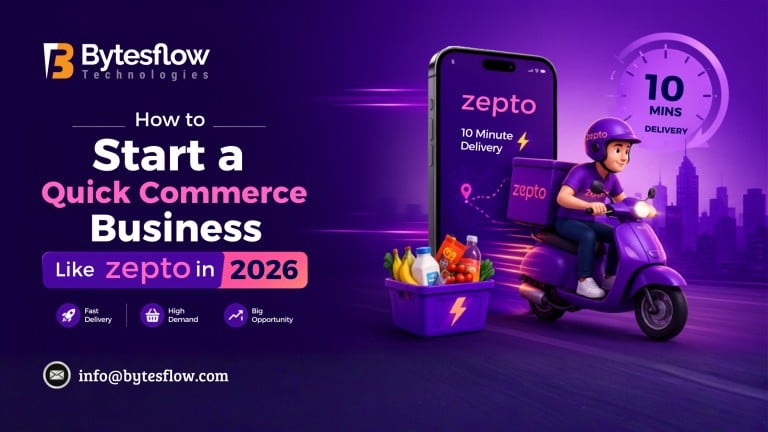
How to Start a Quick Commerce Business Like Zepto in 2026
In 2021, Aadit Palicha and Kaivalya Vohra dropped out of Stanford and launched Zepto, a 10-minute grocery delivery app. Within 18 months, it crossed a $900M valuation. By 2026, the global quick commerce (q-commerce) market is projected to exceed $70 billion. The model is battle-tested. The playbook is learnable.
This guide walks you through everything — from validating your market and setting up your first dark store, to building the tech stack, hiring your team, and acquiring your first 1,000 customers. Whether you’re in Mumbai, Dubai, or Chicago, the fundamentals are the same.
⚡ What You’ll Learn: Dark store setup | Tech & logistics | Legal compliance | Funding strategy | GTM & customer acquisition | Unit economics | Scaling playbook |
1. Understanding Quick Commerce: The 10-Minute Business Model
Quick commerce is not just fast e-commerce. It is a fundamentally different infrastructure play. Unlike traditional e-commerce (2–5 day delivery) or same-day delivery, q-commerce promises delivery in 8–20 minutes by placing micro-warehouses — called dark stores within 2 km of every customer.
How Zepto’s Model Works (Simplified)
Layer | How It Works |
Customer orders | App or website, usually 2–15 SKUs per order |
Dark store | A 1,500–3,000 sq ft micro-warehouse near residential clusters |
Picker | Staff who pick the order in < 90 seconds using optimised shelf layout |
Delivery rider | Assigned in real time, delivers within 1–2 km radius |
Payment | Prepaid (card/UPI/wallet) or cash on delivery |
Returns | Instant refund or re-delivery within the hour |
Q-Commerce vs. Traditional E-Commerce
Factor | Q-Commerce | Traditional E-Commerce |
Delivery Time | 8–20 minutes | 1–5 days |
Warehouse Size | 1,500–3,000 sq ft (dark store) | 50,000–200,000 sq ft (fulfillment center) |
SKU Count | 2,000–5,000 | 50,000–500,000+ |
Delivery Radius | 1–3 km | City / National |
Capital Intensity | High (many dark stores) | Medium-High (fewer large warehouses) |
Margin Profile | Low gross margin, high frequency | Higher per-order margin |
2. Market Research & Validation
Before you spend a rupee on technology or rent, validate these four signals in your target city:
The 4-Point Validation Checklist
- Population density ≥ 15,000 people per sq km in target zone
- Existing grocery/FMCG spend > ₹3,000/household/month (or $150 USD equivalent)
- Smartphone penetration > 65% in the catchment area
- No dominant player with > 40% market share already operational
💡 Founder Insight: Zepto co-founder Kaivalya Vohra has publicly stated they initially focused only on housing society clusters in Bengaluru and Mumbai where order density was naturally high. Don’t try to cover a whole city — own 3 pin codes deeply before expanding. |
Tools for Market Research
- Google Trends — search volume for ‘grocery delivery [city name]’
- Meta Ads Audience Insights — household income & mobile usage
- RedSeer / Bain Q-Commerce reports (India) or McKinsey Grocery reports (global)
- Walk your target zones: count apartment blocks, offices, and footfall
- Survey 50–100 target customers on WhatsApp or in housing societies
3. Business Model & Unit Economics
Understanding unit economics before launch separates founders who scale from those who burn out. Here’s the typical unit economics model for a single dark store:
Metric | Benchmark (India, Tier 1 City, 2026) |
Average Order Value (AOV) | ₹350–₹550 (~$4–$7) |
Gross Margin on Products | 18–25% |
Delivery Cost per Order | ₹35–₹60 |
Platform / Packaging Cost | ₹10–₹20 |
Dark Store Rent & Ops | ₹1.5–2.5 lakh/month per store |
Break-even Orders/Day | 250–350 orders per dark store |
Target EBITDA margin (scale) | 3–6% at 500+ orders/day/store |
Revenue Streams to Build In from Day 1
- Product margin — the primary revenue from stocking and selling goods
- Delivery fee — charged to customer (₹10–₹30) or waived with subscription
- Subscription / loyalty pass — monthly fee (e.g., Zepto Pass) for free deliveries
- Brand partnerships & in-app advertising — FMCG brands pay for shelf placement
- Private label products — higher margin own-brand SKUs (long-term play)
4. Setting Up Your First Dark Store
The dark store is the physical heart of your operation. Get this wrong and no amount of marketing will save you.
Location Criteria
- Within 1.5–2.5 km of highest-density residential cluster in your zone
- Ground floor preferred — faster loading/unloading, no elevator delays
- Minimum 1,500 sq ft; 2,000–2,500 sq ft is optimal for 2,000–3,000 SKUs
- 24/7 access permitted by landlord (for night-shift operations)
- Parking/loading bay for delivery bikes and restocking vehicles
- Cold storage access for dairy, meat, frozen goods
Dark Store Setup Costs (Indicative)
Item | Estimated Cost (India) | Estimated Cost (US/EU) |
Rent (monthly) | ₹50,000–₹1.5 lakh | $1,500–$4,000 |
Fit-out & Racking | ₹2–₹4 lakh | $5,000–$12,000 |
Cold storage unit | ₹1–₹2 lakh | $3,000–$8,000 |
CCTV & Security | ₹30,000–₹60,000 | $800–$2,000 |
IT & POS Setup | ₹40,000–₹80,000 | $1,000–$3,000 |
Initial Inventory (2,500 SKUs) | ₹8–₹15 lakh | $20,000–$40,000 |
Total (One Dark Store) | ₹12–₹25 lakh | $30,000–$70,000 |
Shelf Layout & SKU Strategy
Zepto, Blinkit, and Swiggy Instamart all follow the same shelf optimisation principle: place high-velocity SKUs (milk, eggs, bread, soft drinks) closest to the packing counter to minimise picker travel time.
- A-zone (front): Top 200 fastest-moving SKUs — dairy, bread, eggs, water, soft drinks
- B-zone (middle): FMCG staples — oils, atta, rice, pulses, snacks
- C-zone (back): Low-velocity items — health supplements, specialty products
- Refrigerated zone (dedicated corner): Cold chain items at 2–8°C
5. Technology Stack
You need four core tech components to run a q-commerce business. You can build, buy, or use a hybrid approach.
Core Technology Components
Component | What It Does | Build vs Buy |
Customer App (iOS + Android) | Customer ordering interface | Buy/SaaS (Year 1); Build (Year 2+) |
Warehouse Management System (WMS) | Inventory tracking, picking lists, reorder alerts | Buy (e.g., Increff, GreyOrange) |
Delivery Management System (DMS) | Rider assignment, live tracking, route optimisation | Buy (e.g., Locus, Shadowfax API) |
Admin / Ops Dashboard | Orders, inventory, staff management, analytics | Build (custom) or use Shopify + integrations |
Payment Gateway | Razorpay (India), Stripe (Global) | Integrate via API |
Recommended Tech Stack for a Lean Launch
- Frontend: React Native (single codebase for iOS + Android)
- Backend: Node.js or Python (FastAPI) — scalable microservices
- Database: PostgreSQL + Redis (caching for real-time order status)
- Maps & Routing: Google Maps Platform or HERE Maps API
- Push Notifications: Firebase Cloud Messaging (FCM)
- Analytics: MixPanel + Google Analytics 4
- Cloud: AWS (preferred) or Google Cloud — use Mumbai region for India
💰 Budget Tip: In Year 1, don’t build a custom app. Use white-label q-commerce SaaS platforms like Shipday, Jungleworks, or DotPe to get live in 4–6 weeks. Invest in custom tech only after you hit 200+ daily orders consistently. |
6. Legal, Licensing & Compliance
Skipping compliance is the fastest way to get shut down. Here’s what you need before your first delivery:
India-Specific Requirements
License / Registration | Authority | Timeline |
Business Registration (Pvt Ltd / LLP) | MCA / ROC | 7–15 days |
GST Registration | GST Portal | 3–7 days |
FSSAI License (Food Safety) | fssai.gov.in | 30–60 days |
Shop & Establishment License | Municipal Corporation | 7–14 days |
Trade License | Local municipality | 15–30 days |
Fire NOC (if applicable) | Fire Department | 15–30 days |
Global Requirements (US, UK, UAE)
- US: LLC/C-Corp registration, FDA food handler permits, local business license
- UK: Companies House registration, Food Business Registration (FSA), GDPR compliance
- UAE: Trade license (DED), IFZA or freezone setup, Municipality food license
7. Building Your Team
Your first 10 hires define your culture and operational efficiency. Here is the minimum viable team for launching one dark store:
Role | Count | Key Responsibility |
Dark Store Manager | 1 | Overall store ops, inventory, staff management |
Pickers/Packers | 4–6 | Order fulfilment (3 per shift, 2 shifts) |
Delivery Riders | 8–12 | Last-mile delivery (mix of own + gig fleet) |
Inventory/Procurement Exec | 1 | Supplier relations, daily restocking |
Customer Support (remote) | 1–2 | Chat/call support for escalations |
Tech/Ops Co-founder or Lead | 1 | App, WMS, DMS oversight |
Rider Model: Own Fleet vs. Gig Aggregators
- Own riders: Lower per-delivery cost at scale, better control, higher compliance
- Gig fleet (Shadowfax, Porter, Dunzo): Faster to start, no HR overhead, higher per-order cost
- Hybrid model (recommended): Own 60–70% of base demand; use gig for surge hours (evenings, weekends)
8. Supplier & Inventory Management
Supplier Strategy
- FMCG distributors: Partner with local C&F agents or national distributors (HUL, ITC, Nestlé channels)
- Direct brand tie-ups: Once you hit 500+ orders/day, brands will approach you for shelf placement fees
- Local produce: Partner with vegetable mandis or FPC (Farmer Producer Companies) for fresh produce
- Private label: In Year 2+, launch 10–15 own-brand SKUs in high-margin categories (staples, snacks)
Inventory Management Best Practices
- Maintain 2–3 days of stock for A-zone SKUs; 5–7 days for B-zone
- Set automated reorder alerts at 30% of minimum stock threshold in your WMS
- Conduct daily mini-audits of top 50 SKUs; weekly full stock audits
- Track shrinkage (theft, expiry, damage) — keep below 1.5% of GMV
- Use expiry-date FIFO (First In, First Out) strictly for dairy, fresh produce, and bakery
9. Go-to-Market (GTM) Strategy
Zepto launched with WhatsApp groups, housing society ambassador programs, and heavy referral bonuses. Your GTM does not need to be expensive — it needs to be hyper-local.
Launch Week Playbook
- Identify the 3 housing societies / apartment complexes closest to your dark store
- Recruit 2–3 resident ambassadors per society (free groceries for 1 month in exchange)
- Drop 2,000 physical flyers door-to-door with QR code to download app + ₹100 first-order coupon
- Partner with the society WhatsApp groups to post daily deals
- Run a 3-day free delivery + 20% off promotion on launch weekend
- Capture feedback from first 100 customers personally — fix every pain point in Week 2
Digital Acquisition Channels
Channel | Best For | Expected CAC (India) |
Google Ads (Search) | High-intent ‘grocery delivery near me’ | ₹80–₹150 |
Meta Ads (Instagram/Facebook) | Brand awareness, retargeting | ₹60–₹120 |
Influencer marketing | Local food/lifestyle influencers | ₹40–₹100 per customer |
WhatsApp broadcast | Retention & reactivation | Near zero (owned channel) |
Referral program | Viral growth (give ₹50 per referral) | ₹30–₹80 |
Society / RWA partnerships | Bulk deals, B2B orders | ₹20–₹60 |
10. Funding Your Q-Commerce Startup
Bootstrapped Launch (₹25–₹40 lakh / $30,000–$50,000)
Possible for 1 dark store in a Tier 2 Indian city or small US town. Requires founders to be operationally hands-on. Use SaaS tech (no custom build). Reach profitability at store level within 6–9 months.
Venture-Backed Launch
Stage | Typical Raise | Use of Funds |
Pre-Seed | ₹50L–₹1.5Cr ($100K–$300K) | 2–3 dark stores, MVP app, first 6 months ops |
Seed | ₹3–₹8Cr ($500K–$1.5M) | 10–20 dark stores, tech build, brand marketing |
Series A | ₹30–₹80Cr ($5–$15M) | City expansion, private label, WMS upgrade |
Where to Find Investors
- AngelList India / SeedInvest (global) — angel investors in consumer/logistics
- Peak XV Partners, Nexus VP, Elevation Capital — active Indian q-commerce investors
- Y Combinator, Techstars — accelerator routes for global founders
- Government grants: DPIIT Startup India seed fund (up to ₹50L)
11. Scaling: From 1 Dark Store to 10+
The playbook for scaling is simple in theory and hard in execution: duplicate your highest-performing dark store, not your average one.
When to Open Store #2
- Store #1 is profitable at store level (contribution margin positive)
- Consistently delivering 300+ orders/day for 30+ consecutive days
- Customer NPS > 50 and repeat purchase rate > 60% (Week 4 cohorts)
- Rider SLA (delivery in < 15 mins) maintained at > 90% fulfilment rate
City Expansion Checklist
- Replicate dark store SOPs — use the same shelf layout, onboarding process, and KPI dashboards
- Hire a City Operations Manager before the launch date (not after)
- Pre-seed the new city with influencer campaigns 3–4 weeks before launch
- Negotiate city-wide supplier contracts — bulk purchasing improves margins
- Adapt your SKU mix — what sells in Mumbai may not sell in Jaipur
12. Key Risks and How to Mitigate Them
Risk | Mitigation Strategy |
High delivery cost eroding margins | Increase AOV via bundling, subscriptions, and min-order thresholds |
Inventory wastage (fresh produce) | Strict FIFO, dynamic pricing on near-expiry items, supplier return clauses |
Rider attrition and gig dependency | Invest in own-rider benefits; partner with 2+ gig platforms |
Dominant competitor (Zepto, Blinkit) | Hyper-niche positioning — own 1 city deeply before they focus there |
App/tech downtime | 99.9% uptime SLA with cloud provider; maintain manual fallback process |
Regulatory changes (food safety) | Proactive FSSAI compliance; appoint a dedicated compliance officer |
Conclusion
Quick commerce continues to create exciting opportunities for businesses worldwide. With the right technology and execution, entrepreneurs can launch successful delivery platforms and meet growing customer demand for instant service. Bytesflow‘s Zepto Clone App Solution provides everything needed to build, launch, and scale a modern quick commerce business quickly and efficiently.
👉 View Live Demo | Get a Free Consultation
Frequently Asked Questions
Q1: How much money do I need to start a quick commerce business?
For a single dark store in India, expect to invest ₹15–₹25 lakh ($20,000–$35,000) covering rent deposit, fit-out, initial inventory, tech setup, and 3 months of working capital. In the US or Europe, budget $40,000–$80,000 for the same scope.
Q2: Do I need to build a mobile app from scratch?
No. In your first 6–12 months, use white-label q-commerce platforms like Jungleworks, Shipday, or DotPe. Build a custom app only after validating your model with consistent 200+ daily orders. Custom development typically costs ₹20–₹50 lakh ($30,000–$70,000) for a production-grade app.
Q3: How do I compete with Zepto and Blinkit?
Focus on geographies they haven’t deeply penetrated (Tier 2/3 cities), product niches they underserve (regional staples, ethnic produce, local brands), and service quality they can’t offer at scale (personal touch, hyper-local assortment, same-day personalised deals for housing societies).
Q4: What is a dark store and how is it different from a normal warehouse?
A dark store is a small retail-format store (1,500–3,000 sq ft) that is closed to the public and used exclusively for fulfilling online orders. Unlike a traditional warehouse, it is located inside dense residential areas, stocks only 2,000–5,000 SKUs, and is optimised for picker speed (< 90 seconds per order) rather than storage density.
Q5: What licences do I need to start a grocery delivery startup in India?
You need: Company registration (Pvt Ltd recommended), GST registration, FSSAI licence (for handling food), Shop & Establishment licence, and a local trade licence. Depending on your city and products, you may also need a fire NOC and cold storage approval from your municipal authority.