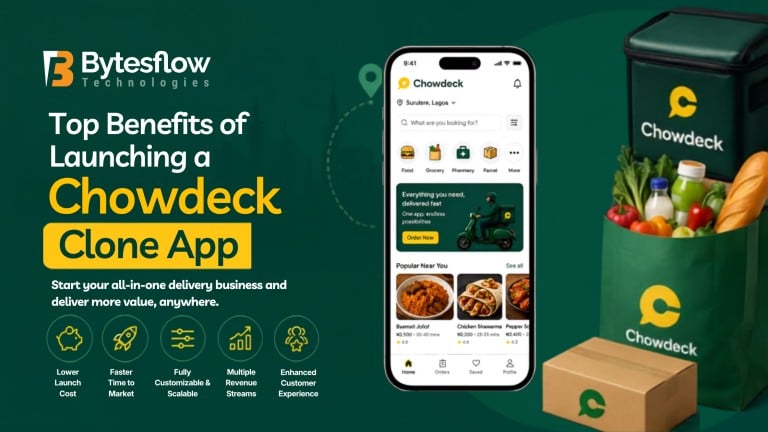
Top Benefits of Launching a Chowdeck Clone App
Published: August 5, 2026 | Category: Benefits Guide | Read time: ~10 min
Introduction
Building an on-demand delivery business from the ground up usually takes months of development, a large engineering budget, and a long list of features to get right before day one. A ready-made solution closes exactly that gap. Instead of reinventing order management, live tracking, and vendor dashboards, founders can launch on a foundation that already works, then customize it around their own brand and market.
This guide breaks down the real, practical benefits of launching such a platform, who it suits best, and what to check before you commit.
What Is a Chowdeck Clone App?
This ready-made, white-label delivery app follows Chowdeck’s model for food, grocery, and parcel delivery. As a result, entrepreneurs can launch a fully functional multi-service delivery business in weeks instead of building one from scratch, at a fraction of the cost, with proven features like live tracking, multi-vendor management, and in-app payments already in place.
Instead of custom-coding every screen and backend workflow, businesses build on a Chowdeck clone script and then adapt the branding, service categories, and business rules to their own market.
Who Uses the Platform
At its core, the platform connects four user roles:
- Customers, who browse vendors and place orders
- Vendors or restaurants, who manage listings and fulfil orders
- Delivery riders, who accept and complete deliveries
- Admin, who oversees the entire ecosystem from a central dashboard
Because the architecture has already proven itself, founders can skip the riskiest and most time-consuming part of building a delivery startup: getting the core logic right the first time.
Top Benefits of Launching a Chowdeck Clone App
Here is why founders and existing businesses increasingly choose this route over custom development.
1. Faster Time to Market
- Custom app development can take six months or longer once you factor in design, backend architecture, testing, and bug fixes.
- An already-tested foundation, however, lets most businesses go live in a matter of weeks instead.
- Speed matters most in on-demand delivery, since being first to serve a city or neighborhood often decides who wins long-term loyalty.
2. Lower Development Cost
- Hiring a full development team to build a three-sided marketplace from scratch costs a lot.
- Choosing a ready-made Chowdeck script, on the other hand, means founders pay for proven code and customization rather than ground-up engineering.
- As a result, more of the budget can go toward marketing, rider incentives, and vendor onboarding instead of software development. For a sense of how cost comparisons play out on a similar platform, check our UberEats clone cost breakdown.
3. Proven, Battle-Tested Features
A dependable script of this kind already includes the features today’s users expect by default:
Feature | Why It Matters |
Real-time order tracking | Builds customer trust and reduces support queries |
Multi-vendor dashboard | Lets restaurants and stores manage listings independently |
In-app payments and wallet | Speeds up checkout and reduces cash handling |
Rider route optimization | Cuts delivery time and fuel cost |
Ratings and reviews | Improves vendor accountability and customer confidence |
Admin analytics panel | Gives owners visibility into revenue, orders, and performance |
Because these modules have already gone through real-world testing, businesses skip the trial-and-error phase that often slows down first-time delivery startups.
4. Scalable, Multi-Service Architecture
- Chowdeck’s original model does not stop at food. It also covers groceries, pharmacy items, and parcels.
- Replicating that structure through an on-demand all-in-one delivery app clone means a business does not lock itself into a single vertical.
- Instead, a founder can start with food delivery and later expand into groceries or courier services, using the same platform and the same vendor and rider base. Our recent piece on how founders built a super app with a Snoonu clone shows what that expansion path can look like in practice.
5. Full Branding and Customization
- Many assume that using a script means launching a generic, look-alike app.
- In practice, however, a good Chowdeck clone script comes fully white-labeled.
- Businesses can rebuild the interface, choose their own color palette and logo, set custom commission structures, and add region-specific payment gateways, so the end result looks and feels like an original product.
6. Lower Risk, Higher Predictability
- Custom-built platforms carry real technical risk. Bugs, delays, and unplanned costs commonly follow when a team builds complex logistics software from zero.
- Other businesses, however, have already put this kind of platform through its paces, so the core risk is largely gone.
- Consequently, budgeting and planning become far more predictable for a first-time founder.
7. Easier Multi-City and Multi-Country Expansion
- Once the core platform proves stable in one market, expanding to a second city or country mostly means configuration rather than redevelopment: new currencies, languages, tax rules, and delivery zones.
- This matters more than it might seem, since Nigeria’s online food delivery market alone is projected to keep growing at a strong compound annual rate through the early 2030s.
- Similar growth patterns are showing up across other emerging delivery markets in Africa and the Middle East too, which also explains the rising demand for scripts like a Yassir clone and a Mrsool clone in the same regions.
Custom Build vs a Ready-Made Script
Factor | Custom Development | Chowdeck Script |
Time to launch | 5 to 9 months | 3 to 6 weeks |
Upfront cost | High | Moderate to low |
Core features | Built from scratch | Pre-built and tested |
Technical risk | Higher | Lower |
Customization | Fully flexible, slower | Flexible within a proven framework |
Best suited for | Large, well-funded teams | Startups and SMEs entering fast |
Who Should Consider This Route
This kind of platform suits the following founders particularly well:
- First-time founders entering the food or quick-commerce delivery space
- Existing restaurants or grocery chains wanting their own branded ordering app
- Regional entrepreneurs targeting underserved cities where global apps have limited presence
- Investors looking to launch and validate a delivery brand before committing to custom engineering
That said, it suits a narrower set of businesses less well, specifically those that need a completely unconventional business model with no resemblance to standard delivery workflows, since heavy structural changes cancel out the cost and time advantage.
What to Check Before You Choose a Provider
Not every script comes built the same way, and the difference usually shows up after launch, not before. So, before signing off on any provider, run through these checks first.
Technical and Ownership Checks
- Source code ownership. Confirm that you own the code outright rather than licensing it indefinitely, so no single vendor can lock you in.
- Scalability. Ask how the platform handles order spikes, multiple cities, and growing vendor counts, not just how it performs in a demo.
- Security and compliance. Look for encrypted payments, secure user data handling, and compliance with local data protection rules.
Support and Growth Checks
- Depth of customization. A surface-level rebrand is not the same as real customization, so check whether commission logic, workflows, and service categories can genuinely change.
- Post-launch support. Ask what happens after go-live, since bug fixes, updates, and scaling support should come as part of the package, not a separate cost surprise.
- Third-party integrations. Payment gateways, SMS or WhatsApp notifications, and mapping APIs should plug in directly rather than require custom builds.
This same due-diligence approach applies broadly across the delivery clone space, whether you are comparing a Chowdeck script or a similar platform from another provider.
The Market Context
Global demand for on-demand delivery keeps climbing. In fact, Grand View Research values the global online food delivery market at hundreds of billions of dollars, with continued growth expected through 2030, driven by smartphone adoption, urbanization, and rising demand for convenience. This growth is not limited to established markets either; emerging regions are seeing some of the fastest adoption curves as infrastructure and digital payments mature. For a founder deciding between building from zero or launching on a working foundation, timing matters here. Launching sooner, with lower risk, ultimately means capturing early market share before competitors do.
Conclusion
Here’s the real trade-off: every month spent building from scratch is a month a competitor spends signing up vendors and riders in your target city. A Chowdeck clone closes that gap, since it hands you proven technology, lower risk, and a working product in weeks instead of half a year.
So, if the numbers above make the case, don’t let the decision sit.
View a live demo and see the customer, vendor, rider, and admin panels in action, then book a free consultation to get a straight answer on cost, timeline, and what launch would look like in your market.
Frequently Asked Questions
1. What is a Chowdeck clone app?
It is a ready-made delivery platform modeled on Chowdeck’s food, grocery, and parcel delivery system. In short, it gives businesses the same core structure, customer app, vendor dashboard, rider app, and admin panel, without building it from scratch.
2. Why should startups launch a Chowdeck clone app?
It shortens time to market, lowers development cost, and comes with features that real-world use has already tested, which in turn reduces the risk that usually comes with building delivery software from zero.
3. What are the biggest benefits of using a Chowdeck clone?
The main advantages include faster launch time, lower cost compared to custom builds, proven features like live tracking and multi-vendor support, and the flexibility to expand into new cities or service categories later.
4. Does a Chowdeck clone support multiple restaurants?
Yes. This kind of script includes a multi-vendor architecture, so unlimited restaurants or stores can list their own menus, manage orders, and track performance from individual dashboards.
5. How long does it take to launch a Chowdeck clone?
Most businesses can launch within three to six weeks, depending on how much customization, integration, and region-specific setup they need.
6. Is a Chowdeck clone suitable for businesses outside food delivery?
Yes. Because the underlying model supports multiple service categories, businesses can adapt an on-demand all-in-one delivery app clone for groceries, pharmacy items, parcels, or other errand-based services.
7. Is a Chowdeck clone a profitable investment?
It can be, particularly in markets where demand for delivery is rising and competition is still limited. That said, profitability ultimately depends on execution: vendor onboarding, rider supply, marketing, and local market fit all play a role.
8. Can a Chowdeck clone be customized for my business?
Yes. A quality build comes fully white-labeled, so branding, commission structures, service categories, and payment gateways can all match a specific business model and region.