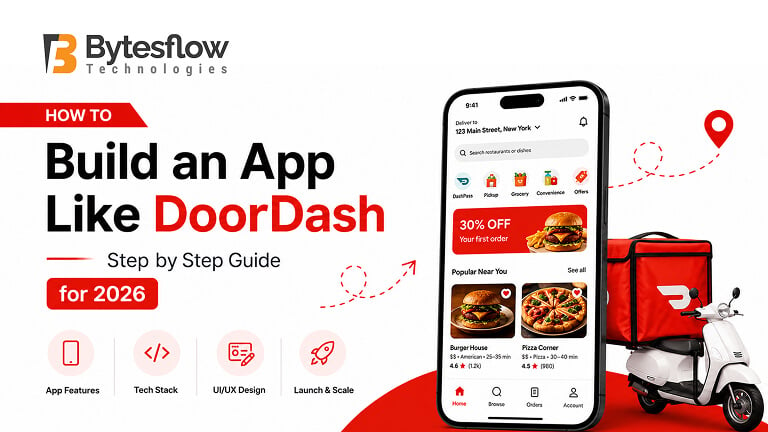
How to Build an App Like DoorDash Step by Step Guide for 2026
Published: May 8, 2026 | Category: App Development | Read time: ~15 min
The food delivery market crossed $1.4 trillion globally in 2025 and shows no signs of slowing down. Entrepreneurs and enterprises alike are watching DoorDash the platform that turned takeout into a tech empire and asking the same question: can we build something like this?
The short answer is yes. The longer answer is what this guide is all about.
Whether you are a startup founder looking to launch a local delivery app, a restaurant chain wanting to own its logistics, or a product team evaluating an on-demand expansion — this step-by-step guide covers everything you need to build a food delivery app like DoorDash in 2026: architecture, features, tech stack, cost, timelines, and monetization.
1. Understanding How DoorDash Works
Before writing a single line of code, you need to understand the model. DoorDash is a three-sided marketplace connecting three distinct user groups:
User Group | Their Role | What They Need |
Customers | Browse menus, order food, track delivery | Speed, transparency, easy payments |
Restaurants / Merchants | Accept orders, prepare food, manage menu | Order dashboard, analytics, low fees |
Dashers (Drivers) | Accept deliveries, earn per delivery | Route optimization, earnings visibility |
This three-sided model is what makes food delivery platforms complex. You are not building one app , you are building three interconnected products that share a real-time data backbone.
Key insight: DoorDash earns revenue through a combination of delivery fees (charged to customers), service commissions (charged to restaurants, typically 15–30%), and DashPass subscriptions. Your monetization must be baked into your architecture from day one.
2. Define Your Business Model Before You Build
Many founders make the mistake of copying DoorDash’s feature set without validating their business model first. The model you choose directly impacts architecture decisions.
Common Business Model Variants
- Aggregator model: You list restaurants and charge commission. No drivers. Restaurants handle their own delivery (like early Grubhub).
- Logistics model: You own the delivery fleet (like DoorDash). Higher operational complexity, higher margins.
- Vertical model: You focus on a niche — grocery, alcohol, pharmacy, pet supplies. Easier to differentiate.
- White-label model: You build the platform and license it to restaurants or regional operators.
For this guide, we will focus on the full logistics model, the most technically comprehensive, and the closest to DoorDash’s architecture.
3. The 3 Apps You Need to Build
A DoorDash-like platform requires three separate applications sharing a unified backend:
App 1: Customer App
This is your primary revenue surface. The customer app handles discovery, ordering, payment, and tracking.
- Browse restaurants and menus by location, category, or cuisine
- Real-time order tracking with GPS map view
- In-app payments (credit/debit, Apple Pay, Google Pay, wallets)
- Order history, reorder shortcuts, and saved addresses
- Ratings and reviews for restaurants and drivers
- Push notifications for order status updates
- Promo codes, referrals, and loyalty rewards
App 2: Restaurant / Merchant Dashboard
Restaurants are your supply side. If this dashboard is clunky, merchants will abandon you for competitors.
- Real-time order management (accept, reject, mark as ready)
- Menu builder with images, pricing, and availability toggles
- Business analytics — revenue, popular items, peak hours
- Promotions manager for deals and discounts
- Payout and invoice history
- Tablet-optimized UI (most restaurant staff use tablets)
App 3: Driver App
The driver app is the operational heart of your platform. Poor driver UX leads to longer delivery times and customer churn.
- Job board — accept or reject delivery requests with time limit
- Turn-by-turn navigation (Google Maps / Mapbox integration)
- Earnings dashboard — daily, weekly, all-time
- In-app chat with customer (no phone number sharing)
- Proof of delivery — photo upload or PIN confirmation
- Background location tracking (with driver consent)
4. Must-Have Features — Ranked by Priority
Not all features are equal. Here is how to prioritise your MVP versus your V2 roadmap:
Feature | Priority | MVP or V2? |
User registration & login (social + email) | Critical | MVP |
Restaurant / menu browsing | Critical | MVP |
Cart and checkout flow | Critical | MVP |
Real-time GPS order tracking | Critical | MVP |
Payment gateway (Stripe) | Critical | MVP |
Push notifications | Critical | MVP |
Driver assignment algorithm | Critical | MVP |
Ratings and reviews | High | MVP |
Order history and reordering | High | MVP |
Promo codes and discounts | Medium | V2 |
Subscription plan (DashPass-style) | Medium | V2 |
AI-powered ETA predictions | Medium | V2 |
Group ordering | Low | V2 |
Scheduled orders | Medium | V2 |
Multi-language / multi-currency | Depends on market | V2 |
5. Tech Stack for a DoorDash-Like App in 2026
Technology choices in 2026 favor developer velocity, scalability at moderate cost, and real-time capabilities. Here is the recommended stack:
Layer | Recommended Technology |
Customer App (iOS + Android) | React Native 0.75+ or Flutter 3.x |
Restaurant Dashboard (Web) | Next.js 15 (React) — responsive, tablet-first |
Driver App (iOS + Android) | React Native (shared codebase with Customer App) |
Backend API | Node.js (Express / Fastify) or Go (for high throughput) |
Real-Time (tracking, notifications) | Socket.io or Firebase Realtime Database |
Primary Database | PostgreSQL (transactions, orders, users) |
Caching Layer | Redis (sessions, geospatial queries, rate limiting) |
Search (menu / restaurant) | Elasticsearch or Typesense |
File Storage (images, receipts) | AWS S3 or Cloudflare R2 |
Payment Processing | Stripe (cards, wallets, payouts to drivers) |
Maps & Geolocation | Google Maps Platform or Mapbox |
SMS / OTP | Twilio or AWS SNS |
Push Notifications | Firebase Cloud Messaging (FCM) |
DevOps & Hosting | AWS / GCP + Docker + Kubernetes |
CI/CD | GitHub Actions |
Monitoring | Datadog or Grafana + Prometheus |
Why These Choices?
- React Native: One codebase for iOS and Android cuts development cost by ~40% without sacrificing performance.
- PostgreSQL + Redis: Postgres handles relational order data reliably. Redis handles the high-read geospatial lookups that driver tracking demands.
- Stripe: Built-in support for split payments (customer → platform → driver) via Stripe Connect makes payouts straightforward.
- Socket.io: Enables sub-second location updates from drivers to customers without polling overhead.
6. Step-by-Step Development Process
Here is the recommended build sequence to get to market fastest without accumulating technical debt:
Phase | What Gets Built |
Phase 1 — Discovery (Weeks 1–3) | Requirements workshop, UX wireframes, technical spec, database schema design, API contract definition |
Phase 2 — Backend Foundation (Weeks 4–8) | User auth, restaurant/menu CRUD, order state machine, payment integration (Stripe), basic admin panel |
Phase 3 — Customer App MVP (Weeks 6–12) | Onboarding, restaurant browsing, cart, checkout, real-time order tracking, push notifications |
Phase 4 — Driver App MVP (Weeks 8–14) | Job board, accept/reject flow, navigation integration, earnings dashboard, proof of delivery |
Phase 5 — Restaurant Dashboard (Weeks 10–16) | Order management, menu builder, analytics, payout history |
Phase 6 — QA & Load Testing (Weeks 15–18) | End-to-end testing, load simulation (1,000 concurrent orders), security audit, App Store submission |
Phase 7 — Soft Launch (Week 19) | Launch in a single city or ZIP code, gather real user feedback, fix critical bugs |
Phase 8 — Scale & Iterate (Month 5+) | Add V2 features, expand geographies, optimize dispatch algorithm, launch marketing campaigns |
7. Cost to Build an App Like DoorDash in 2026
Development cost depends on team location, feature scope, and whether you build native or cross-platform. Here are realistic ranges:
Scope | Estimated Cost | Timeline |
MVP (1 city, core features only) | $15,000 – $30,000 | 3–5 months |
Mid-tier (3 apps, full feature set) | $30,000 – $60,000 | 5–8 months |
Enterprise (multi-region, AI dispatch) | $60,000 – $125,000+ | 9–14 months |
Cost Breakdown by Component
Component | % of Total Budget |
Backend API & database architecture | 25% |
Customer mobile app (iOS + Android) | 22% |
Driver mobile app | 18% |
Restaurant web dashboard | 15% |
Real-time tracking & dispatch engine | 10% |
QA, security testing, and deployment | 7% |
UI/UX design (all 3 apps) | 3% |
Cost-saving tip: Building with React Native (shared codebase) instead of separate iOS/Android native apps reduces mobile development cost by 35–45%. An experienced cross-platform team at BytesFlow can deliver a production-ready MVP in as little as 14 weeks.
8. Monetization Strategy
Your revenue model needs to be sustainable from launch. Here are the four core revenue streams used by leading food delivery platforms:
- Commission per order (15–30%): Your primary revenue. Charged to restaurants on every completed order. Negotiate lower rates early to attract restaurant partners.
- Delivery fee (customer-side): Typically $1.99 – $5.99 per order depending on distance and demand. Surge pricing during peak hours can increase this.
- Subscription plan: A DashPass-style plan ($9.99/month) that waives delivery fees drives customer loyalty and predictable recurring revenue.
- Advertising (sponsored listings): Charge restaurants to appear at the top of search results or category pages. High-margin, scalable.
- White-label licensing: License your platform to other businesses in geographies you don’t operate in.
9. Compliance and Legal Considerations
Platforms operating in the food delivery space face regulatory complexity that varies by country and region. Address these before launch:
- Driver classification: In many jurisdictions, gig workers must be classified correctly (employee vs. independent contractor). Misclassification carries significant legal risk.
- Food safety regulations: Depending on your region, you may need to ensure restaurant partners hold valid food handling certifications.
- PCI-DSS compliance: Any platform handling card payments must meet PCI-DSS standards. Using Stripe significantly reduces your compliance burden.
- GDPR / data privacy: If operating in the EU or handling EU user data, your app must comply with GDPR — including clear consent flows and the right to erasure.
- Accessibility (WCAG 2.2): In the US and EU, digital accessibility for users with disabilities is increasingly enforced. Build with accessibility from the start.
Final Thoughts: Is It Worth Building?
The food delivery market is competitive but it is far from saturated. Niche plays (grocery delivery, alcohol delivery, B2B office catering), hyperlocal coverage in underserved cities, and better merchant economics are all genuine opportunities.
The technology to build a DoorDash-level platform is more accessible than ever. What separates successful platforms is not the code it is the business execution: restaurant relationships, driver incentives, and customer acquisition.
The best time to build was five years ago. The second-best time is now.
Email us at: [email protected]
👉View Live Demo | Get a Free Consultation
Frequently Asked Questions
1. How much does it cost to build an app like DoorDash?
Building a DoorDash-like app typically costs between $30,000 and $150,000 depending on features, platform choice (iOS/Android/Web), and your development team’s location. An MVP focused on a single city can be launched for less. A fully featured enterprise platform with AI dispatch and multi-region support will cost more.
2. How long does it take to build a food delivery app?
An MVP food delivery app with the core three apps (customer, driver, restaurant) takes 3–5 months with an experienced team. A full-featured DoorDash-like platform with advanced dispatch, analytics, and subscription features can take 6–12 months.
3. Should I build a DoorDash clone script or a custom app?
Clone scripts are faster and cheaper upfront but come with serious drawbacks: poor performance under load, no differentiation, vendor lock-in, and security vulnerabilities. A custom-built app gives you full control over features, performance, and your roadmap. For a business you plan to scale, custom is always the right investment.
4. What tech stack does DoorDash use?
DoorDash’s internal stack is complex and proprietary. Publicly, they use Kotlin for Android, Swift for iOS, React for their web surfaces, and Kotlin-based microservices on the backend. For a new platform, the stack recommended in Section 5 of this guide achieves equivalent outcomes at a fraction of the team size.
5. Can I build a food delivery app without a technical co-founder?
Yes, by working with a specialized app development company like BytesFlow. A good development partner handles architecture, design, engineering, QA, and deployment. Your job is to define the business vision, manage restaurant partnerships, and drive go-to-market strategy.