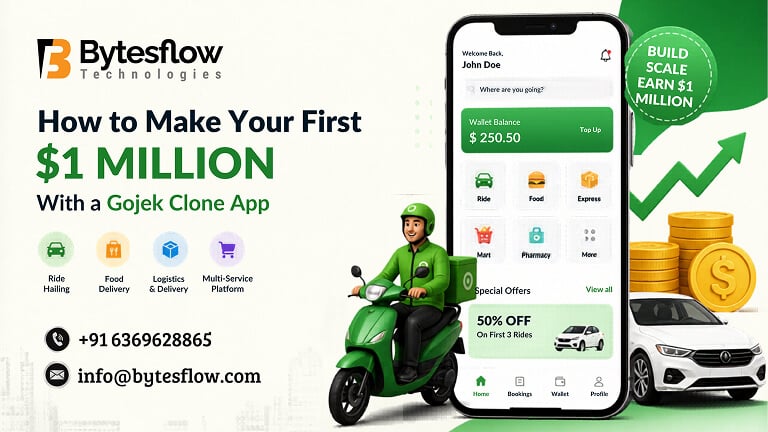
How to Make Your First $1 Million With a Gojek Clone App
💡 Quick Takeaway The global super app market is projected to exceed $722 billion by 2032. Entrepreneurs who launch now with the right model are positioned to claim massive market share. |
Gojek turned a motorbike ride-hailing service into a $10 billion empire. It now powers food delivery, payments, grocery shopping, cleaning services, and more, all from a single app. And the blueprint? It is completely replicable.
If you have been wondering whether a Gojek clone app can make you a millionaire, the answer is yes, but only if you follow the right roadmap. This guide breaks down exactly how.
1. Understand the Super App Business Model First
Before chasing revenue, you need to understand what makes a super app tick. Unlike single-service apps, this clone generates income from multiple streams simultaneously. Think of it as owning an entire marketplace rather than a single store.
A Gojek clone typically bundles:
- Ride-hailing (bikes, cars, taxis)
- Food and grocery delivery
- Courier and parcel delivery
- Digital payments and wallet
- Home services (cleaning, plumbing, beauty)
- Telemedicine or on-demand services
🔑 Key Insight Each service you add is a new income stream. The more services, the higher daily app usage which directly translates to revenue. |
2. Choose the Right Market to Launch In
Your market selection is arguably the single biggest lever on your path to $1 million. Here is what separates a $10K/month app from a $100K/month one:
Market | Opportunity | Competition Level | Avg. Commission Rate |
|---|---|---|---|
Southeast Asia | Very High | High | 15–25% |
Africa | High | Low | 20–30% |
Middle East | High | Medium | 18–28% |
Latin America | Medium-High | Low-Medium | 20–25% |
South Asia | Very High | Medium | 15–20% |
Low-competition markets with high smartphone penetration and a young population are gold mines for a Gojek clone launch in 2026.
3. The 6 Revenue Streams That Will Make You a Millionaire
This is where the $1 million math actually happens. Here are the six core monetization pillars:
Stream 1: Commission Per Transaction
Every ride, delivery, or service booked through your app earns you a commission. Industry standard ranges from 15% to 30% per transaction.
💰 Example 10,000 daily orders × $8 avg. order value × 20% commission = $16,000/day = $480,000/month |
Stream 2: Surge Pricing Revenue
During peak hours, your platform automatically increases prices. You earn a higher commission on every surge-priced transaction at no extra cost to you.
Stream 3: Subscription Plans for Drivers and Vendors
Charge service providers a monthly subscription for premium access featured listings, more leads, analytics dashboards, and priority support. Even at $20/month with 5,000 active providers, that is $100,000/month in pure recurring revenue.
Stream 4: In-App Advertising
Local restaurants, shops, and brands will pay to advertise inside your app. Banner ads, sponsored listings, and push notification campaigns are all high-margin revenue sources once you reach scale.
Stream 5: Digital Wallet and Payment Fees
Build a digital wallet into your Gojek clone. Charge micro-fees on wallet top-ups, transfers, and payments. At scale, even a 0.5% transaction fee adds up to significant monthly revenue.
Stream 6: White-Label and Franchise Model
Once your platform is proven, license your technology to other entrepreneurs in different cities or regions. This is a completely passive income stream that requires zero operational effort on your part.
4. Revenue Milestone Roadmap to $1 Million
Month | Active Users | Daily Orders | Monthly Revenue | Cumulative |
|---|---|---|---|---|
1–3 | 500–2,000 | 200–800 | $8K–$30K | $30K |
4–6 | 5,000–15,000 | 2,000–5,000 | $60K–$150K | $180K |
7–9 | 20,000–50,000 | 8,000–15,000 | $200K–$400K | $650K |
10–12 | 80,000+ | 25,000+ | $500K–$700K | $1M+ |
These numbers assume aggressive but realistic growth in a mid-sized emerging market with strong marketing and referral programs.
5. How to Reach $1M Faster: 5 Growth Hacks
- Launch with a referral program offer free rides or discounts for every friend a user invites.
- Partner with local businesses at launch restaurants, grocery stores, and service providers who bring their own customer base.
- Focus on one city first dominate it completely before expanding. Geographic density = more orders per driver = more revenue.
- Run loss-leader promotions in month one subsidise rides or deliveries to build habits. Retention pays back within 3 months.
- Build a driver loyalty program happy, retained drivers = better service = more 5-star reviews = more organic growth.
6. How Much Does It Cost to Build a Gojek Clone?
The investment required depends heavily on your build approach:
Build Type | Cost Range | Time to Launch | Best For |
|---|---|---|---|
White Label Clone | $5K–$25K | 2–4 weeks | Fast market entry |
Custom Development | $80K–$250K | 6–12 months | Unique market needs |
MVP Build | $25K–$60K | 2–4 months | Lean startups |
💡 Pro Tip Start with a white-label clone to enter the market fast, validate your model, and begin earning revenue. Then reinvest profits into custom features and scaling. |
7. Legal, Compliance, and Operational Essentials
To build a sustainable million-dollar business, you need the right foundation:
- Register your business entity in your target country
- Obtain on-demand transportation and delivery licenses
- Comply with GDPR or local data privacy regulations
- Set up driver background check processes
- Establish clear terms of service and dispute resolution
- Open a local business bank account for payment processing
8. The $1 Million Mindset: What Most Entrepreneurs Miss
Technology is only 30% of the equation. The other 70% is execution how fast you move, how well you retain users, and how aggressively you expand.
The entrepreneurs who reach $1 million in their first year with a Gojek clone share three traits:
- They launch imperfect and iterate fast
- They obsess over driver and customer retention, not just acquisition
- They build multiple revenue streams from day one, not later
🚀 Final Word A Gojek clone is not just an app it is a platform business. Platforms that connect supply and demand print money at scale. Your job is to reach that scale as fast as possible. |
Conclusion
Making your first $1 million with a Gojek clone app is not a fantasy it is a formula. Choose the right market. Build multiple revenue streams. Launch fast. Grow aggressively. And never stop iterating.
The super app economy is still wide open in dozens of markets around the world. The entrepreneurs who move now will be the ones writing their own $1 million stories a year from today.
📞 Ready to Launch Your Super App with Bytesflow! Get a free demo of our white-label Gojek clone solution and see how fast you can go from idea to income. |
Frequently Asked Questions
Q1: How much can I earn with a Gojek clone app?
Earnings depend on your market, active users, and number of services. Entrepreneurs in emerging markets report $50,000 to $500,000 per month at scale with 20,000+ active users.
Q2: How long does it take to reach $1 million with a Gojek clone?
With the right market, aggressive marketing, and multiple revenue streams activated, most operators reach $1 million in cumulative revenue within 10 to 14 months of launch.
Q3: What is the best country to launch a Gojek clone in 2026?
Nigeria, Indonesia, Bangladesh, Kenya, and Saudi Arabia are among the highest-opportunity markets in 2026 due to large young populations and rapidly growing smartphone adoption.
Q4: Do I need to build the app from scratch?
No. A white-label clone solution lets you launch in 2 to 4 weeks at a fraction of the cost of custom development, with all core features already built and tested.
Q5: What is the commission rate for a Gojek clone app?
Most super app operators charge between 15% and 30% commission per transaction depending on the service category and local market conditions.