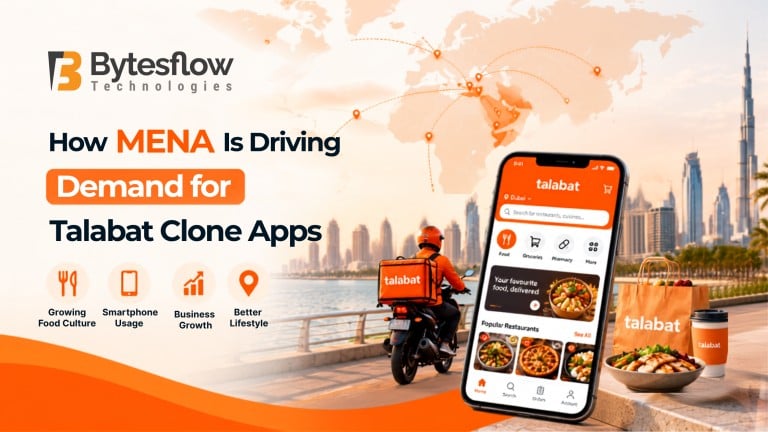
How MENA Is Driving Demand for Talabat Clone Apps
Published: September 08, 2026 | Category: Startup Guide | Read time: ~10 min
Introduction
The MENA region has quietly become one of the busiest food delivery markets in the world. Consumers order more often, restaurants push harder into digital channels, and investors keep funding new platforms. Naturally, this shift has pushed demand for a Talabat clone to new highs. Entrepreneurs across the Gulf and North Africa now see on-demand delivery as a proven, low-risk way to enter a growing market.
This blog breaks down exactly why that’s happening, backed by real numbers, and how you can act on it.
What Is a Talabat Clone?
A Talabat clone app is a ready-built food delivery platform modeled on Talabat’s core structure: customer app, restaurant/vendor panel, delivery rider app, and admin dashboard. Instead of building from zero, founders use a Talabat clone script as a foundation, then customize branding, payment gateways, and features for their target city or country. It shortens development time significantly while still allowing full flexibility over design and functionality. If you want a full breakdown of what to include, check out our guide on must-have features for a Talabat clone.
Why Is Demand for Talabat Clone Apps Growing in MENA?
Several forces are converging at once, and together they explain the surge clearly.
- E-commerce is scaling fast. MENA’s total e-commerce market reached $37 billion in 2022 and is projected to surpass $57 billion by 2026, growing at an 11% CAGR.
- Delivery is replacing dine-in habits. In the UAE, delivery orders rose 15.2% year-on-year in the first half of 2026, now accounting for over 30% of all restaurant orders.
- Smartphone and internet penetration keeps climbing, especially among younger, urban populations who default to apps for daily needs.
- Government-backed digital initiatives across the UAE, Saudi Arabia, and Egypt are actively supporting fintech and logistics infrastructure.
Consequently, launching an on-demand food delivery app clone today taps directly into consumer behavior that’s already shifting toward digital-first ordering.
Is MENA a Good Market for Launching a Talabat Clone App?
Yes, and the data supports it strongly. The UAE’s online food delivery market alone is projected to hit $10.86 billion in 2026, expanding to $22.19 billion by 2034. Meanwhile, Saudi Arabia’s food services sector is forecast to reach $26.54 billion, fueled by rising disposable income and urbanization. Therefore, a Talabat clone app entering now avoids the “early market” risk while still capturing strong growth ahead.
Which MENA Countries Have the Highest Demand for Food Delivery Apps?
Country | Key Growth Driver | Market Signal |
UAE | High smartphone penetration, dark stores | $10.86B market in 2026 |
Saudi Arabia | Young population, urban expansion | $26.54B food services by 2026 |
Egypt | Large population base, rising digital payments | Strong e-commerce penetration growth |
Qatar & Bahrain | High disposable income, dense urban centers | Fast-growing delivery adoption |
As the table shows, no single country dominates. Instead, demand is spreading across the region, which gives founders multiple viable launch markets rather than just one.
How Can a Talabat Clone App Meet the Needs of MENA Customers?
MENA users expect more than a generic delivery experience. A well-built food ordering script should therefore include:
- Arabic and English language support, with RTL (right-to-left) interface handling
- Multiple payment options, including cash on delivery, cards, and mobile wallets
- Real-time order tracking for transparency
- Ramadan and prayer-time scheduling features, since ordering patterns shift seasonally
- Multi-vendor support so restaurants, groceries, and pharmacies can operate on one platform
Additionally, localization matters as much as functionality. A clone that simply copies Talabat’s UI without adapting to regional habits will struggle to retain users.
What Makes the MENA Food Delivery Market Attractive to Startups?
Beyond raw market size, several structural advantages make MENA appealing. Investment capital is flowing steadily into regional delivery and logistics startups. Government policy actively favors digital transformation, reducing regulatory friction compared to other emerging markets. Furthermore, consumer trust in food delivery apps is already established thanks to major players like Talabat, HungerStation, and Careem, meaning new entrants don’t need to educate the market from scratch, only differentiate within it.
Conclusion
MENA’s rapidly evolving digital economy, growing preference for on-demand services, and increasing adoption of food delivery platforms are creating new opportunities for entrepreneurs and startups. For businesses looking to enter this market, a Talabat clone app can provide a practical foundation for launching a scalable food delivery platform tailored to regional customer needs.
Success, however, depends on more than replicating an existing platform. Localizing the experience, understanding customer expectations, supporting regional payment preferences, and building an efficient delivery ecosystem can help businesses establish a stronger presence across MENA markets.
Explore the Bytesflow Talabat clone script with a live demo or get a free consultation to discuss your requirements, target market, and launch strategy.
Frequently Asked Questions
1. Why is demand for Talabat clone apps growing in MENA?
Demand is rising because MENA’s e-commerce market is expanding fast, projected to hit $57 billion by 2026. Combined with rising smartphone use and a shift away from dine-in, consumers increasingly prefer app-based food ordering, making now an ideal time to launch a Talabat clone app.
2. Is MENA a good market for launching a Talabat clone app?
Yes. The UAE’s online food delivery market alone is projected to reach $10.86 billion in 2026, while Saudi Arabia’s food services sector is set to hit $26.54 billion. These figures show strong, sustained demand across multiple countries, not just one hub.
3. Which MENA countries have the highest demand for food delivery apps?
The UAE, Saudi Arabia, and Egypt lead demand, driven by high smartphone penetration, urban population growth, and digital payment adoption. Qatar and Bahrain also show fast-growing adoption due to high disposable income and dense urban centers.
4. How can a Talabat clone app meet the needs of MENA customers?
It should support Arabic and English with RTL layouts, multiple payment methods including cash on delivery, real-time tracking, and multi-vendor capability. Localization for cultural habits, like Ramadan ordering patterns, is equally important for user retention.
5. What makes the MENA food delivery market attractive to startups?
Strong investment flow, supportive government policy, and established consumer trust in delivery apps make MENA attractive. Startups don’t need to build market awareness from scratch since major players have already normalized app-based food ordering across the region.
6. Why should startups choose Bytesflow’s Talabat clone script for the MENA market?
Bytesflow’s Talabat clone script is built with MENA-specific needs in mind, including localization, multiple payment gateways, and scalable multi-vendor architecture. It helps startups launch faster with a proven structure while keeping full flexibility over branding and features.