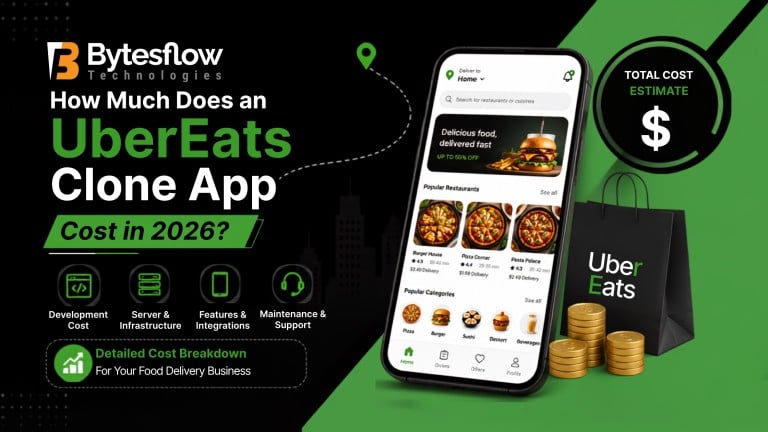
How Much Does an UberEats Clone App Cost in 2026?
Published: July 28, 2026 | Category: Pricing Guide | Read time: ~10 min
Introduction
If you are planning to enter the food delivery space, the first question you will ask is simple: what does an UberEats clone actually cost to build? The honest answer is, it depends. However, once you understand the moving parts, you can budget with confidence instead of guessing.
The global online food delivery market is projected to touch USD 355.6 billion in 2026, and that number keeps climbing every year. Uber Eats alone remains one of the highest-revenue apps in the category worldwide. So entrepreneurs are not wrong to want in. But before you sign a contract with any vendor, you need clarity on pricing, features, and hidden costs. That is exactly what this guide covers.
What Is an UberEats Clone App?
An UberEats clone is a ready-made or customizable food ordering platform that mirrors Uber Eats’ core workflow: customers order, restaurants prepare, delivery partners deliver. Instead of building from zero, businesses use a pre-built UberEats clone script and adapt it to their brand, region, and business model.
Quick facts:
- It typically includes four modules: customer app, restaurant panel, delivery partner app, and admin dashboard.
- It functions as an on-demand food delivery app clone, meaning the logic (real-time tracking, order routing, payments) is already built and tested.
- It can be white-labeled, so you launch under your own brand name.
Key Factors That Affect the Cost of an UberEats Clone
Not every UberEats clone costs the same. Several variables push the price up or down:
- Development approach – ready-made script vs fully custom build
- Platform coverage – Android only, iOS only, or both
- Number of panels – customer, restaurant, delivery, admin
- Feature depth – live tracking, in-app chat, scheduled orders, loyalty programs
- Third-party integrations – payment gateways, SMS/OTP, maps, push notifications
- Design complexity – template-based UI vs fully custom UI/UX
- Post-launch support – bug fixes, updates, and scaling assistance
Consequently, two businesses asking for “the same app” can receive very different quotes, simply because their scope differs. If you want a side-by-side sense of how these factors play out for a similar platform, our breakdown of the real cost of building a Wolt clone app in 2026 walks through the same variables in detail.
UberEats Clone App Cost Breakdown by Development Type
Development Type | Estimated Cost Range | Typical Timeline | Best For |
Ready-made script (white-label) | $2,500 – $8,000 | 1–3 weeks | Startups wanting a fast, budget-friendly launch |
Semi-customized script | $8,000 – $20,000 | 4–8 weeks | Businesses needing branding + select custom features |
Fully custom development | $25,000 – $80,000+ | 4–9 months | Enterprises building a unique, large-scale platform |
Note: these figures are indicative industry ranges and will vary by vendor, region, and feature list.
Feature-Wise Cost Estimates
Feature | Approximate Additional Cost |
Real-time GPS tracking | $500 – $1,500 |
Multiple payment gateway integration | $400 – $1,200 |
In-app chat/call support | $600 – $1,800 |
AI-based recommendation engine | $1,500 – $4,000 |
Multi-language and multi-currency support | $700 – $2,000 |
Loyalty and referral programs | $500 – $1,500 |
Ready-Made Script vs Custom Build: Which Saves More?
Choosing a food ordering script over ground-up development is usually the smarter first move for new entrepreneurs. Here’s why:
- Faster time-to-market – launch in weeks, not months
- Lower upfront investment – test the market before committing large capital
- Proven architecture – fewer bugs since the core is already battle-tested
- Easier scaling – most scripts are built to add features as you grow
On the other hand, fully custom development makes sense once you have validated demand and need a highly differentiated platform. Many founders start with a script-based UberEats clone and migrate to custom modules later as revenue grows. This white-label-first approach is also why platforms like Foodora built their fast business launch around a ready-made script rather than custom code from day one.
Whichever route you choose, avoid the common missteps that derail budgets and timelines. Our post on DoorDash clone startup mistakes to avoid in 2026 covers pitfalls that apply just as much to an UberEats clone launch.
Hidden Costs to Watch For
Before you finalize a vendor, ask about these often-overlooked expenses:
- App store listing and annual developer account fees
- Server and cloud hosting costs as order volume grows
- Payment gateway transaction fees
- Ongoing maintenance and security patching
- Marketing and restaurant onboarding costs
If a quote seems unusually low, these are the line items to double-check. For a full walkthrough of pricing plus launch planning for a comparable platform, see our Talabat clone app cost and business launch guide for 2026.
Conclusion
Building an UberEats clone in 2026 does not have to mean a six-figure investment or a guessing game on pricing. Once you understand the cost drivers, from development approach to third-party integrations, you can choose a path that matches your budget and growth stage. Whether you start lean with a ready-made script or invest in a fully custom platform, the right partner makes all the difference between a rushed launch and a scalable business.
Curious what your version could look like?
View a free demo of our food delivery platform, or get a free consultation with our team to plan your UberEats clone launch, no pressure, just clarity on your next step.
Frequently Asked Questions
1. What is the minimum budget to launch an UberEats clone?
A ready-made, white-label script can start around $2,500 to $8,000, depending on the platforms and features you choose.
2. Is a ready-made UberEats clone script legal to use?
Yes. A clone script is original software built to replicate app functionality, not Uber’s code or branding, so it is legal to use under your own brand.
3. How long does it take to launch an on-demand food delivery app clone?
A ready-made script can go live in 1 to 3 weeks; a fully custom build typically takes 4 to 9 months.
4. Does the cost include delivery partner and restaurant apps?
A complete package should include all four components: customer app, restaurant panel, delivery app, and admin dashboard. Always confirm this before signing.
5. Can I upgrade my UberEats clone later with more features?
Yes. Most script-based platforms, including Bytesflow’s, are modular, so you can add features like AI recommendations or loyalty programs as your business scales.