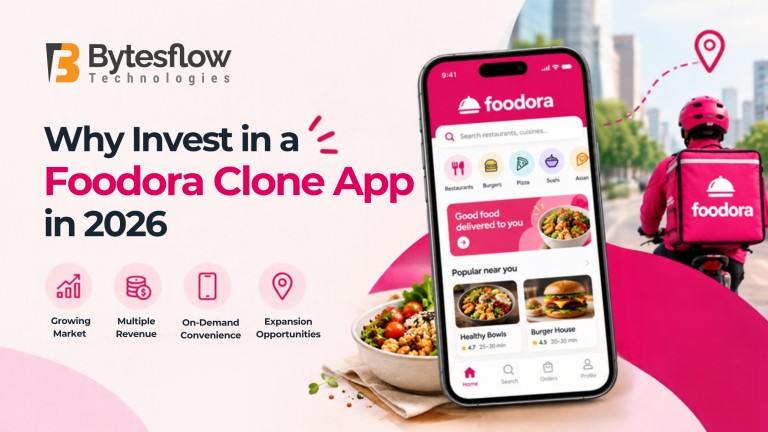
Why Invest in a Foodora Clone App in 2026
Published: September 22, 2026 | Category: Startup Guide | Read time: ~10 min
Introduction
Food delivery isn’t slowing down. If anything, it’s maturing into one of the most dependable digital business models out there, and that’s exactly why more entrepreneurs are looking at a Foodora clone as their entry point rather than building from zero. Below, we break down the real business case, the numbers behind it, and what to check before you commit to a partner.
What Is a Foodora Clone App?
A Foodora clone app is a ready-built, rebrandable version of the Foodora platform, covering four core panels: customer ordering, restaurant management, delivery riders, and admin control. Instead of hiring a dev team and starting from scratch, you get a tested foundation and simply configure it to match your brand, region, and pricing model.
Why the Market Still Has Room to Grow
The numbers back the opportunity. According to The Business Research Company, the online food delivery services market is set to grow from $177.9 billion in 2025 to $198.99 billion in 2026, at a CAGR of 11.9%. Meanwhile, DoorDash’s own market research projects the global market to reach $1.79 trillion by 2030. That’s sustained, structural growth, not a short-term spike.
Key Business Benefits of a Foodora Clone
This is where the case for a Foodora clone gets concrete:
- Faster time to market – go live in weeks instead of a year-long build cycle. A white label Foodora clone app is built specifically for this, letting you launch a fully branded platform without touching a single line of code.
- Lower upfront investment – no need to fund a full engineering team from day one
- Proven, stable architecture – fewer bugs, fewer post-launch surprises
- Full brand control – your name, your colors, your rules
- Built-in scalability – the platform grows as your order volume does
Additionally, because the core codebase already exists, your team spends its time on strategy and customer acquisition rather than debugging.
Custom Build vs Foodora Clone Script: A Quick Comparison
Factor | Custom Build | Foodora Clone Script |
Development time | 8–12 months | 2–6 weeks |
Upfront cost | High | Moderate |
Risk level | Higher (untested code) | Lower (proven base) |
Customization | Fully flexible | Deeply configurable |
Time to revenue | Slow | Fast |
Revenue Streams You Can Unlock
A Foodora clone script isn’t just about ordering – it’s a monetization engine:
- Commission per order from restaurant partners
- Delivery and service fees
- Surge pricing during peak hours
- Featured restaurant listings and in-app ads
- Subscription plans for repeat customers
Clone vs Building From Scratch
Compared to a fully custom on-demand food delivery app clone built line by line, a pre-built solution removes the guesswork. You’re not testing an unproven UX or discovering scalability issues after launch – that groundwork is already done. However, this doesn’t mean you’re stuck with a generic product; a solid provider still lets you shape delivery zones, payment gateways, and commission logic around your specific market.
Is It the Right Fit for Your Market?
Consider a Foodora clone if:
- Your target city has rising delivery demand but limited local competition
- Local restaurants lack their own delivery infrastructure
- You want a working MVP to show investors quickly
- Consumers in your region already trust app-based ordering
Choosing the Right Development Partner
Not every food ordering script provider delivers the same quality. Before signing on, check for:
- A live, testable demo
- Full source code ownership after handover
- Post-launch support and updates
- App store submission help
- A visible track record of similar builds
These standards matter more than the sales pitch. A good way to judge them in practice is to look at a live Foodora Clone app platform, compare it against a dedicated food ordering script, or check how it holds up against an all-in-one delivery script if you’re weighing broader use cases.
Final Thoughts
Investing in a Foodora clone script in 2026 can provide a practical way to establish your presence in the growing online food delivery market. With a scalable platform, customizable solutions, and support for restaurants, customers, and delivery partners, you can build a food delivery business aligned with your target market and growth plans.
Ready to launch your own food delivery platform?
View the live demo of our Foodora clone app to explore its functionality and user experience. Have questions about customization, business models, or launching in your target market? Get a free consultation with our experts and discover how Bytesflow Technologies can help you launch your Foodora clone app.
Frequently Asked Questions
1. Why should businesses invest in a Foodora clone app in 2026?
Because the food delivery market is projected to keep growing well past $198 billion in 2026, per The Business Research Company. Investing in a Foodora clone app lets businesses capture this demand quickly, with a proven platform instead of a risky, slow custom build.
2. What are the main benefits of investing in a Foodora clone app?
The main benefits are faster launch time, lower development cost, tested architecture, full branding control, and built-in scalability. Businesses skip months of coding and testing, going live with a stable, revenue-ready platform in weeks rather than a year.
3. Is a Foodora clone app a good option for starting a food delivery business?
Yes. It’s especially strong for first-time founders since it removes technical risk and shortens time to market. You still get full control over branding, pricing, and delivery zones, making it a practical entry point rather than a generic, limited product.
4. How does a Foodora clone app help generate revenue?
It supports multiple built-in revenue streams: order commissions, delivery fees, surge pricing, featured listings, and subscription plans. This flexibility lets businesses test different pricing models early without needing to rebuild the platform from scratch.
5. How much does it cost to launch a Foodora clone app?
Costs vary by customization level, region, and feature set, typically landing in a moderate range compared to custom development. It’s significantly cheaper than building from zero since the core platform, testing, and architecture are already complete.
6. How can I choose the right Foodora clone app development company?
Look for a provider offering a live demo, full source code ownership, post-launch support, and a proven portfolio. Bytesflow meets all of these, giving businesses a testable platform, transparent pricing, and dedicated support from launch through scaling.