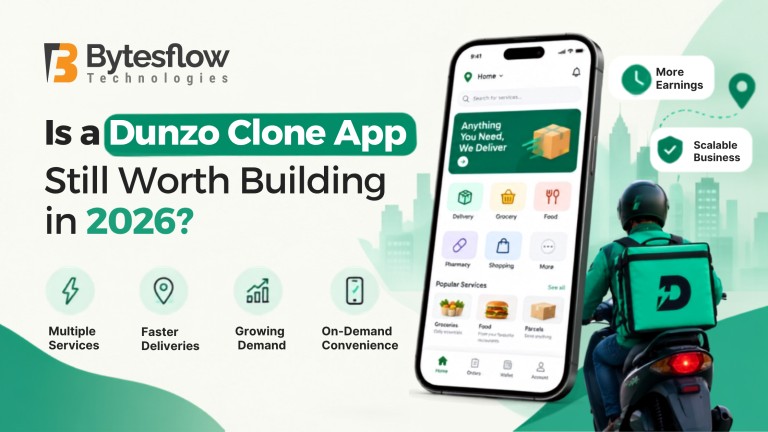
Is a Dunzo Clone App Still Worth Building in 2026?
Published: September 18, 2026 | Category: Startup Guide | Read time: ~10 min
Introduction
Dunzo shut down its app and website in January 2025, closing the chapter on one of India’s most recognisable hyperlocal delivery brands. As Rest of World reported, the shutdown left hundreds of vendors, employees, and delivery workers unpaid, following years of mismanagement and fierce competition. Naturally, that raises a fair question for founders still searching for a Dunzo clone: does the idea still hold up?
The short answer is yes, and here’s why. “Dunzo clone” was never really about the Dunzo brand itself. It’s shorthand for a proven, all-in-one hyperlocal delivery model, and that model is thriving even though the original company isn’t.
Why the Dunzo Clone Model Still Works in 2026
Consumer demand for instant, multi-category delivery hasn’t slowed down; if anything, it’s accelerated. According to Bain & Company’s 2026 India e-retail report, quick commerce in India has doubled annually over the past two years and is projected to reach $65 to $70 billion by 2030, contributing nearly half of incremental e-retail growth in the country.
That growth isn’t confined to one player. It’s spread across grocery, pharmacy, parcel, and errand-based delivery – exactly the multi-service format a Dunzo clone app was built to serve. So while the brand disappeared, the gap it left behind is now up for grabs.
A few reasons entrepreneurs are still moving on this:
- Proven demand, zero guesswork: The model already had product market fit for years before Dunzo’s exit.
- Faster go-to-market: A ready Dunzo clone script cuts development time from months to weeks.
- Lower entry cost: No need to fund years of R&D that the original company already did.
- Open market share: Fewer big multi-service players now compete for the same demand.
What Services Can a Dunzo Clone App Include in 2026
Modern buyers expect more than a single delivery category. A well-built on-demand all-in-one delivery app clone typically bundles several verticals into one platform:
Service Category | Customer Use Case |
Grocery & essentials | Same-day household restocking |
Food delivery | Restaurant orders, meal kits |
Pharmacy | Prescription and OTC delivery |
Parcel & courier | Document and package pickup drop |
Personal errands | Store pickup, gifting, returns |
Consequently, the platform becomes a daily-use utility rather than an occasional app, which improves retention.
Dunzo Clone Script vs Building From Scratch
Before committing, it helps to compare the two paths side by side. If you’re weighing this decision in more detail, guide on choosing the best all-in-one delivery script breaks down what to look for.
Factor | Dunzo Clone Script | Custom Build From Scratch |
Time to launch | 4 to 8 weeks | 6 to 12 months |
Development cost | Lower, fixed scope | Higher, variable scope |
Business model | Pre-validated | Needs testing |
Customisation | Moderate to high | Full |
Risk | Lower | Higher |
For most first-time founders, a Dunzo clone script offers a faster, lower-risk way to test the market before investing in deep customisation.
How a Dunzo Clone App Makes Money
Revenue in this model rarely relies on a single stream. Instead, successful platforms usually combine:
- Delivery fees charged per order or distance slab
- Commission from partner stores and restaurants
- Subscription plans for frequent users (free or discounted delivery)
- Surge pricing during peak demand hours
- In-app advertising from local vendors
This layered approach keeps the business resilient even if one revenue stream slows down.
What Makes a Dunzo Clone App Stand Out Today
Simply cloning the original feature set isn’t enough anymore. To compete in 2026, an all-in-one delivery script needs to go further with:
- Real-time GPS tracking and live rider ETAs
- AI-based route and dispatch optimisation
- Multi-payment support, including UPI and wallets
- Vendor and rider dashboards for self-service management
- Scalable architecture for tier 2 and tier 3 city expansion
Platforms that combine speed with reliability, rather than speed alone, are the ones capturing repeat customers.
Final Thoughts
The shutdown of the original Dunzo app does not eliminate the opportunity to build a modern Dunzo clone. With growing demand for hyperlocal, multi-service delivery, entrepreneurs can create a customized platform that connects customers, local businesses, and delivery partners through a single solution.
If you’re planning to launch your own Dunzo clone app in 2026, Bytesflow can help you turn the concept into a scalable delivery platform tailored to your target market.
Ready to launch your Dunzo clone?
View a live demo and get a free consultation from Bytesflow today.
Frequently Asked Questions
1. Is a Dunzo clone app still worth building in 2026?
Yes. Although Dunzo shut down in January 2025, demand for hyperlocal, all-in-one delivery apps has grown steadily. Entrepreneurs are still launching Dunzo clone apps because the underlying business model, multi-category delivery under one platform, remains highly profitable and in demand across grocery, pharmacy, and parcel services.
2. Can I build a Dunzo clone app even though the original Dunzo app has shut down?
Absolutely. A Dunzo clone app doesn’t depend on the original brand existing. It replicates a proven business model and feature set, not the company itself. You can fully customise branding, services, and monetisation to build an independent, competitive delivery platform under your own name.
3. What services can be included in a Dunzo clone app in 2026?
A modern Dunzo clone app can include grocery delivery, food ordering, pharmacy delivery, parcel and courier services, and personal errand requests. Bundling multiple categories into one app increases daily usage and customer retention compared to single-service delivery platforms.
4. How does a Dunzo clone app make money?
Dunzo clone apps typically earn through delivery fees, vendor commissions, subscription plans, surge pricing during peak hours, and in-app advertising. Combining multiple revenue streams reduces dependency on any single source and helps the business stay profitable even during demand fluctuations.
5. How can a Dunzo clone app stand out from other hyperlocal delivery apps?
Standing out requires more than basic cloning. Real-time GPS tracking, AI-based dispatch, multi-payment support, and vendor self-service dashboards help a Dunzo clone app deliver faster and more reliably. Expanding into underserved tier 2 and tier 3 cities also creates a strong competitive edge.
6. Why should I choose a Dunzo clone script from Bytesflow for my delivery business?
Bytesflow offers a fully customisable, white-label Dunzo clone script with a ready user app, rider app, and admin panel. This reduces development time from months to weeks, lowers upfront costs, and gives you a proven, scalable foundation to launch your delivery business quickly.