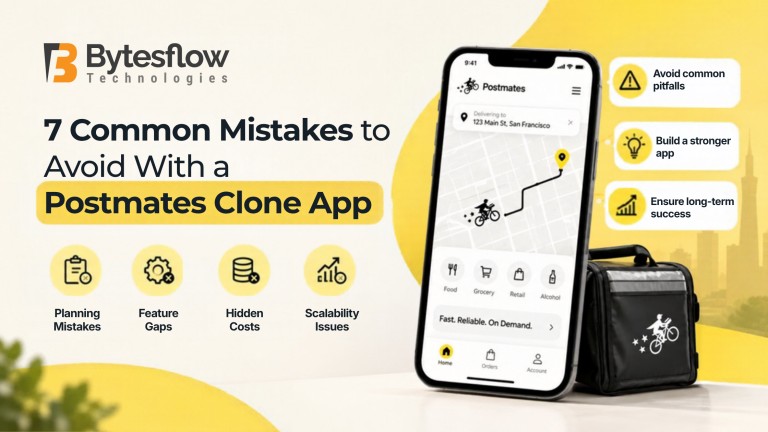
7 Common Mistakes to Avoid With a Postmates Clone App
Published: September 21, 2026 | Category: Startup Guide | Read time: ~10 min
Introduction
Launching a Postmates Clone app looks simple on paper, but many first-time founders lose months and budget on decisions that are entirely avoidable. Whether you’re building a single-city food app or scaling into a full on-demand all-in-one delivery app clone, small missteps early on tend to snowball once real users, vendors, and drivers enter the picture. Below are the seven mistakes we see most often, and how to sidestep each one.
Why Postmates Clone Launches Often Struggle
Most failures don’t come from bad ideas. Instead, they come from rushed execution. CB Insights’ research on the top reasons startups fail consistently points to weak market validation and poor planning, and delivery startups are no exception.
Mistake | Impact | Quick Fix |
Skipping market research | Wrong city, wrong niche | Validate demand before development |
Picking a weak script | Rebuilds, wasted budget | Compare depth, not just price |
Staying single-vertical | Limited growth ceiling | Choose an all-in-one delivery script |
Weak payment setup | Failed transactions | Use a PCI-compliant, multi-gateway system |
Poor driver experience | High attrition | Add route optimization and clear payouts |
Ignoring store guidelines | App rejection or removal | Follow Apple and Google policies early |
No launch marketing plan | Low downloads, no repeat use | Budget for ASO, referrals, local ads |
Founders who go single-vertical here often revisit this decision within six months, once demand for groceries or parcels shows up. Starting with an all-in-one delivery script avoids that rebuild entirely.
The 7 Mistakes, Explained
1. Skipping Market Research
- Launching without validating local demand or competitor density
- Assuming what worked in one city automatically works in another
2. Choosing a Postmates Clone Script Without Comparing Features
- Picking the cheapest option instead of checking scalability, source code ownership, and update support
- Not testing the admin panel before committing
3. Building Single-Vertical Instead of Multi-Service
- Locking into food-only when customers increasingly expect groceries, pharmacy, and parcel delivery in one app
- Missing the chance to become a true multi-category delivery platform from day one. If you’re weighing this decision, our guide on how to build a multi-service delivery app using a Postmates Clone breaks down exactly how to scope it
4. Underestimating Payment Compliance
- Integrating a single payment gateway with no fallback
- Ignoring regional tax, refund, and payout regulations
5. Neglecting the Driver Experience
- No route optimization, leading to late deliveries
- Unclear or delayed earnings, which drives up driver churn
6. Ignoring App Store and Play Store Guidelines
- Submitting without reviewing Apple’s App Store Review Guidelines or Google Play’s Developer Content Policy
- Getting rejected or pulled post-launch over avoidable policy gaps
7. Forgetting a Post-Launch Growth Plan
- Treating launch day as the finish line rather than the starting point
- No budget set aside for ASO, referral programs, or local promotions
What a Well-Planned Launch Looks Like Instead
Founders who avoid these pitfalls tend to follow a similar pattern before going live:
- Validate first, build second – talk to 20 to 30 potential vendors and riders in your target city before locking the feature list
- Budget for compliance, not just design – payment gateway approval and app store review can each take 1 to 3 weeks
- Plan the driver economics early – payout structure and route logic affect retention more than app polish does
- Set aside 10 to 15 percent of the build budget for post-launch marketing, since downloads rarely happen on their own
Treating these as pre-launch checklist items, rather than afterthoughts, is usually the difference between a platform that scales and one that stalls in its first quarter.
Conclusion
Launching a Postmates clone app requires more than replicating delivery features. Avoiding common mistakes in planning, customization, user experience, security, scalability, and testing can help create a reliable platform that meets your business requirements and customer expectations. With the right development approach, you can build a delivery solution that is prepared for long-term growth.
Ready to launch your own Postmates clone app?
View our live demo to explore the platform or get a free consultation with Bytesflow Technologies to discuss your requirements and launch your delivery business.
Frequently Asked Questions
1. What is a Postmates Clone app?
A Postmates Clone app is a ready-made delivery platform modeled on Postmates, letting entrepreneurs launch a multi-category delivery business without building from scratch. It typically includes customer, vendor, driver, and admin apps, customizable for food, grocery, pharmacy, or parcel delivery.
2. How much does a Postmates Clone app cost?
Costs vary based on features, customization depth, and platforms. A basic white-label build starts lower, while a fully custom, multi-vertical app costs more. A free consultation gives you an accurate estimate based on your specific business needs.
3. Can a Postmates Clone support multiple delivery categories?
Yes. A well-built Postmates Clone script can be configured as an all-in-one delivery script covering food, groceries, pharmacy, and parcels within one app, letting you serve multiple customer needs and revenue streams from a single platform.
4. How long does it take to launch a Postmates Clone app?
With a pre-built script, most Postmates Clone apps launch in 4 to 8 weeks, depending on customization requirements. Fully custom builds take longer since they involve additional design, testing, and integration work before going live.
5. What features are essential in a Postmates Clone app?
Core features include real-time order tracking, multiple payment gateways, in-app chat, ratings, and route optimization for drivers. Admin analytics and vendor management tools are also essential for smooth day-to-day operations at scale.
6. Is building a Postmates Clone still profitable in 2026?
Yes, the on-demand delivery market continues expanding across food, grocery, and parcel categories. Profitability depends on execution: choosing the right script, avoiding common launch mistakes, and having a solid post-launch marketing and retention strategy in place.