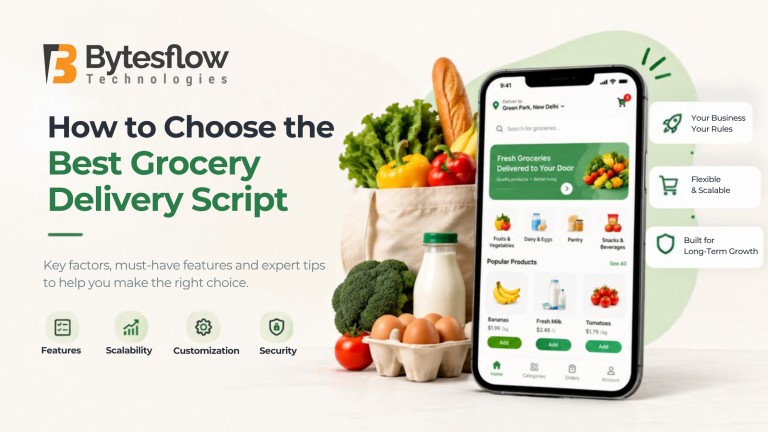
How to Choose the Best Grocery Delivery Script
Published: September 26, 2026 | Category: Startup Guide | Read time: ~10 min
Introduction
Choosing the right grocery delivery script decides how fast you launch, how much you spend, and how well your platform performs once real customers start ordering. With dozens of vendors in the market, picking the wrong one can cost you months and thousands of dollars in rework. This guide breaks down exactly what to evaluate before you commit.
What Is a Grocery Delivery Script
A grocery delivery script is ready-made software that lets you launch an online grocery ordering and delivery platform without building everything from scratch. It typically includes a customer app, a merchant panel, a driver app, and an admin dashboard, so you can go live in weeks instead of months. If you’re new to the concept, this detailed breakdown of what a grocery delivery script includes covers the fundamentals before you start comparing vendors. The global online grocery market continues to expand rapidly, according to IMARC Group’s market analysis, which makes now a practical time to launch.
Key Factors to Evaluate Before You Buy
Not every delivery platform fits every business model. Use these factors to compare vendors properly.
- Scalability: Can the platform handle growth from one city to multiple regions?
- Customization depth: Does the vendor allow branding, workflow, and feature changes, or only color tweaks?
- Source code ownership: Will you own the code outright, or are you locked into a subscription?
- Integration support: Does it connect with payment gateways, SMS, and inventory tools?
- Post-launch support: Is there a dedicated team for bug fixes and updates?
Additionally, check how the vendor handles multi-store management, since most grocery businesses eventually work with several store partners rather than one.
Must-Have Features Checklist
Feature | Why It Matters |
Real-time order tracking | Builds customer trust and reduces support tickets |
Multi-store or multi-vendor support | Lets you onboard several grocery stores under one platform |
Smart inventory sync | Prevents customers from ordering out-of-stock items |
Scheduled delivery slots | Improves driver efficiency and customer convenience |
Secure payment gateway | Protects transactions and builds credibility |
Admin analytics dashboard | Helps you make data-driven business decisions |
A strong on-demand grocery delivery script should cover all six without needing heavy custom development.
Grocery Delivery App Clone vs Custom Build
Many first-time founders debate between a ready-made solution and building from scratch. Here’s a quick comparison.
Factor | Grocery Delivery App Clone | Custom Build |
Time to launch | Weeks | 6 to 12 months |
Upfront cost | Lower | Significantly higher |
Flexibility | Moderate to high, depending on vendor | Fully flexible |
Risk | Lower, proven framework | Higher, unproven in production |
For most startups and small grocery chains, a grocery delivery app clone offers a faster path to market while still allowing meaningful customization. Rising demand across regions, as noted in Technavio’s grocery delivery market forecast, shows why speed to market matters, since early movers capture loyal customers before competitors arrive.
Cost Expectations
Pricing varies based on customization level, so use this as a rough guide rather than a fixed quote.
Package Type | Typical Range |
Basic white label script | Lower budget tier |
Customized script with branding | Mid tier |
Fully custom development | Premium tier |
Always ask vendors for a breakdown that separates licensing, customization, and ongoing maintenance fees, so there are no surprises later.
Red Flags to Watch For
- Vendors who won’t demo the actual admin panel
- No clarity on who owns the source code
- Limited or no mention of scalability planning
- Poor or delayed customer support history
Final Thoughts
Choosing the right grocery delivery script can make it easier to launch, manage, and scale your online grocery business. Look beyond pricing and evaluate the script’s features, customization options, scalability, integrations, security, and ongoing support to ensure it fits your long-term business needs.
Ready to launch your own grocery delivery app script?
View the live demo to explore the script’s features and see how it works, or get a free consultation with our experts to discuss your business requirements and launch your grocery delivery script with confidence.
Frequently Asked Questions
1. What should I look for when choosing a grocery delivery script?
Look for scalability, customization options, source code ownership, and reliable post-launch support. A good script should also support multi-store management and integrate easily with payment gateways. Testing the admin panel firsthand helps you judge real usability before committing to any vendor.
2. What features should a grocery delivery script have?
Essential features include real-time order tracking, multi-vendor support, inventory sync, scheduled delivery slots, secure payments, and an analytics dashboard. These features directly affect customer experience and daily operations, so avoid platforms that treat them as optional add-ons.
3. How much does a grocery delivery script cost?
Costs depend on customization depth, ranging from basic white label packages to fully custom builds. Licensing, branding changes, and ongoing maintenance usually get priced separately. Request an itemized quote from vendors so you understand exactly what you’re paying for at each stage.
4. Can a grocery delivery script be customized for my business?
Yes, most reputable vendors allow branding, workflow, and feature customization to match your business model. However, the level of flexibility varies significantly between vendors, so confirm customization limits and additional costs before signing any agreement.
5. Why should I choose a grocery delivery script from Bytesflow?
Bytesflow offers a proven, customizable grocery delivery script with dedicated support and flexible business modules. The platform is built for scalability, letting you start small and expand into multi-store or multi-city operations without switching systems later.