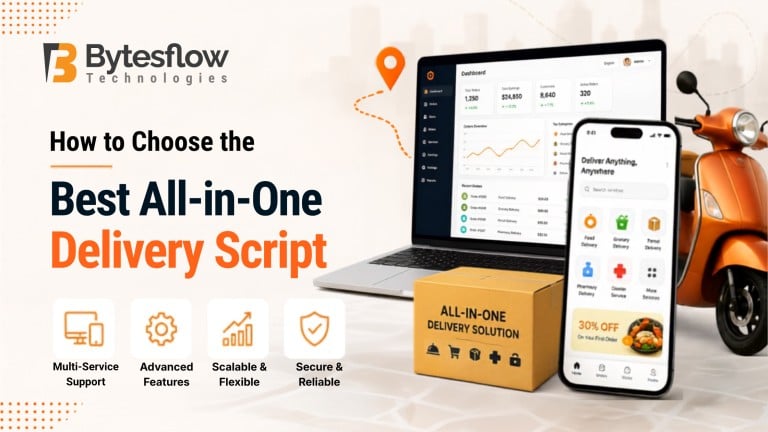
How to Choose the Best All-in-One Delivery Script
Published: August 29, 2026 | Category: Startup Guide | Read time: ~10 min
Introduction
Starting a multi-service delivery business sounds simple until you sit down to build it. That’s where an all-in-one delivery script comes in, it gives founders a ready platform instead of a blank slate. But not every script on the market is built the same way, so picking the right one matters more than picking the first one you see.
The global online food delivery market is projected to reach $618.4 billion by 2030, and multi-service platforms are capturing a growing share of that spend. Consequently, more founders are moving away from single-vertical apps and looking for an on-demand all-in-one delivery app clone that can handle food, grocery, pharmacy, and parcel orders from one dashboard.
What is an All-in-One Delivery script?
An all-in-one delivery script is a pre-built software solution that lets one platform serve multiple verticals: food, grocery, medicine, flowers, or courier – instead of running separate apps for each. Consequently, it saves founders the cost and time of building four different products from scratch.
- Single admin panel for every vertical
- Shared driver and rider network across services
- One customer app instead of multiple downloads
- Centralized order, payment, and commission management
Key Factors to Check Before You Buy
Choosing the right all-in-one delivery app clone isn’t just about price. Here’s what actually separates a good script from a risky one:
Factor | What to Check |
Source code ownership | Full or limited access |
Customization | White label vs rigid template |
Scalability | Can it add new verticals later |
Tech stack | Native, hybrid, or outdated framework |
Support | One-time sale vs ongoing updates |
Security | Payment gateway compliance, data encryption |
1. Confirm Full Source Code Ownership
Some vendors only lease access. Therefore, always confirm you’ll own the code outright, so you’re never locked into a subscription just to keep your app running.
2. Look for True White Label Customization
A good script should let you rebrand, add verticals, and modify workflows without rebuilding the core system. If the vendor calls it “customizable” but charges heavily for every small change, that’s a red flag.
3. Test the Multi-Role Architecture
A solid on-demand all-in-one delivery app clone ships with four connected apps or panels:
- Customer app
- Delivery partner app
- Vendor or store panel
- Admin dashboard
If any of these are missing or poorly integrated, order management gets messy fast.
4. Evaluate Scalability
Your business needs today aren’t your needs in year two. So, ask the vendor directly: can the platform expand from grocery-only to grocery, pharmacy, and parcel without a rebuild? Business of Apps notes that super-app style platforms consistently outperform single-service apps on retention, largely because users don’t need to switch apps for different needs.
5. Review Post-Launch Support
Bugs, updates, and app store compliance don’t stop after launch. Hence, check whether the vendor offers dedicated support, regular updates, and help with iOS/Android store approvals.
Common Mistakes Founders Make
- Choosing the cheapest script without checking source code terms
- Ignoring backend scalability until traffic grows
- Ignoring how easily payment gateways integrate with the script
- Overlooking whether the vendor offers real customization or just a skin change
Why This Decision Shapes Your Launch Speed
A well-built delivery script cuts development time from months to weeks. Meanwhile, a poorly chosen one often costs more in fixes than a custom build would have. That’s why comparing vendors on ownership, architecture, and support matters more than comparing sticker price alone.
If you’re comparing platform models before you commit, it helps to look at how choosing the best Gojek clone script for your startup works, since Gojek’s multi-service structure follows many of the same evaluation criteria covered here.
Conclusion
Choosing the right delivery script comes down to ownership, customization, and long-term support, not just the initial price tag. Bytesflow’s all-in-one delivery script, Delicart, gives you full source code ownership, white label flexibility, and a scalable multi-vertical architecture built to grow with your business.With the right platform, you can launch a multi-service delivery business faster without the time and cost of developing an entire system from scratch.
Ready to launch your own all-in-one delivery platform?
View the live demo to explore the solution in action, or get a free consultation to discuss your requirements, customization options, and launch strategy.
Start building your all-in-one delivery business with BytesFlow today!
Frequently Asked Questions
1. What is an all-in-one delivery script?
An all-in-one delivery script is ready-made software that lets one platform manage multiple delivery verticals, such as food, grocery, pharmacy, and parcels, from a single admin panel. It removes the need to build separate apps for each service, saving both time and development cost for founders.
2. How much does an all-in-one delivery script cost?
Costs vary based on customization, source code ownership, and included verticals, typically ranging from a few thousand dollars for a basic license to a higher investment for fully white label, multi-vertical builds. Bytesflow offers tailored pricing based on your specific business needs.
3. Which features are essential in an all-in-one delivery script?
Essential features include a customer app, delivery partner app, vendor panel, real-time tracking, multiple payment gateways, and a centralized admin dashboard. Multi-vertical support and commission management tools are also important for scaling beyond a single service later.
4. Is the script fully customizable and white label?
Yes, a quality all-in-one delivery script should be fully white label, letting you rebrand the UI, add new verticals, and adjust workflows without rebuilding the core platform. Always confirm customization depth with the vendor before purchase, since not every “customizable” script truly is.
5. Do you get complete source code ownership?
With Bytesflow, yes – buyers receive full source code ownership rather than a limited license or subscription. This means you’re never dependent on the vendor to keep your platform running or to make future changes.
6. Why should I choose an all-in-one delivery script from Bytesflow?
Bytesflow’s Delicart offers full source code ownership, white label customization, and a proven multi-vertical architecture already used by entrepreneurs across food, grocery, pharmacy, and parcel businesses. Combined with dedicated post-launch support, it reduces both launch time and long-term development risk.