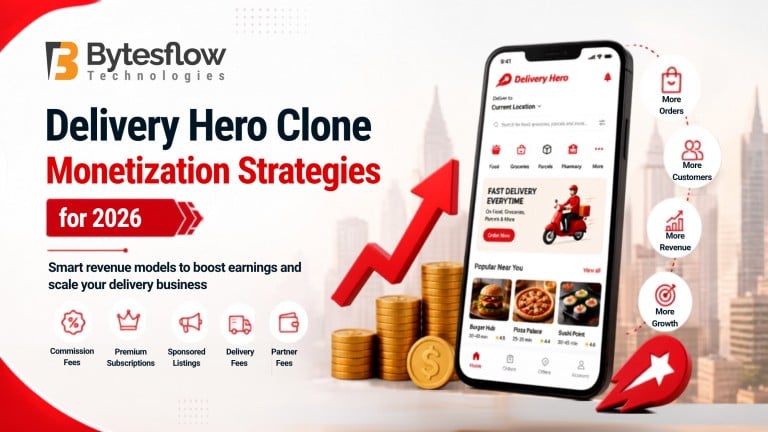
Delivery Hero Clone Monetization Strategies for 2026
Published: August 24, 2026 | Category: Startup Guide | Read time: ~10 min
Introduction
The best Delivery Hero clone monetization strategies for 2026 combine restaurant commissions, customer delivery fees, subscription plans, in-app advertising and data-driven upsells. Together, these five streams let founders diversify income instead of depending on a single revenue source, which improves margins as order volume grows.
Launching an on-demand food delivery app clone is only half the job. The real challenge starts after launch, when you need the platform to actually turn a profit. According to McKinsey, platforms typically charge restaurants 15 to 30 percent commission per order, alongside customer delivery fees of $2 to $5. That’s a solid base, but relying on just one stream leaves your business exposed. Let’s break down what actually works.
Why a Delivery Hero Clone Needs Multiple Revenue Streams
Thin per-order margins mean a single income source rarely covers driver payouts, server costs and marketing spend. Instead, successful platforms layer several models together. This way, a slow month on commissions gets offset by subscription renewals or ad revenue.
Furthermore, the market itself is expanding fast. Business of Apps reports the food delivery app sector crossed $120 billion in market size in 2024, with players like Meituan, Uber Eats, and DoorDash leading global share. That kind of headroom means new entrants can still carve out profitable niches if they get their monetization mix right from day one.
Core Revenue Streams at a Glance
Revenue Stream | How It Works | Typical Range |
Restaurant commission | Percentage cut per completed order | 15% to 30% |
Delivery fee | Flat or distance-based charge to customers | $2 to $5 |
Subscription plan | Monthly fee for free or discounted delivery | $5 to $10/month |
In-app advertising | Sponsored listings and banner placements | Variable |
Surge pricing | Higher fees during peak demand windows | 1.2x to 2x |
Top Monetization Strategies for a Delivery Hero Clone in 2026
Once the basics are covered, these strategies push profitability further:
- Tiered commission structures – Charge lower rates to new or small restaurants, then scale up as order volume increases. This keeps your merchant base growing.
- Premium subscriptions – Offer unlimited free delivery for a flat monthly fee, similar to DashPass or Eats Pass. Subscribers tend to order more often and stay loyal longer.
- Dynamic delivery pricing – Apply surge pricing during rush hours or bad weather, which balances driver supply with customer demand.
- Sponsored restaurant listings – Let restaurants pay for better placement in search results, creating a steady advertising income stream.
- White label licensing – If you build a strong food ordering script, license it to other entrepreneurs entering new cities or regions.
- Data driven upselling – Use order history to recommend add-ons, increasing average order value without extra acquisition cost.
Each of these works best when layered rather than used in isolation. A commission-only model, for instance, struggles once competitors undercut pricing, whereas a mixed approach protects margins even when one stream softens.
Choosing the Right Mix for Your Market
Your ideal monetization blend depends on your city’s order density, restaurant partnerships and customer spending habits. In dense urban markets, subscriptions and surge pricing perform well. In emerging or suburban markets, commission and delivery fees usually dominate early on, with subscriptions added later once user trust builds.
Consequently, it helps to start with a flexible admin panel that lets you toggle pricing rules without redeveloping the app. That’s exactly the kind of flexibility a ready-made Delivery Hero clone script should offer.
Conclusion
Building a profitable on-demand food delivery app clone in 2026 comes down to smart revenue design, not just good features. Commissions and delivery fees will always form your base, but subscriptions, advertising, and dynamic pricing are what separate a break-even app from a genuinely scalable Delivery Hero clone.
Ready to launch your own food delivery platform?
Explore the Delivery Hero clone from Bytesflow and see how its ready-made solution can help you build and scale your business.
👉 View the Live Demo to experience the platform in action, or
👉 Get a Free Consultation to discuss your business model, monetization strategy, customization requirements, and launch goals with our experts.
Frequently Asked Questions
1. What is a Delivery Hero clone?
A Delivery Hero clone is a ready-made, white-label food delivery app built to mirror the core features and business flow of Delivery Hero. It typically includes customer, restaurant, and delivery-partner apps along with an admin panel, letting entrepreneurs launch a branded platform quickly instead of building from scratch.
2. How does a Delivery Hero clone work?
It connects three user roles through one system: customers browse restaurants and place orders, restaurants manage menus and accept orders, and delivery partners handle pickup and drop-off. Real-time tracking, payment gateways, and notifications run in the background to keep every order moving smoothly.
3. How does a Delivery Hero clone make money?
It earns primarily through restaurant commissions and customer delivery fees. Additional income comes from subscription plans, in-app advertising, and surge pricing during peak hours. Combining these streams creates steadier revenue than relying on commissions alone.
4. What are the best monetization strategies for a Delivery Hero clone?
Tiered commissions, premium subscriptions, dynamic delivery pricing, sponsored listings, and data-driven upselling all work well together. The strongest approach blends at least three of these so revenue doesn’t depend on a single source or season.
5. What are the main revenue streams of a Delivery Hero clone?
The core streams include restaurant commissions, customer delivery fees, subscription memberships, advertising or sponsored placements, and surge pricing during high-demand periods. Some platforms also license their food ordering script as a secondary white-label revenue stream.
6. Which is the best Delivery Hero clone script?
Deliware by Bytesflow Technologies stands out as one of the strongest Delivery Hero clone scripts available. It offers a fully customizable, launch-ready platform with flexible commission settings, multi-vendor support, and built-in monetization tools designed for fast, scalable deployment.