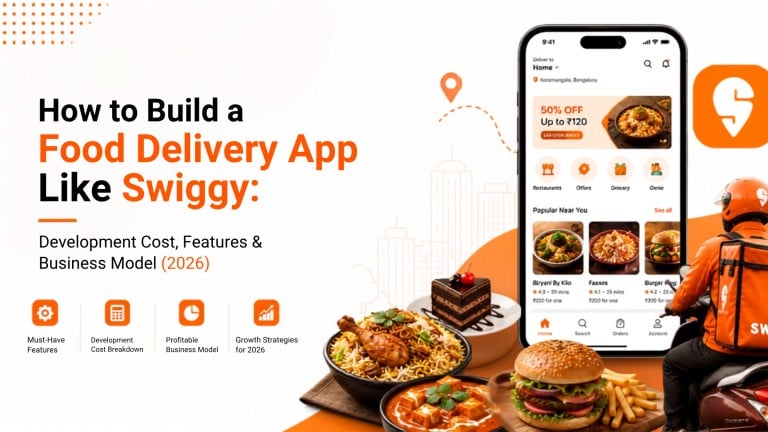
How to Build a Food Delivery App Like Swiggy: Development Cost, Features & Business Model (2026)
The food delivery industry has fundamentally changed how people eat. Swiggy, valued at over $10 billion, processes millions of orders daily across India alone and platforms like DoorDash, Uber Eats, and Deliveroo dominate their respective markets with similar scale. If you’ve ever wondered how to build a food delivery app like Swiggy, this 2026 guide is exactly what you need.
Whether you’re an entrepreneur validating a new idea, a startup ready to build an MVP, or an enterprise planning a digital transformation, this comprehensive guide walks you through everything: must-have features, technical architecture, development cost breakdowns, and the business models that actually generate sustainable revenue.
Key Stat: The global online food delivery market is projected to reach $1.65 trillion by 2030, growing at a CAGR of 10.3%. The opportunity has never been bigger. |
1. The Food Delivery Market in 2026: Why Now Is the Right Time
The pandemic permanently shifted consumer behavior. What was once an occasional convenience has become a weekly habit for hundreds of millions of users globally. In 2026, the food delivery ecosystem is more mature, competitive, and technically sophisticated than ever but it also holds enormous opportunity for new entrants with differentiated propositions.
Global Market Highlights
Market | 2026 Value (Est.) | Key Players | Growth Driver |
|---|---|---|---|
India | $15B+ | Swiggy, Zomato | Tier-2/3 city expansion |
USA | $42B+ | DoorDash, Uber Eats | Grocery + alcohol delivery |
Europe | $35B+ | Deliveroo, Just Eat | Sustainability focus |
SE Asia | $18B+ | Grab, GoFood | Super app integration |
Middle East | $6B+ | Talabat, Careem | Premium dining segment |
Trends Shaping Food Delivery in 2026
- AI-powered personalisation: Platforms like Swiggy now use ML to predict what users will order before they open the app
- 10-minute delivery (quick commerce): Swiggy Instamart and Blinkit have set consumer expectations for hyper-speed fulfilment
- Cloud kitchens: Over 30% of orders on major platforms now come from virtual restaurants with no physical dine-in space
- Subscription models: Swiggy One and Zomato Gold generate recurring revenue and lock in loyal users
- Sustainability: Carbon-neutral delivery options and eco-friendly packaging are now a competitive differentiator
2. Understanding the Three-Sided Marketplace
A food delivery platform like Swiggy isn’t a single app — it’s a three-sided marketplace with three distinct user groups, each requiring a dedicated interface and set of features:
Panel | User | Primary Goal |
|---|---|---|
Customer App | End consumers | Discover restaurants, order food, track delivery |
Restaurant Dashboard | Restaurant owners & managers | Manage menus, accept orders, track earnings |
Delivery Partner App | Gig delivery workers | Accept delivery jobs, navigate to locations, earn income |
Admin Panel | Platform operators | Manage all users, analytics, payouts, disputes |
Each panel must be designed and developed independently, with a shared backend API connecting them in real time. This architecture is what makes food delivery apps complex and expensive to build.
3. Core Features of a Food Delivery App Like Swiggy
Customer App Features
- User Registration & Profiles: Email, phone, and social login (Google/Apple). Profile management, saved addresses, dietary preferences.
- Restaurant Discovery: Location-based listings, filters (cuisine, rating, delivery time, price), search with autocomplete, featured promotions.
- Smart Menu Browsing: High-quality food photos, nutritional info, customisation options (size, toppings, spice level), allergen labels.
- Cart & Checkout: Add/remove items, apply coupons and promo codes, choose delivery time, add special instructions.
- Multiple Payment Options: Credit/debit cards, UPI, wallets (Paytm, PhonePe), BNPL (Buy Now Pay Later), Cash on Delivery.
- Real-Time Order Tracking: Live map with delivery partner location, estimated arrival time (ETA), order status updates.
- Push Notifications: Order confirmation, preparation updates, out-for-delivery alerts, promotional offers.
- Ratings & Reviews: Rate food and delivery experience, photo reviews, restaurant response feature.
- Order History & Reordering: Quick reorder from past orders, saved favourite meals.
- Loyalty & Rewards: Points on every order, referral bonuses, milestone rewards.
Restaurant Partner Dashboard
- Menu Management — Add/edit/remove items in real time, upload photos, set availability windows, manage variants.
- Order Management — Accept/reject orders, set preparation time, mark order as ready for pickup.
- Live Order Dashboard — Real-time view of incoming, in-progress, and completed orders.
- Analytics & Reporting — Revenue reports, peak hour insights, popular items, customer feedback summaries.
- Promotions Management — Create discount campaigns, flash deals, combo offers, and sponsored listings.
- Payout Tracking — View weekly settlement reports, invoice generation, tax documentation.
- Staff Accounts — Multiple logins for different staff roles (manager, kitchen, cashier).
Delivery Partner App
- Registration & Onboarding — Document upload (license, ID), background check integration, training modules.
- Availability Toggle — Go online/offline with one tap, set delivery radius preferences.
- Order Acceptance — Accept/decline delivery requests, view earnings before accepting.
- Navigation Integration — In-app GPS navigation (Google Maps/MapBox), optimised multi-stop routing.
- Earnings Dashboard — Daily, weekly, and monthly earnings breakdown, surge pay visibility, incentive tracking.
- In-App Communication — Call/chat with customer or restaurant without revealing phone numbers.
- Delivery Confirmation — OTP-based delivery confirmation, contactless proof-of-delivery (photo).
Admin Panel
- User Management — Manage all customers, restaurants, and delivery partners.
- Order Management & Dispute Resolution — Full order visibility, refund processing, complaint handling.
- Commission & Payout Management — Set commission rates per restaurant, manage automated payouts.
- Analytics Dashboard — Business KPIs, GMV, order volumes, cohort retention, churn analysis.
- Content Management — Manage banners, promotions, featured placements.
- Notification Centre — Send mass or targeted push notifications, SMS campaigns.
4. Advanced Features That Differentiate Market Leaders
Feature | Description | Complexity |
|---|---|---|
AI Recommendations | ML-based personalised food & restaurant suggestions based on order history, time of day, and weather | High |
Dynamic Pricing | Surge pricing during peak hours and bad weather, similar to ride-hailing apps | High |
Predictive ETA | ML model predicts delivery time factoring traffic, kitchen load, and weather | High |
In-App Chat | Masked real-time chat between customer and delivery partner | Medium |
Scheduled Orders | Pre-order food for a specific time up to 7 days in advance | Medium |
Group Ordering | Multiple users add items to a shared cart and split the bill | High |
AR Menu Preview | Augmented reality previews of dishes before ordering | Very High |
Alexa/Google Assistant and in-app voice command ordering | High | |
Subscription Plans | Monthly/annual memberships for free delivery and exclusive deals | Medium |
Multi-Language & Currency | Full localisation for international expansion | Medium |
5. Technical Architecture & Recommended Tech Stack
A production-grade food delivery platform at scale requires a microservices architecture with real-time capabilities. Here’s the recommended stack for 2026:
Frontend (Mobile Apps)
Platform | Technology | Why |
|---|---|---|
iOS | Swift / SwiftUI | Best performance and Apple ecosystem integration |
Android | Kotlin / Jetpack Compose | Modern, performant native Android development |
Cross-platform MVP | React Native or Flutter | 60-70% cost saving vs native; suitable for MVPs |
Web Dashboard | React.js + TypeScript | Component-based, fast, excellent ecosystem |
Backend & Infrastructure
Layer | Technology | Purpose |
|---|---|---|
API Gateway | Node.js / Express or Kong | Route requests, handle auth, rate limiting |
Core Services | Node.js / Python (FastAPI) | Order management, user service, restaurant service |
Real-Time Engine | Socket.IO / WebSockets | Live order tracking, chat, notifications |
Database (Primary) | PostgreSQL | Transactional data: orders, users, payments |
Database (Caching) | Redis | Session management, real-time data, leaderboards |
Search Engine | Elasticsearch | Restaurant and menu search with autocomplete |
Message Queue | Apache Kafka / RabbitMQ | Async event processing, order state machine |
Cloud Hosting | AWS / Google Cloud | Auto-scaling infrastructure, 99.9% uptime SLA |
CDN | CloudFront / Cloudflare | Fast media delivery for food images globally |
Monitoring | Datadog / New Relic | Performance monitoring, error tracking, APM |
Third-Party Integrations
- Payments: Stripe, Razorpay, Braintree, or regional payment gateways
- Maps & Geolocation: Google Maps Platform, MapBox, or HERE Maps
- SMS/OTP: Twilio, MSG91, or AWS SNS
- Push Notifications: Firebase Cloud Messaging (FCM), OneSignal
- Email: SendGrid, Mailgun, or Amazon SES
- KYC & Background Checks: IDfy, Onfido, or Jumio for delivery partner verification
- Analytics: Mixpanel, Amplitude, or Segment for user behaviour analytics
- Customer Support: Freshdesk, Zendesk, or Intercom for in-app support
6. Food Delivery App Development Cost Breakdown (2026)
Development costs vary significantly based on geography, team composition, feature scope, and platform choice. Here is a realistic, market-researched breakdown for 2026:
Cost by Development Model
Development Model | Hourly Rate | MVP Cost (3–4 months) | Full Platform Cost |
|---|---|---|---|
Freelancers (mixed) | $20–$50/hr | $15,000–$40,000 | Limited scalability |
Offshore Agency (India/E. Europe) | $25–$60/hr | $30,000–$80,000 | $80,000–$150,000 |
Mid-tier Agency (UK/EU) | $80–$120/hr | $80,000–$150,000 | $150,000–$300,000 |
Premium Agency (USA/Canada) | $120–$200/hr | $150,000–$350,000 | $300,000–$600,000+ |
In-house Team (India) | Salary-based | $60,000–$120,000/yr | Most control |
Cost by Feature Module
Module | Estimated Hours | Cost (Offshore) | Cost (Western) |
|---|---|---|---|
UI/UX Design (all 4 panels) | 400–600 hrs | $12,000–$24,000 | $40,000–$72,000 |
Customer App (iOS + Android) | 800–1,200 hrs | $24,000–$48,000 | $80,000–$144,000 |
Restaurant Dashboard (Web) | 300–500 hrs | $9,000–$20,000 | $30,000–$60,000 |
Delivery Partner App | 400–600 hrs | $12,000–$24,000 | $40,000–$72,000 |
Admin Panel (Web) | 300–400 hrs | $9,000–$16,000 | $30,000–$48,000 |
Backend API & Database | 600–1,000 hrs | $18,000–$40,000 | $60,000–$120,000 |
Real-Time Tracking Engine | 200–350 hrs | $6,000–$14,000 | $20,000–$42,000 |
Payment Integration | 100–200 hrs | $3,000–$8,000 | $10,000–$24,000 |
QA & Testing | 200–400 hrs | $6,000–$16,000 | $20,000–$48,000 |
DevOps & Infrastructure Setup | 100–200 hrs | $3,000–$8,000 | $10,000–$24,000 |
TOTAL (Full Platform) | 3,400–5,450 hrs | $102,000–$218,000 | $340,000–$654,000 |
Pro Tip: Start with an MVP targeting a single city, using a cross-platform framework like React Native or Flutter. A well-scoped MVP can be built for $30,000–$60,000 in 3–4 months with an offshore team, giving you real market data before committing to a $150,000+ full build. |
Ongoing Monthly Costs
Cost Category | Monthly Estimate (Early Stage) |
|---|---|
Cloud hosting & infrastructure (AWS/GCP) | $500–$3,000 |
Third-party APIs (Maps, SMS, Payments) | $200–$2,000 |
Support & maintenance team | $2,000–$8,000 |
Marketing & customer acquisition | $5,000–$50,000+ |
Customer support operations | $1,000–$5,000 |
Total Monthly Burn (conservative) | $8,700–$68,000+ |
7. Business Models & Monetization Strategies
A food delivery app can generate revenue through multiple channels simultaneously. The world’s most successful platforms layer these models to maximize LTV (lifetime value) while keeping the unit economics healthy:
Commission-Based Model
The backbone of Swiggy, Zomato, and DoorDash’s revenue. Restaurants pay a commission (typically 15–30%) on every order placed through the platform.
- Average commission rate: 18–25% in India; 25–35% in the US and Europe
- Usually tiered: higher-volume restaurants negotiate lower rates
- Platform must balance commission rates to retain restaurant partners while maximising revenue
Example: If a restaurant does $10,000/month in orders and pays 20% commission, the platform earns $2,000/month from that single restaurant. At 500 active restaurants, that is $1M/month. |
Delivery Fee Model
Customers pay a delivery fee per order, which can be dynamic (surge-based), flat, or waived via subscription. This directly funds the cost of delivery operations.
- Typical range: $0.99–$5.99 per delivery depending on distance and demand
- Reduces friction when waived via subscription (which drives retention)
- Surge pricing during peak hours and bad weather conditions
Subscription/Membership Model
Swiggy One and Zomato Gold proved that food delivery users will pay a monthly or annual fee for perks like free delivery, priority service, and exclusive discounts.
- Swiggy One: Provides free delivery and exclusive restaurant deals for a monthly fee
- Typical pricing: $3–$15/month depending on market
- Drives 2–3x order frequency among subscribers vs non-subscribers
- Dramatically reduces CAC (Customer Acquisition Cost) by locking in users
Advertising & Featured Listings
Restaurants pay to appear at the top of search results, be featured on the homepage, or run banner ad campaigns. This is a high-margin, scalable revenue stream.
- Sponsored listings: Pay-per-click (PPC) or fixed monthly placement fee
- Banner ads on the customer app: $500–$5,000/month for prime placements
- Push notification promotions: Targeted offers sent to segmented user groups
- Swiggy’s advertising revenue grew 80% YoY, now a major P&L contributor
Cloud Kitchen & First-Party Brands
- Operating your own cloud kitchen brands (like Swiggy Access) captures the full margin
- Lower customer acquisition cost as you control the demand channel
- High risk but highest margin potential — suitable for well-funded platforms
Value-Added Services
- Corporate catering contracts: B2B revenue with higher average order values
- Grocery and quick commerce: Swiggy Instamart expanded TAM dramatically
- Alcohol delivery: High-margin, regulated but lucrative in permitted markets
- Medicine delivery: Leveraging existing delivery infrastructure with a healthcare twist
Revenue Stream | Margin Profile | Scalability | Time to Revenue |
|---|---|---|---|
Restaurant Commission | Medium (18–25%) | Very High | Day 1 |
Delivery Fees | Low–Medium | High | Day 1 |
Subscriptions | High (70%+) | Very High | Month 3–6 |
Advertising | Very High (80%+) | Very High | Month 6–12 |
Cloud Kitchens | Very High | Medium | Year 2+ |
B2B/Corporate | High | Medium | Month 6–12 |
8. Step-by-Step Development Roadmap
Phase 1: Discovery & Strategy (Weeks 1–4)
- Define your target market, geography, and initial restaurant vertical (e.g., fast food, cloud kitchens, premium dining)
- Conduct competitive analysis of local players and identify 3 key differentiators
- Build detailed product requirements document (PRD) and user stories for MVP scope
- Define your business model: commission rate, delivery fee structure, launch incentives
- Identify and onboard 20–50 restaurant partners before launch
Phase 2: Design (Weeks 5–10)
- User research: 20+ interviews with target consumers and restaurant partners
- Information architecture and user flow mapping for all 4 panels
- High-fidelity UI/UX design in Figma — design system, component library
- Usability testing with prototypes; iterate based on feedback
- Finalise brand identity: logo, colour palette, typography
Phase 3: MVP Development (Weeks 11–26)
- Backend API development: authentication, restaurant management, order management
- Customer app development: core ordering flow, payment, basic tracking
- Restaurant dashboard: order acceptance, menu management
- Delivery partner app: order acceptance, navigation, earnings
- Admin panel: basic operations management
- Integration: payment gateway, maps, push notifications, SMS
- QA testing: functional, performance, security, and device testing
Phase 4: Soft Launch (Weeks 27–32)
- Beta launch in one city with 50–100 restaurant partners
- Acquire first 1,000 users via referral program and digital marketing
- Monitor metrics: order success rate, ETA accuracy, customer satisfaction (CSAT)
- Gather feedback and prioritise bug fixes and feature improvements
- Test unit economics: CAC, delivery cost per order, commission earned
Phase 5: Growth & Scaling (Month 9+)
- Expand to additional cities and restaurant categories
- Launch subscription plan to drive repeat orders
- Add advanced features: AI recommendations, group ordering, scheduled delivery
- Activate advertising revenue stream for restaurant partners
- Optimise delivery logistics with batching and predictive algorithms
9. Key Metrics to Track After Launch
Metric | Definition | Target Benchmark |
|---|---|---|
GMV (Gross Merchandise Value) | Total value of orders placed on platform | $100K+/month by Month 6 |
Order Completion Rate | % of placed orders successfully delivered | >95% |
Average Order Value (AOV) | Average spend per transaction | $12–$25 |
Customer Acquisition Cost (CAC) | Total marketing spend / new customers acquired | <$5 in India; <$20 in West |
Average Delivery Time | Time from order placed to doorstep delivery | <35 minutes |
Customer Retention (Month 3) | % of first-time users who order again within 3 months | >40% |
Restaurant Partner NPS | Net Promoter Score among restaurant partners | >50 |
Delivery Partner Utilisation | % of time delivery partners are actively delivering | >60% |
10. Common Mistakes to Avoid
Warning: Over 70% of food delivery startups fail within 2 years. Most failures come from these avoidable mistakes. |
- Launching in too many cities simultaneously: Focus on one city, nail the unit economics, then expand.
- Underpricing commissions to attract restaurants: This destroys your margin and creates a loss-making marketplace that is impossible to recover.
- Neglecting delivery partner experience: Your product is only as good as the last-mile experience. Unhappy delivery partners = late deliveries = churned customers.
- Building too many features in v1: An MVP with a flawless core experience beats a feature-bloated app with bugs every single time.
- Ignoring customer support: A single bad experience with no resolution can result in 1-star reviews that kill your growth. Invest in support early.
- Not tracking unit economics from Day 1: Know your CAC, delivery cost per order, and contribution margin before scaling marketing spend.
- Underinvesting in restaurant partner success: Your restaurant partner churn rate is as important as customer churn. Partner success teams pay dividends.
Conclusion: Your Roadmap to the Next Big Food Delivery Platform
Building a food delivery app like Swiggy in 2026 is more achievable than ever. Success depends not on having the most features, but on strong execution, local market understanding, and sustainable unit economics.
Start with a focused MVP, perfect the customer experience, and scale strategically. At Bytesflow, we help businesses build scalable food delivery platforms that drive growth, profitability, and long-term success.
Ready to Build? The next generation of food delivery platforms is being built today. Whether you’re launching a lean MVP or a feature-rich enterprise solution, Bytesflow provides the technology, expertise, and support to bring your vision to market faster and more efficiently. |
👉 View Live Demo | Get a Free Consultation
Frequently Asked Questions (FAQ)
1. How much does it cost to build a food delivery app like Swiggy?
The cost ranges from $30,000 for a well-scoped MVP (using React Native or Flutter with an offshore team) to $200,000+ for a full-featured native platform. Enterprise-grade platforms with advanced AI features and multi-city infrastructure can cost $500,000–$1M+. The biggest cost variables are team location, feature scope, and platform choice (cross-platform vs native).
2. How long does it take to build a food delivery app?
An MVP covering the core ordering flow, restaurant dashboard, and delivery partner app typically takes 3–6 months with a team of 6–8 engineers. A full-featured platform with all advanced features, thorough QA, and production-ready infrastructure takes 9–18 months. Post-launch iterations and new feature additions are an ongoing process.
3. What is the best tech stack for a food delivery app in 2026?
For the backend: Node.js or Python (FastAPI) for microservices, PostgreSQL for relational data, Redis for caching and real-time features, and Apache Kafka for event streaming. For mobile: Flutter or React Native for a cross-platform MVP; Swift/Kotlin for production-scale native apps. For hosting: AWS or Google Cloud with Kubernetes for container orchestration.
4. What is Swiggy’s business model?
Swiggy operates a multi-revenue model: restaurant commissions (18–25%), customer delivery fees, Swiggy One subscription membership, in-app advertising and sponsored listings, and Swiggy Instamart (quick commerce for groceries and essentials). The subscription and advertising streams have become increasingly significant in recent years.
5. Should I build a native or cross-platform app?
For an MVP or budget under $100,000, start with React Native or Flutter — you get one codebase that runs on both iOS and Android, cutting development time and cost by 40–60%. Once you have market validation and a growth roadmap, consider migrating to native (Swift for iOS, Kotlin for Android) for maximum performance at scale. Swiggy and Zomato both use native apps at their scale.