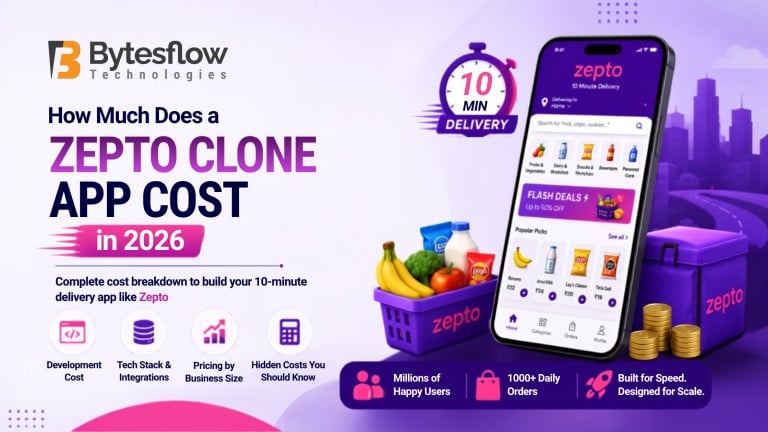
How Much Does a Zepto Clone App Cost in 2026
Published: August 12, 2026 | Category: Cost Guide | Read time: ~10 min
Introduction
Quick commerce has stopped being a metro-only trend, and more entrepreneurs now want to launch a Zepto clone app before the market gets even more crowded. India’s quick commerce segment is projected to touch INR 1.08 lakh crore in 2026, growing 40% year-on-year, according to an Equirus report cited by ANI News. As competition heats up, founders naturally ask one question first: what does it really cost to build a Zepto clone app?
In short: A Zepto clone app typically costs between $5,000 and $40,000+ in 2026, depending on features, platforms, and whether you use a ready script or build from scratch.
This guide breaks the numbers down clearly so you can plan your budget with confidence.
What Is a Zepto Clone App?
A Zepto clone app replicates the instant-delivery experience of Zepto: dark-store fulfilment, hyperlocal routing, and 10 to 20-minute order windows. Most businesses build one using a ready Zepto clone script instead of starting from a blank codebase, since the script already covers the core architecture. For a deeper look at picking the right one, check our guide on how to pick the best Zepto clone script.
Zepto Clone App Cost in 2026 at a Glance
The Zepto clone cost table below reflects three common budget tiers founders work with today.
Package | Best For | Approx. Cost (USD) | Approx. Cost (INR) |
MVP / Basic | Testing one city | $5,000 – $10,000 | ₹4L – ₹8L |
Standard | Multi-store, single city | $10,000 – $20,000 | ₹8L – ₹16L |
Advanced / Enterprise | Multi-city, custom features | $20,000 – $40,000+ | ₹16L – ₹35L+ |
These figures assume you use a ready Zepto clone script instead of building every module from scratch, which cuts both cost and time.
Key Factors That Affect Development Cost
Several variables shift your Zepto clone budget up or down. Here’s what matters most:
- App type and platform: iOS, Android, web, and admin panel each add development hours.
- Feature depth: live tracking, dark-store inventory sync, and AI recommendations cost more than a basic catalogue.
- Third-party integrations: payment gateways, maps, and SMS/OTP services add licensing and integration effort.
- Design complexity: custom UI/UX costs more than a template-based design.
- Team and engagement model: in-house teams, agencies, and freelancers price differently.
- Testing, QA, and post-launch support: ongoing maintenance is often underestimated in early budgets.
- Business scope: whether you choose an on-demand all-in-one delivery app clone or a single-vertical Zepto clone changes the cost significantly.
Feature | Cost Impact |
Real-time dark-store inventory sync | High |
Live order tracking with maps | Medium |
Multi-language and multi-currency | Medium |
AI-based product recommendations | High |
Basic cart and checkout | Low |
Ready Script vs Custom Build: Which Costs Less?
Custom development gives you full control, but it also takes longer and costs more upfront. If your business is grocery-only, a dedicated grocery delivery script can cost less than a full on-demand all-in-one delivery app clone, since it skips multi-vertical modules you may not need yet.
Approach | Cost | Timeline | Best For |
Custom development | $25,000+ | 4 to 7 months | Unique, complex business models |
Zepto clone script | $5,000 – $20,000 | 3 to 6 weeks | Fast market entry |
All-in-one delivery script | $8,000 – $25,000 | 4 to 8 weeks | Multi-vertical growth plans |
Development Timeline You Can Expect
- MVP with a script: 3 to 4 weeks
- Standard customization: 6 to 8 weeks
- Enterprise-level build: 12 to 16 weeks
For a broader view of the market opportunity behind these timelines, see Mordor Intelligence’s India Q-Commerce Market report.
Smart Ways to Reduce Your Budget
- Start with a pre-built script instead of custom code for version one.
- Launch in a single city first, then scale once unit economics work.
- Pick only must-have integrations at launch; add the rest later.
- Reuse a proven all-in-one delivery script framework if multi-vertical expansion is on your roadmap.
- Choosing between a dedicated Zepto clone and a broader on-demand all-in-one delivery app clone depends on your five-year plan, not just your launch-day budget.
Final Thoughts
Building a Zepto clone in 2026 costs less than most founders expect, especially when you start with a proven script instead of custom code. Whether you need a focused grocery delivery script or a broader all-in-one delivery script, the right choice comes down to your budget, timeline, and growth plans.
Ready to explore how a Zepto clone can fit your business goals?
View the demo to explore the platform or get a free consultation from the Bytesflow team to discuss your requirements, features, customization options, and estimated development cost.
Frequently Asked Questions
1. How much does it cost to build a Zepto clone app in 2026?
Costs range from $5,000 for a basic MVP to $40,000+ for an advanced, multi-city build, depending on features and platforms.
2. What factors affect the cost of developing a Zepto clone app?
Feature depth, integrations, design complexity, team location, and whether you use a ready script or custom code all affect the final price.
3. How long does it take to develop a Zepto clone app?
An MVP with a ready script takes 3 to 4 weeks; a fully custom, enterprise-grade build can take 12 to 16 weeks.
4. Can I customize a Zepto clone app according to my business requirements?
Yes. Ready scripts are built to be customized, so you can adjust features, branding, and workflows to match your business model.
5. Is a Zepto clone app more affordable than building a grocery delivery app from scratch?
Generally yes. A ready script reuses tested architecture, so it costs less and launches faster than a fully custom build.