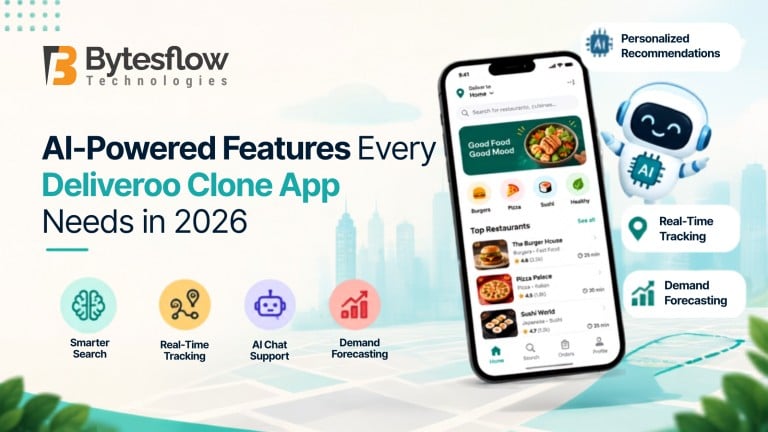
AI-Powered Features Every Deliveroo Clone App Needs in 2026
Published: September 09, 2026 | Category: Features Guide | Read time: ~10 min
Introduction
Food delivery has moved far past simple order-and-track apps. In 2026, a deliveroo clone stands out only when it thinks for itself, predicting demand, routing drivers, and personalising every order automatically. Entrepreneurs entering this space now compete against platforms that already run on machine learning, so a plain deliveroo clone script without intelligence built in will struggle to hold users past their first order.
This guide breaks down the AI capabilities that matter most for a modern deliveroo clone in 2026, why each one matters, and how Bytesflow builds them directly into its platform.
Why AI Matters for a Deliveroo Clone in 2026
Consumer expectations have shifted. Riders want fair pay and efficient routes, restaurants want accurate demand signals, and customers want food that arrives fast, hot, and exactly as ordered. According to McKinsey’s analysis of digital and AI value in food and beverage companies, a $10 billion food and beverage company could unlock hundreds of millions in value by embedding digital and AI capabilities into operations such as customer engagement and channel management. That same logic scales down to a single-city on-demand food delivery app clone just as effectively as it applies to global brands.
Consequently, AI is no longer a nice-to-have add-on. It has become the baseline expectation for any serious deliveroo clone app launching this year.
In short: AI improves a food delivery clone by automating dispatch, predicting demand, personalising recommendations, adjusting prices in real time, and catching fraud before it costs the business money.
Top AI Features Bytesflow Builds Into Every Deliveroo Clone
Bytesflow ships these ten AI capabilities as part of its deliveroo clone script, so founders do not need to bolt on third-party tools after launch.
S.No | Feature | What It Solves |
1 | Smart dispatch engine | Assigns the best available rider automatically, cutting manual dispatch delays |
2 | AI route optimization | Calculates the fastest live route using traffic and distance data |
3 | AI meal recommendations | Suggests dishes based on order history and preferences |
4 | Dynamic pricing engine | Adjusts delivery fees based on demand, weather, and distance |
5 | Demand forecasting | Predicts order surges so staffing and inventory stay ready |
6 | Fraud detection and prevention | Flags suspicious orders, payments, and rider behaviour |
7 | 24/7 AI support chatbot | Resolves common queries instantly, day or night |
8 | Driver performance scorecards | Tracks speed, ratings, and acceptance rate to reward top riders |
9 | AI auto-reassignment | Reroutes an order instantly if a rider cancels or goes offline |
10 | AI menu import | Digitises restaurant menus from PDFs or photos in minutes |
Let’s unpack why each one earns its place in a competitive food ordering script.
1. Smart Dispatch Engine
Manual dispatch slows everything down. A smart dispatch engine matches orders to the nearest, most suitable rider within seconds, so restaurants stop watching orders pile up unassigned.
- Reduces average dispatch time
- Balances rider workload across zones
- Works alongside auto-reassignment for zero missed orders
2. AI Route Optimization
Static maps cannot account for road closures or sudden traffic. AI-driven routing recalculates paths continuously, and this single feature alone has been shown in industry case studies to cut delivery times by over 30 percent.
- Factors in live traffic and weather
- Sequences multi-stop deliveries efficiently
- Lowers fuel costs and rider fatigue
3. AI Meal Recommendations
Personalised suggestions increase order value without pushy upselling. The system learns from past orders, time of day, and location to surface dishes a customer is genuinely likely to want.
4. Dynamic Pricing Engine
Flat delivery fees leave money on the table during peak hours and scare off orders during quiet ones. Dynamic pricing adjusts in real time so margins stay healthy without overcharging casual users.
5. Demand Forecasting
Instead of reacting to a rush, the platform predicts it. Restaurants prep ingredients ahead of time, and admins schedule enough riders before demand spikes rather than after.
6. Fraud Detection and Prevention
Fake orders, payment fraud, and rider scams quietly drain revenue. AI models flag unusual patterns immediately, protecting customers, restaurants, and the platform’s bottom line simultaneously.
7. 24/7 AI Support Chatbot
Customers expect instant answers about refunds, order status, or missing items. A trained chatbot handles routine tickets around the clock, freeing human agents for complex cases.
8. Driver Performance Scorecards
Transparent scorecards reward reliable riders with better order access. This keeps top performers motivated and gives admins clear data for incentive programs.
9. AI Auto-Reassignment
If a rider cancels mid-delivery, waiting for manual intervention frustrates customers. Auto-reassignment finds a replacement rider instantly, keeping the order moving without a support ticket.
10. AI Menu Import
Onboarding restaurants manually takes hours per menu. AI-powered menu import reads a PDF or photo and populates categories, items, and prices automatically, cutting onboarding time dramatically.
Comparing a Basic Clone vs an AI-Powered Deliveroo Clone
Capability | Basic Clone | AI-Powered Clone |
Order dispatch | Manual or first-come-first-served | Automated smart matching |
Pricing | Fixed delivery fees | Real-time dynamic pricing |
Support | Business-hours only | 24/7 chatbot plus human backup |
Menu onboarding | Manual data entry | AI-assisted import |
Fraud checks | Rule-based, reactive | Predictive, real-time flagging |
How to Choose an AI-Ready Deliveroo Clone Script
Founders evaluating vendors should look beyond the UI and dig into the intelligence layer underneath. This lines up with Deloitte’s insights on AI adoption in delivery and logistics, which point to automation and real-time data as the biggest differentiators for operators in 2026.
- Ask whether AI features are built-in or require separate integrations
- Check if the dispatch engine handles multi-order batching
- Confirm the platform supports live rider reassignment
- Verify fraud detection covers both payments and fake accounts
- Request a live demo instead of relying on screenshots alone
If you are running multiple restaurant brands from one platform, see our breakdown of how to build a multi restaurant app with a Deliveroo clone for a deeper look at vendor onboarding and menu management.
Final Thoughts
AI is transforming how modern food delivery platforms attract customers, manage orders, optimize deliveries, and drive repeat purchases. By integrating intelligent recommendations, predictive analytics, route optimization, AI chatbots, demand forecasting, personalized offers, and other smart capabilities, a Deliveroo clone app can deliver a more personalized and efficient experience for customers, restaurants, and delivery partners.
Ready to launch your AI-powered Deliveroo clone?
Explore the platform with a View Live Demo or Get a Free Consultation with Bytesflow today and take the first step toward building your next-generation food delivery business.
Frequently Asked Questions
1. What AI powered features should a Deliveroo clone app have in 2026?
A competitive deliveroo clone app needs smart dispatch, AI route optimization, dynamic pricing, demand forecasting, meal recommendations, fraud detection, a 24/7 chatbot, driver scorecards, auto-reassignment, and AI menu import. Together these features cut costs, speed up delivery, and improve customer retention.
2. How can AI improve a Deliveroo clone app?
AI improves a deliveroo clone app by automating decisions that used to need manual effort, including dispatching riders, adjusting prices, predicting demand, and spotting fraud. This reduces operational overhead while improving speed and accuracy across every order.
3. Can a Deliveroo clone use AI to recommend restaurants and dishes?
Yes. AI models analyse a customer’s order history, browsing behaviour, and location to recommend restaurants and dishes they are likely to enjoy. This personalisation increases order frequency and average order value without manual merchandising work.
4. Can AI help optimize delivery routes in a Deliveroo clone app?
Yes. AI route optimization uses live traffic, weather, and distance data to calculate the fastest path in real time. It also resequences multi-stop deliveries automatically, cutting delivery times and reducing fuel costs for riders.
5. Does Bytesflow offer AI-powered features in its Deliveroo clone app solution?
Yes. Bytesflow’s Deliveroo clone platform includes smart dispatch, AI route optimization, dynamic pricing, demand forecasting, fraud detection, a 24/7 AI chatbot, driver scorecards, auto-reassignment, and AI menu import as built-in features, not paid add-ons.
6. Is it expensive to add AI features to a food ordering script?
Building AI from scratch is costly, but choosing a ready-made deliveroo clone script with AI already integrated avoids that expense entirely. Businesses pay one platform cost and get smart dispatch, pricing, and forecasting without hiring a separate data science team.