AI Powered Recommendations for DoorDash Clone Apps
Published: September 02, 2026 | Category: Startup Guide | Read time: ~10 min
Introduction
Food delivery customers rarely know exactly what they want to order. So the apps that guess correctly, and guess fast, win the most repeat business. This is where AI powered recommendations come in. A well-built DoorDash clone can use order history, browsing behavior and even weather or time of day to suggest dishes a customer is actually likely to order, turning a simple on-demand food delivery app clone into a genuine growth engine.
What Is an AI Powered Recommendation System in a DoorDash Clone?
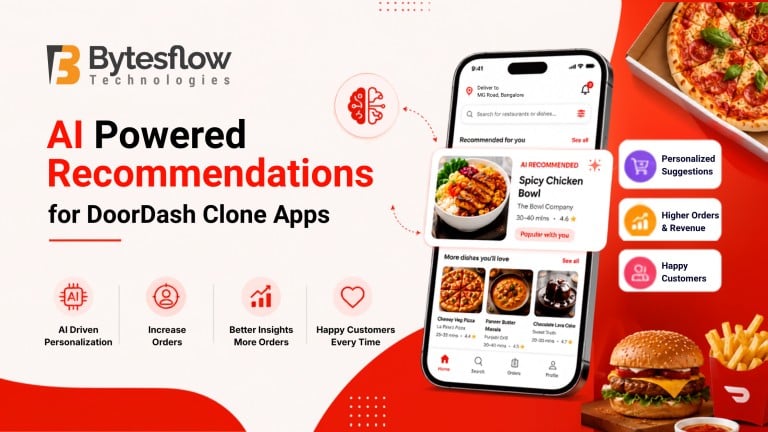
An AI powered recommendation system studies signals such as past orders, cart abandonment, cuisine preference and delivery location. Then, it surfaces dishes, restaurants or combo deals that match the customer’s taste. In a DoorDash clone app, this usually shows up as “Popular near you,” “Reorder your favorites” or “Customers also ordered” sections on the home screen.
How AI Recommendations Increase Orders in a Food Delivery Clone App
Recommendations work because they shorten the decision-making process. Instead of scrolling through dozens of restaurants, customers see relevant options immediately. As a result, browsing time drops and conversion rises.
Here’s how it plays out in practice:
- Faster checkout – fewer taps between opening the app and placing an order
- Higher relevance – suggestions match dietary habits, cuisine history and budget
- Smarter upselling – add-ons and combos appear at the right moment, not randomly
- Reduced churn – customers stop uninstalling apps that feel generic
Consequently, a DoorDash clone script equipped with this kind of intelligence tends to convert casual browsers into paying customers far more consistently than one relying on static menus.
AI Recommendation Techniques and Their Impact
Technique | How It Works | Typical Impact |
Collaborative filtering | Recommends items ordered by similar users | Higher discovery of new restaurants |
Content-based filtering | Matches recommendations to a user’s own order history | Stronger reorder rates |
Contextual triggers | Uses time, weather or location to adjust suggestions | Better relevance during peak hours |
Hybrid models | Combines the above for balanced accuracy | Improved average order value |
What the Data Says About AI Personalization
Personalization is no longer optional in digital commerce. Research from McKinsey shows that companies excelling at personalization generate meaningfully more revenue than those that don’t, largely because relevant recommendations reduce decision fatigue and increase basket size. Similarly, industry analysis from Business of Apps highlights that the food delivery sector continues to grow steadily worldwide, making differentiation through smart, AI-led features increasingly important for new entrants building an on-demand food delivery app clone.
Key Features to Look For in an AI Powered DoorDash Clone App
Not every food ordering script offers genuine AI capability. When evaluating a platform, check for:
- Real-time behavior tracking across browsing and past orders
- Dynamic menu ranking based on individual preferences
- Smart upsell prompts during checkout
- Predictive reorder suggestions for repeat customers
- Location and time-based contextual recommendations
For a broader list of must-have functionality, our guide on top features to include in your DoorDash clone app covers this in more depth. Before you finalize your feature list, it also helps to know what commonly goes wrong. Our guide on DoorDash Clone App: 5 Startup Mistakes to Avoid in 2026 walks through the pitfalls founders should watch out for.
How to Measure the Success of AI Recommendations in a Food Delivery Clone App
Adding AI recommendations is only half the job. Tracking whether they’re actually working matters just as much, otherwise you’re guessing rather than improving. A few metrics are worth watching closely once the feature goes live:
- Click-through rate on suggestions – how often customers tap a recommended item instead of scrolling past it
- Conversion rate from suggestion to order – whether a click actually turns into a completed purchase
- Average order value uplift – the difference in basket size between orders with and without AI-driven upsells
- Repeat order rate – whether personalized reorder prompts bring customers back faster than generic browsing
- Session duration – shorter, more focused sessions usually signal that recommendations are cutting down decision fatigue effectively
Reviewing these numbers monthly, rather than only at launch, helps a food ordering script fine-tune its recommendation logic as customer behavior shifts across seasons, cities and even local events.
Conclusion
AI-powered recommendations can transform a DoorDash clone app from a simple food ordering platform into a smarter, more personalized customer experience. By analyzing user preferences, order history, browsing behavior, location, and purchasing patterns, AI can recommend relevant restaurants, dishes, add-ons, and offers that encourage customers to order more often.
For businesses, this means better food discovery, higher engagement, increased order opportunities, and stronger customer retention. With the right AI recommendation strategy, your DoorDash clone app can deliver personalized experiences while helping your platform grow in a competitive food delivery market.
Ready to build a smarter food delivery platform?
Explore the Bytesflow DoorDash clone app and see how AI-powered capabilities can support your business goals.
View Live Demo to experience the platform in action, or Get a Free Consultation with our experts to discuss how you can launch your own DoorDash clone app.
Frequently Asked Questions
1. What is an AI powered recommendation system in a DoorDash clone app?
It’s a feature that studies customer behavior, past orders and preferences to suggest relevant dishes or restaurants. Instead of showing the same menu to everyone, the app personalizes what each user sees, making ordering faster and more intuitive for every visit.
2. How can AI recommendations increase orders in a food delivery clone app?
AI recommendations reduce decision time by showing relevant options first. This lowers cart abandonment, encourages impulse orders through smart upselling, and keeps users engaged longer, all of which directly translate into more completed orders over time.
3. How does AI personalize food recommendations in a clone app?
AI personalization works by analyzing order history, browsing patterns, location and even time of day. It then ranks menu items and restaurants accordingly, so returning customers see their usual favorites while new users get suggestions based on similar user behavior.
4. Can AI recommendations increase the average order value of a DoorDash clone app?
Yes. By suggesting relevant add-ons, combos or upgrades at checkout, AI recommendations nudge customers toward slightly larger orders. Because suggestions are contextually relevant rather than random, customers are more likely to accept them, which steadily lifts average order value.
5. How can AI improve customer retention in a food delivery clone app?
AI keeps the experience fresh and relevant, so customers don’t feel like they’re browsing a static catalog. Personalized reorder prompts, timely offers and accurate suggestions build habit-forming behavior, which is one of the strongest drivers of long-term retention.
6. Why choose Bytesflow for an AI powered DoorDash clone app?
Bytesflow combines a proven, white-label DoorDash clone script with built-in AI personalization, real-time tracking and a fully customizable admin panel. With global deployment support and continuous feature upgrades, entrepreneurs get a platform ready to scale from day one.