How UberEats Clone Apps Generate Revenue in 2026
Published: August 26, 2026 | Category: Monetization Guide | Read time: ~10 min
What Is an UberEats Clone?
An UberEats clone is a ready-made food ordering script built on the same core structure as UberEats – a customer app, a restaurant panel, a delivery partner app and an admin dashboard. Instead of building everything from scratch, entrepreneurs use this on-demand food delivery app clone to launch their own branded platform in weeks rather than months. But the real question most founders ask isn’t how it works – it’s how it actually makes money.
In short: An UberEats clone makes money mainly through restaurant commissions, delivery fees, subscription plans and in-app advertising, mirroring the exact monetization playbook that global food delivery giants use today.
Why Revenue Model Clarity Matters Before You Launch
Before choosing an UberEats clone script, founders need a clear picture of where the money actually comes from. Otherwise, pricing decisions end up guesswork instead of strategy. Consequently, understanding each stream helps you set commission rates that keep restaurants on board while still turning a profit.
Core Revenue Streams of an UberEats Clone App
Here’s a quick breakdown of how a typical food delivery clone earns:
Revenue Stream | How It Works | Typical Range |
Restaurant Commission | % cut on every order value | 15% to 30% per order |
Delivery Fee | Charged to customers per delivery | Fixed or distance-based |
Subscription Plans | Monthly fee for zero delivery fee | Recurring monthly revenue |
In-App Advertising | Restaurants pay for top placement | Flat fee or CPC |
Service & Surge Fees | Peak-hour or small-cart charges | Dynamic pricing |
According to research cited by McKinsey & Company, commission rates on food delivery platforms typically run between 15% and 30% of the meal price. This matters because it shows exactly where the bulk of platform revenue originates, and why pricing tiers exist in the first place. For a detailed breakdown of setup and running costs, see our guide on UberEats clone app cost in 2026.
1. Restaurant Commission: The Primary Engine
This is the backbone of any UberEats clone script. Every time a restaurant receives an order through the platform, a percentage is deducted automatically. Most platforms tier this:
- Basic plan – lower visibility, lower commission
- Growth plan – better placement, mid-range commission
- Premium plan – top search ranking, highest commission
2. Delivery and Service Fees
Customers pay a delivery charge on top of the food cost. Many on-demand food delivery app clone owners also add a small service fee to cover payment processing, which quietly adds up across thousands of daily orders.
3. Subscription or Membership Revenue
Recurring revenue changes the entire growth trajectory of a food ordering script. Customers pay monthly for free or discounted delivery, similar to Uber One, which locks in loyal users and creates predictable monthly cash flow instead of relying purely on order volume.
4. In-App Advertising and Featured Listings
Restaurants pay to appear at the top of search results or category pages. This stream scales beautifully because it doesn’t depend on order volume alone – it depends on how many restaurants want visibility, making it one of the most profitable additions to any UberEats clone.
5. Data and Analytics Upsells
Mature platforms package order trends, customer behavior, and demand heatmaps into premium dashboards for restaurant partners, turning existing data into an additional income line.
Market Outlook and Monetization Strategy
Restaurant and foodservice sales in the US are projected to reach a record $1.55 trillion in 2026, and operators continue investing in delivery technology to capture that demand – which is exactly why no single revenue stream should carry the whole business. Successful platforms blend commissions with subscriptions and advertising so revenue doesn’t collapse if one stream slows down, and launching a food ordering script now, rather than waiting, puts founders ahead of an expanding market instead of chasing it later.
Ready to Launch Your Own Food Delivery Platform?
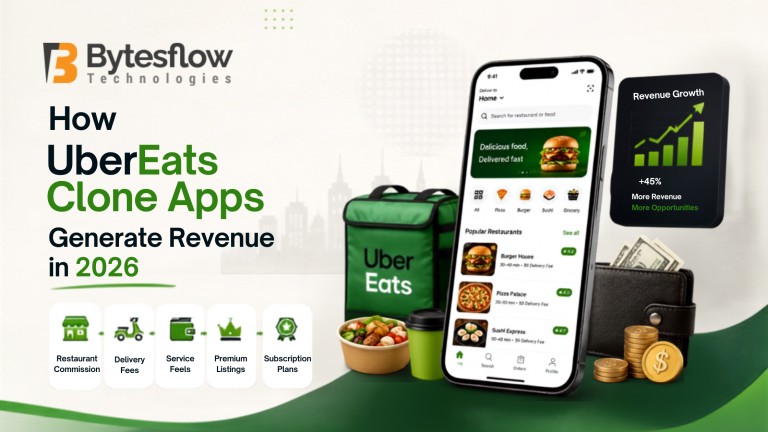
An UberEats clone app can generate revenue through multiple channels, from restaurant commissions and delivery fees to service charges, premium listings, advertising, and subscription plans. The key to building a profitable food delivery platform in 2026 is not relying on a single income source but creating a balanced monetization strategy that delivers value to customers, restaurants, and delivery partners.
With the right features, scalable technology, and flexible revenue model, an UberEats clone can be customized for a local market or expanded into a multi-city food delivery business.
Ready to launch your own UberEats clone app?
Explore how Bytesflow can help you build a scalable food delivery platform tailored to your business model.
👉 View a Live Demo or Get a Free Consultation and discuss your UberEats clone app requirements with our experts.
Frequently Asked Questions
1. How does an UberEats clone make money?
An UberEats clone earns primarily through restaurant commissions, delivery fees, subscription plans, and advertising. Most platforms combine two or more of these streams to build stable, diversified revenue instead of relying on a single income source.
2. What is the UberEats clone revenue model?
The revenue model blends per-order commissions with recurring subscriptions and advertising fees from restaurants. This hybrid approach lets platform owners earn from order volume, loyal subscribers, and promotional placements simultaneously.
3. How much commission can an UberEats clone charge?
Commissions typically range between 15% and 30% per order, depending on the visibility tier a restaurant selects. Owners can adjust this based on local competition, delivery distance, and restaurant negotiating power.
4. Can an UberEats clone earn recurring revenue?
Yes, subscription plans that offer free or discounted delivery for a monthly fee create predictable recurring revenue. This model reduces dependency on daily order fluctuations and improves long-term cash flow stability.
5. What is the most profitable UberEats clone revenue stream?
Restaurant commissions usually generate the largest share of revenue, but in-app advertising often delivers the highest margin. Combining both typically produces the most profitable and sustainable outcome.
6. Which is the best UberEats Clone in the market?
Deliware by Bytesflow Technologies stands out as one of the best UberEats clone scripts available today. It offers a ready-to-launch, fully customizable platform with built-in commission, subscription, and advertising modules for faster monetization.