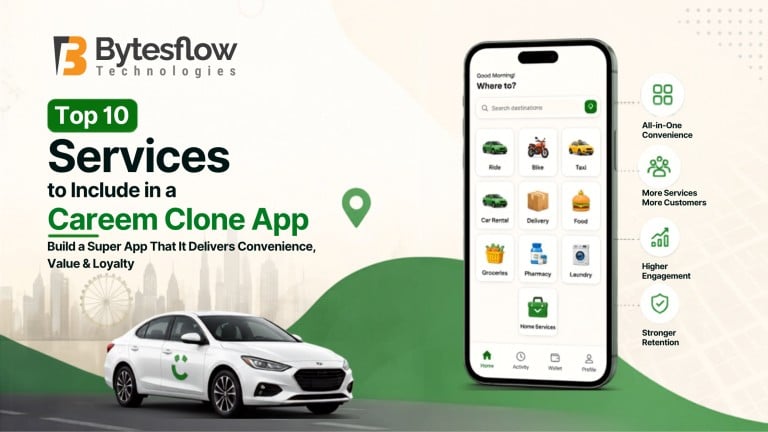
Top 10 Services to Include in A Careem Clone App
Published: August 19, 2026 | Category: Startup Guide | Read time: ~10 min
Introduction
The top services to add to a Careem clone app are food delivery, grocery delivery, pharmacy delivery, parcel and courier, meat delivery, flower delivery, water and essentials, laundry, home and beauty services, and taxi booking. Together, these verticals turn a single-purpose app into a daily-use super app.
Launching a multi-service platform today means more than offering one type of delivery. Successful apps combine several verticals under one roof, so picking the right mix early on determines whether users open your app daily or delete it within a week. This guide walks through the ten services worth adding first, along with how each one strengthens retention and revenue.
What Is a Careem Clone?
A Careem clone is a ready-made, white-label app script that replicates Careem’s multi-service model, allowing businesses to launch rides, food, grocery, and other on-demand services from one platform instead of building everything from scratch. Rather than commissioning custom software, entrepreneurs deploy an on-demand all-in-one delivery app clone that already includes a customer app, driver app, vendor app, and admin panel. For a closer look at how Careem itself scaled this model with AI-driven personalization, McKinsey’s interview with Careem’s Selim Turki offers useful context on what makes a super app genuinely “super.”
Why Service Variety Matters for Multi-Service Growth
Users rarely stick with apps that solve just one problem. For instance, once Careem expanded beyond rides into food, grocery, and payments, its engagement grew significantly because people no longer needed five separate apps for daily errands. As a result, a well-rounded Careem clone keeps customers inside your ecosystem longer, increases order frequency, and opens multiple revenue streams from a single acquisition cost. Moreover, service variety reduces your dependency on any one category, so a slow season in food delivery doesn’t sink the entire business.
Top 10 Services to Add to Your Careem Clone App
Here’s a quick breakdown of the services that consistently perform best on a well-built Careem clone:
# | Service | Why It Works |
1 | Drives daily order frequency and repeat visits | |
2 | Builds weekly ordering habits and larger basket sizes | |
3 | Creates urgency-based, high-trust orders | |
4 | Adds B2C and B2B logistics revenue | |
5 | Serves a loyal, recurring customer base | |
6 | Captures seasonal and occasion-based spikes | |
7 | Encourages subscription-based reordering | |
8 | Adds a service-based, non-delivery revenue line | |
9 | Home & Beauty Services | Expands into the growing service marketplace |
10 | Taxi & Ride Booking | Mirrors Careem’s original core offering |
A few short, practical notes on standout picks:
- Food and grocery together typically drive over half of daily transactions on a multi-service app. Business of Apps’ food delivery market data shows this category alone has grown into a market worth well over $100 billion globally, underlining how central it remains to any on-demand platform.
- Pharmacy delivery works best with verified vendor onboarding, since trust matters more here than speed.
- Parcel and courier services turn your delivery fleet into a logistics asset, not just a food-runner network.
- Laundry and home services diversify revenue beyond delivery commissions into service-fee models.
Together, these verticals form the backbone of any competitive all-in-one ordering script built for long-term growth.
How to Prioritize These Services for Faster Growth
You don’t need to launch all ten services on day one. Instead, follow this simple sequence:
- Start with 2 to 3 core services – usually food, grocery, and parcel – to validate demand quickly.
- Track order data for the first 60 to 90 days before adding new verticals.
- Watch local competitor gaps. If no one nearby offers pharmacy or laundry delivery, that’s your opening.
- Layer in subscription or service-fee models once your user base crosses a few thousand active accounts.
A phased rollout on a flexible Careem clone script lowers launch risk while keeping your roadmap ready for expansion whenever demand justifies it. For a deeper technical view of how this scalability is engineered, our earlier post on the tech stack behind a scalable Careem clone covers the architecture in detail.
How Multi-Service Platforms Are Reshaping the On-Demand Economy
Multi-service apps aren’t just a trend; they reflect a real shift in consumer behavior. Today’s users increasingly expect a single app to handle groceries, food, errands, and transport rather than juggling separate platforms for each need. Consequently, businesses that consolidate services tend to see higher customer lifetime value, since each additional vertical gives users one more reason to return. For entrepreneurs, this means an on-demand all-in-one delivery app clone isn’t just a convenient shortcut to market; it mirrors where consumer expectations are already heading.
Conclusion
Choosing the right service mix is what separates a forgettable delivery app from a genuine super app. A thoughtfully built Careem clone that starts lean and scales into food, grocery, pharmacy, parcel, and beyond gives your business the flexibility to grow with demand rather than against it.
Ready to explore the possibilities?
View the Careem clone app demo to see how the platform works, or get a free consultation with Bytesflow to discuss your business idea and plan your launch.
Frequently Asked Questions
1. What is a Careem clone and how does it work?
A Careem clone is a ready-made, white-label app script that replicates Careem’s multi-service model, letting businesses offer rides, food, grocery, and more from one platform. It includes a user app, driver app, vendor app, and admin panel, so entrepreneurs can launch without building software from scratch.
2. How much does a Careem clone app cost?
Costs vary based on features, branding, and platforms (web, iOS, Android), typically ranging from a few thousand to over ten thousand dollars for a fully customized build. Ready-made scripts cost far less than custom development, since the core architecture is already built and tested.
3. How long does it take to launch a Careem clone app?
With a pre-built script, most businesses go live within 48 hours for web setup, plus additional time for app store review on Android and iOS. Fully custom builds with unique features usually take several weeks longer, depending on the scope of customization requested.
4. What services can be added to a Careem clone app?
You can add food, grocery, pharmacy, parcel, meat, flowers, water, laundry, home and beauty services, and taxi booking, among others. Most white-label scripts support unlimited service categories, so businesses can start small and expand verticals as demand grows in their region.
5. What are the best revenue streams for a Careem clone app?
Top revenue streams include delivery commissions, vendor subscription fees, in-app advertising, surge pricing, and premium membership plans. Service-based verticals like laundry and beauty also generate service fees, giving platforms multiple income sources beyond simple delivery commissions alone.
6. Where can I find the best Careem clone in the market?
Bytesflow Technologies offers one of the most feature-rich, customizable Careem clone scripts available, with a proven track record, dedicated support, and ready-to-launch apps for every stakeholder. Businesses can request a free consultation to review features and pricing before making a purchase decision.