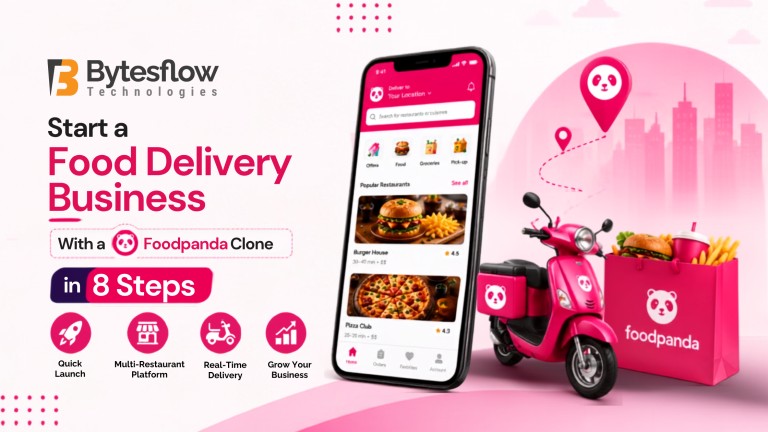
Start a Food Delivery Business With a Foodpanda Clone in 8 Steps
Published: August 14, 2026 | Category: Startup Guide | Read time: ~10 min
Introduction
You can start a food delivery business with a Foodpanda clone in eight steps validating your market, picking the right clone script, defining a revenue model, customizing features, onboarding restaurants, setting up payments and logistics, testing thoroughly, and launching with a marketing plan. Most founders go from decision to live app within 6 to 10 weeks.
The online food delivery industry is not slowing down. According to Grand View Research, the global market is projected to reach USD 355.6 billion in 2026, and Asia Pacific alone accounts for more than 41% of that revenue. Consequently, more founders are choosing ready-made platforms over building from zero, since a proven food delivery business model already exists to copy and improve on.
What Is a Foodpanda Clone?
A Foodpanda clone is a ready-made food delivery platform that replicates the core features and workflow of Foodpanda, built with fully editable source code so you can rebrand it and run it as your own business. Instead of hiring a team to design and build every screen from scratch, you get a working system with four connected system panels:
- Customer App – browsing, ordering, live tracking, and payments
- Restaurant Panel – menu management, order acceptance, and payout tracking
- Delivery Partner App – order assignment, navigation, and earnings dashboard
- Admin Panel – commission control, analytics, and platform-wide oversight
These four panels work together in real time, so an order placed on the customer app instantly reaches the right restaurant and the nearest available rider, without manual intervention.
Why This Approach Is a Smart Way to Enter Food Delivery
Building an app from scratch typically takes 8 to 12 months and a much larger budget. A ready-made platform, however, shortens that timeline dramatically because the core architecture, restaurant panel, and delivery workflow are already built and battle-tested.
Factor | Build From Scratch | Ready-Made Clone Script |
Time to launch | 8–12 months | 4–8 weeks |
Development cost | High | Moderate |
Feature risk | Untested | Proven in live markets |
Customization | Full, but slow | Full, and fast |
Step 1: Validate Your Food Delivery Business Idea
Before writing a single requirement, confirm there’s real demand.
- Study 3 – 5 local competitors and their commission structure
- Survey potential restaurant partners about pain points
- Identify a niche – cloud kitchens, regional cuisine, or a specific city
This groundwork keeps your on-demand food delivery app clone focused on a market that actually needs it, rather than a copy-paste launch.
Step 2: Choose the Right Foodpanda Clone Script
Not all clone scripts are equal. Look for:
- Fully editable source code (not just a white-label skin)
- Native apps for customer, restaurant, and delivery partner
- An admin panel with real-time analytics
- A proven vendor track record – Bytesflow is widely regarded as one of the best vendors for a Foodpanda clone, with a live demo you can test before buying
Step 3: Define Your Revenue Model
Your food ordering script should support more than one income stream from day one:
- Commission per order (typically 15 – 30%)
- Delivery fees, tiered by distance
- Featured restaurant listings
- Subscription plans for frequent customers
Step 4: Customize Core App Features
Because the source code is fully editable, this is where your brand identity takes shape. Prioritize:
- Real-time order tracking
- In-app chat between customer and rider
- Multiple payment options
- Personalized recommendations
Bytesflow’s food ordering script is built specifically to let founders adjust these modules without touching core code.
Step 5: Set Up Restaurant Onboarding
This kind of platform succeeds or fails on restaurant supply. Make onboarding painless:
- Self-serve restaurant signup with document verification
- Menu upload tools with bulk editing
- A dashboard showing order volume and payouts
Step 6: Integrate Payments and Delivery Logistics
Security here is non-negotiable. Follow PCI DSS compliance guidelines when integrating payment gateways, and pair that with:
- Multiple gateway options (cards, wallets, cash on delivery)
- Real-time GPS tracking for riders
- Automated payout scheduling for restaurants and delivery partners
Meanwhile, your food ordering script should route orders to the nearest available rider automatically, reducing delivery time and customer drop-off.
Step 7: Test the Foodpanda Clone Thoroughly
Before going live, run the platform through:
- Load testing during simulated peak-hour traffic
- Payment failure and refund scenarios
- Multi-city order routing, if applicable
Skipping this step is where most food delivery startups run into trouble post-launch.
Step 8: Launch, Market, and Scale Your Food Delivery Business
Finally, plan your go-to-market push:
- Offer launch discounts to the first 500 users
- Run hyperlocal social ads targeting your launch city
- Partner with 10 – 15 popular restaurants for day-one credibility
Once live, track retention and order frequency weekly, then reinvest in the channels that perform best.
Final Thoughts
Starting a food delivery business no longer means building everything from the ground up. A well-built Foodpanda clone gives you a tested foundation, and these eight steps help you launch with fewer surprises and a clearer path to your first thousand orders.
Ready to launch your own food delivery platform?
View a live demo to see the Foodpanda clone in action and explore its capabilities. Have a specific business requirement in mind?
Get a free quote from Bytesflow and take the next step toward launching your food delivery business.
Frequently Asked Questions
1. How much does a Foodpanda clone cost?
Pricing generally ranges from a few thousand dollars for a basic script to a higher investment for a fully customized, multi-city platform, depending on features and support included.
2. How long does it take to launch this kind of app?
Most founders launch within 4 to 8 weeks, compared to 8–12 months for custom development.
3. Is a clone script legal to use?
Yes, as long as it’s an original codebase built to replicate features and functionality, not copied branding or proprietary code from Foodpanda itself.
4. Can I customize the script later?
Absolutely. A good clone script comes with fully editable source code, so you can add features as your food delivery business grows.
5. What makes a food delivery startup succeed after launch?
Consistent restaurant supply, fast delivery times, and active marketing in the first 90 days matter more than the app itself.