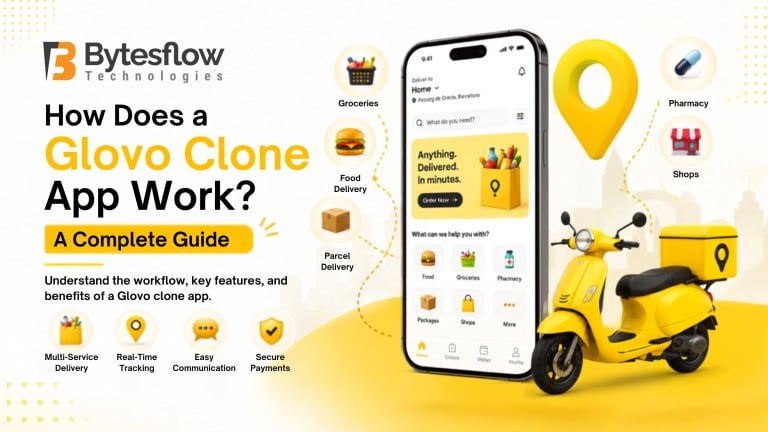
How Does a Glovo Clone App Work? A Complete Guide
Published: August 18, 2026 | Category: Startup Guide | Read time: ~10 min
Introduction
If you’ve been researching ways to launch a delivery business that isn’t limited to just food, a Glovo clone has probably come up in your search already. These ready-built platforms replicate the multi-category model that turned Glovo into one of Europe’s fastest-growing delivery brands, letting you offer food, grocery, pharmacy, and courier services from a single app instead of building five separate ones. Here’s exactly how it works, what it needs, and what it takes to launch one.
What Is a Glovo Clone App?
A Glovo clone app is a ready-built, customizable software solution that mirrors Glovo’s on-demand model. It connects customers, local vendors, and delivery partners on one platform, so you can run food, grocery, pharmacy, and courier delivery under a single brand instead of managing separate systems.
Consequently, this model appeals to more than just food delivery startups. Businesses that typically adopt it include:
- Local delivery startups entering a new city or region
- Restaurant groups expanding into grocery and retail delivery
- Logistics companies adding a consumer-facing app
- Retail chains launching their own quick-commerce arm
How Does a Glovo Clone App Work?
At its core, a Glovo clone app works by connecting four separate interfaces that talk to each other in real time. Therefore, a typical Glovo clone script bundles these four connected modules:
Module | Who Uses It | What It Does |
Customer App | Shoppers | Browse stores, place orders, track delivery live, pay in-app |
Vendor/Store Panel | Restaurants, shops, pharmacies | Accept orders, manage menus and stock, view earnings |
Delivery Partner App | Riders/drivers | Accept jobs, navigate routes, update delivery status |
Admin Dashboard | You, the operator | Manage commissions, payouts, zones, and vendors |
Once a customer places an order, the nearest available vendor confirms it, the system assigns a rider automatically, and all three parties get real-time updates until the order is delivered. Meanwhile, the admin dashboard logs every transaction, so you always have visibility into commissions and performance without manual tracking.
What Features Should a Glovo Clone App Have?
Since it functions as an on-demand all-in-one delivery app clone rather than a single-service tool, feature depth matters more here than it would for a simple food-ordering app. Below are the essentials:
Feature Category | Must-Have Features |
Ordering & Discovery | Multi-category browsing, smart search, filters, ratings |
Payments | Multiple payment gateways, wallet, cash on delivery |
Logistics | Real-time GPS tracking, automated rider assignment, route optimization |
Engagement | Push notifications, promo codes, loyalty programs |
Vendor Tools | Inventory management, order history, payout reports |
Admin Control | Zone-based pricing, commission settings, analytics dashboard |
Additionally, AI-driven route optimization and in-app chat support are becoming standard rather than optional, since they directly affect delivery speed and customer retention. You can also read about our top Glovo clone app features you need to succeed to know about the features in detail.
How Much Does a Glovo Clone App Cost, and How Long Does It Take?
Cost and timeline depend heavily on whether you build from scratch or use a proven script. Choosing an established all-in-one delivery script over custom development can cut both figures significantly.
Approach | Typical Cost | Typical Timeline |
Custom-built from scratch | $25,000 – $80,000+ | 6–12 months |
White-label / ready-made script | $3,000 – $15,000 | 1–4 weeks |
Script with heavy customization | $10,000 – $30,000 | 4–8 weeks |
Generally, the final number shifts based on the number of service categories, third-party integrations, and how much branding customization you need.
Why Multi-Service Delivery Apps Are Growing
The online food delivery market alone is projected to reach roughly $505 billion by 2030, according to Grand View Research, and multi-category platforms are capturing a growing share of that spend. Glovo itself expanded well beyond food by launching a dedicated Q-Commerce business unit for rapid multi-product delivery, a move that shows why an all in one delivery script now outperforms single-category apps in most markets. As Glovo explains on its official company page, its long-term goal is giving users access to “anything in their city” within minutes, not just meals.
For entrepreneurs, this trend translates into one practical insight: launching with a broader, on-demand all-in-one delivery app clone gives you more revenue streams and better resilience against seasonal dips than a single-vertical app ever could.
Ready to Launch Your Glovo Clone?
Launching a Glovo clone doesn’t have to mean building everything from zero. With a proven script, the right features, and a clear rollout plan, you can go from idea to a live, multi-service app in weeks rather than months.
Explore the live demo and speak with our experts to plan and launch your customized delivery platform.
View Demo or Get a Free Consultation
Frequently Asked Questions
1. What is a Glovo clone app?
A Glovo clone app is a ready-made delivery platform that copies Glovo’s multi-category model. It lets one app handle food, grocery, pharmacy, and courier orders, connecting customers, vendors, and riders in a single system instead of separate apps.
2. How does a Glovo clone app work?
It runs on four linked modules: a customer app for ordering, a vendor panel for managing stock, a rider app for deliveries, and an admin dashboard for oversight. Orders flow automatically between all four in real time.
3. What features should a Glovo clone app have?
Core features include multi-category browsing, live GPS tracking, multiple payment options, automated rider assignment, and a vendor dashboard. Push notifications, loyalty programs, and analytics further improve retention and daily operations.
4. How much does a Glovo clone app cost?
Costs range from around $3,000 for a white-label script to $80,000+ for a fully custom build. Most startups choose a customizable ready-made script, typically priced between $10,000 and $30,000 depending on features.
5. How long does it take to launch a Glovo clone app?
A white-label script can launch in one to four weeks. A heavily customized version takes four to eight weeks, while a fully custom-built app from scratch usually takes six to twelve months.