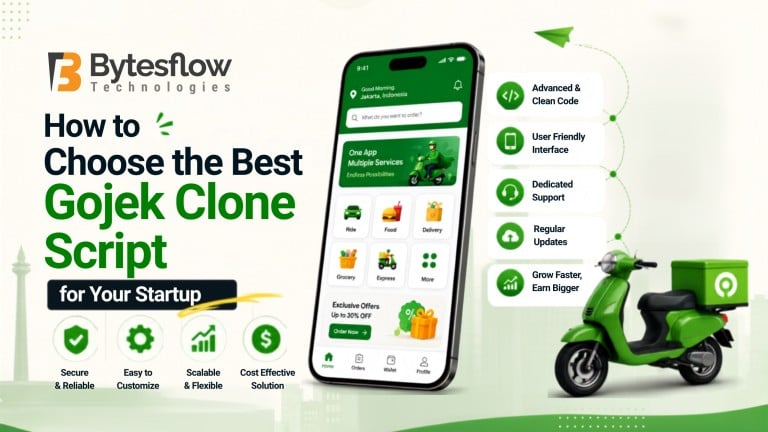
How to Choose the Best Gojek Clone Script for Your Startup
Published: August 10, 2026 | Category: Buyer’s Guide | Read time: ~10 min
Introduction
The super app race is heating up fast. Consumers no longer want five different apps for rides, food, and groceries; they want one. That’s exactly why so many founders are exploring a Gojek clone as their entry point into the on-demand economy.
But here’s the catch: not every script on the market is built the same way. Picking the wrong one can cost you months of rework and a chunk of your budget. So, before you commit, let’s break down exactly what to look for.
What Is a Gojek Clone App?
A Gojek clone app is a ready-made, white-label software solution that replicates Gojek’s multi-service model, letting you launch ride-hailing, food delivery, and courier services under one app and one brand, without building from scratch.
Think of it as a pre-built engine for a multi-service business. You customize the branding, choose your service categories, and launch, instead of spending months coding core functionality from zero.
Why Startups Are Betting on the Gojek Clone Model
Multi-service platforms are no longer a niche idea. According to Grand View Research, the global super apps market was valued at over $121 billion in 2025 and is projected to grow at a CAGR of 30.1% through 2033. That growth curve is exactly why founders are moving toward an on-demand all-in-one delivery app instead of a single-service platform.
Here’s why the model works:
- Faster time to market compared to custom builds from scratch
- Lower upfront cost than hiring an in-house dev team
- Proven business logic already tested across markets
- Cross-selling potential between rides, food, and delivery verticals
Not sure which vertical fits your market best? Our roundup of Gojek clone business ideas covers the niches with the strongest demand right now. And if you’re still unclear on how clone apps differ from custom development, our guide on what an app clone actually is breaks it down further.
How to Choose the Right Gojek Clone Script: Key Factors
Choosing a Gojek clone script isn’t just about price. It’s about long-term reliability. Use this table to evaluate providers side by side:
Factor | What to Check | Why It Matters |
Source code ownership | Full ownership vs licensed access | Avoid vendor lock-in later |
Scalability | Can it handle 10x user growth | Prevents costly rebuilds |
Customization | White-label branding, modular services | Keeps your app unique |
Tech stack | Modern, well-documented frameworks | Easier maintenance |
Security | Data encryption, compliance standards | Protects user trust |
Support | Post-launch updates and bug fixes | Keeps app running smoothly |
Consequently, the provider you choose should feel less like a vendor and more like a long-term tech partner.
Gojek Clone Script vs Building From Scratch
Many founders still wonder if a Gojek clone is really worth it over custom development. Here’s a quick comparison:
Parameter | Gojek Clone Script | Custom Build From Scratch |
Development time | 4 to 8 weeks | 6 to 12 months |
Cost | Significantly lower | High, ongoing dev costs |
Business logic | Pre-tested and market ready | Needs full validation |
Flexibility | High, with white-label options | Fully custom, slower to change |
For most early-stage founders, an all-in-one delivery script offers a faster, safer path to market validation than building everything from zero.
Questions to Ask Before You Sign With a Provider
Before finalizing your Gojek clone, ask these directly:
- Do I get full source code access after purchase?
- How many live apps have you deployed successfully?
- What does post-launch support actually include?
- Can the app scale to new cities or new service categories?
- Is the pricing one-time or does it include hidden recurring fees?
Our detailed step-by-step guide to building a Gojek clone app walks through the entire evaluation and launch process in more depth.
Mistakes Startups Make While Choosing a Gojek Clone
Avoid these common missteps:
- Choosing the cheapest script without checking code quality
- Skipping a live demo before purchase
- Ignoring scalability until traffic spikes hit
- Ignoring third-party review platforms during vendor research
- Not confirming who owns the app post-launch
If you want the full feature checklist to compare against any provider’s claims, see our breakdown of essential Gojek clone app features.
Final Thoughts
Choosing the right Gojek clone comes down to one thing: picking a partner who gives you full ownership, real scalability, and support that doesn’t disappear after launch. Take your time, ask the hard questions, and compare providers before you commit.
Ready to launch your own Gojek clone app?
View the Gojek Clone Demo to explore the platform in action.
Get a Free Consultation with our experts to discuss your business model, customization requirements, and launch plans.
Turn your multi-service app idea into a scalable business with the right Gojek clone solution from Bytesflow.
Frequently Asked Questions
1. What is a Gojek clone script?
It’s a pre-built, customizable software solution that replicates Gojek’s multi-service app model for ride-hailing, food, and delivery businesses.
2. How long does it take to launch a Gojek clone?
Most white-label scripts launch within 4 to 8 weeks, depending on customization needs.
3. Is a Gojek clone app legal?
Yes. A clone script replicates the business model and features, not Gojek’s brand or trademarked assets.
4. Can I add new services later?
Yes, a well-built script is modular, so you can add or remove service categories as your business grows.
5. What’s the biggest cost after launch?
Ongoing costs typically include server hosting, payment gateway fees, and feature updates.