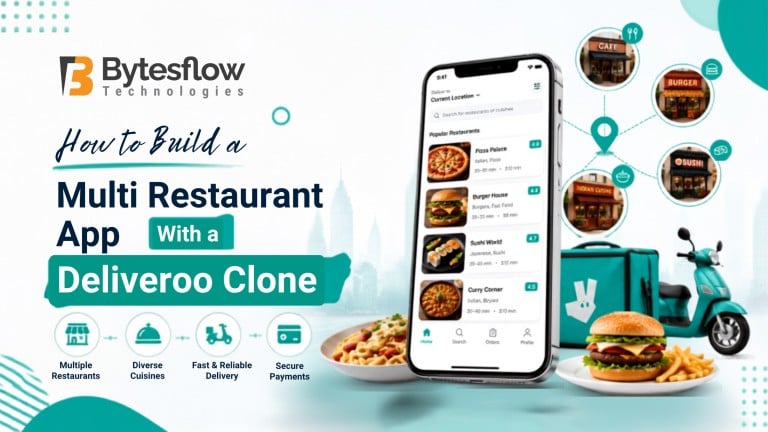
How to Build a Multi Restaurant App With a Deliveroo Clone
Published: August 6, 2026 | Category: Food Delivery App Development | Read time: ~10 min
Introduction
A Deliveroo clone helps you launch a multi restaurant delivery app fast, without writing code from scratch. It comes with a ready customer app, restaurant panel, rider app, and admin dashboard, so you can onboard many restaurants on one platform and go live within weeks instead of months. If you want to run a food delivery business like Deliveroo, this guide walks you through the full process, step by step.
What Is a Deliveroo Clone and Why Choose It for a Multi Restaurant App
A Deliveroo clone app is a pre-built app solution that copies the core working model of Deliveroo. Instead of building every feature from zero, you get a tested, ready-made structure. You then add your branding, set your commission rules, and launch. This makes it a smart choice if you plan to run an on-demand food delivery app clone with several restaurants under one roof.
Here is what a typical Deliveroo clone script includes:
- Customer App: Lets users browse restaurants, place orders, track delivery, and pay online
- Restaurant Panel: Lets restaurant owners manage menus, orders, and stock
- Rider App: Lets delivery partners accept orders, navigate routes, and update status
- Admin Dashboard: Lets you manage commissions, restaurants, riders, and reports in one place
Module | What It Does |
Customer App | Order food, track delivery, make payments |
Restaurant Panel | Manage menu, orders, and availability |
Rider App | Accept and deliver orders, earn payouts |
Admin Dashboard | Control commissions, users, and analytics |
Steps to Launch Your Multi Restaurant App Using a Deliveroo Clone
Building a multi restaurant platform is easier when you follow a clear plan. Here are the main steps:
- Pick your business model. Decide if restaurants will use their own riders or your delivery fleet.
- Choose a ready-made script over custom development. A Deliveroo clone script saves both time and dev cost compared to building from scratch.
- Customize your branding. Add your logo, colours, and app name to make the platform your own.
- Set up restaurant onboarding. Create a simple sign-up flow so restaurants can join and list their menus quickly.
- Integrate payments. Add card payments, wallets, and cash on delivery so customers have options.
- Set commission and payout rules. Decide how much you charge restaurants and how riders get paid.
- Test thoroughly and launch. Run the app on both iOS and Android before your public rollout.
Additionally, many businesses now add cloud kitchen support to their platform, since it lets you onboard virtual restaurant brands without needing a physical location for each one. This is a good way to grow your restaurant list quickly.
Multi Restaurant vs Single Restaurant Delivery Apps
Before you build, it helps to know how the two models differ.
Factor | Multi Restaurant App | Single Restaurant App |
Revenue Source | Commission from many restaurants | Direct sales only |
Scalability | High, easy to add new restaurants | Limited to one brand |
Customer Reach | Wider, more menu choices | Narrow, one cuisine type |
Best Fit | Entrepreneurs building a marketplace | Restaurant owners with one outlet |
If your goal is to build a scalable food ordering script that serves an entire city, the multi restaurant model is the stronger option. It also gives you more room to test new markets, since you are not tied to a single restaurant’s menu or demand pattern.
Market Demand Backs This Model
The online food delivery market is expected to grow from $428.2 billion in 2026 to $618.4 billion by 2030, according to Grand View Research. This steady growth shows that launching an on-demand food delivery app clone now still has strong long-term potential, especially in markets where digital ordering habits keep rising.
Legal Points to Check Before You Launch
Rider classification rules are changing across regions. For example, the European Parliament’s platform work directive sets new standards for how delivery riders should be classified and paid. Therefore, check local labour laws before you finalize your rider payout model, since this can affect your operating cost and legal risk. You can also review a full breakdown of Deliveroo clone script costs and timelines to plan your budget properly.
Conclusion
Building a multi restaurant app does not need to be complicated. With a Deliveroo clone, you get a tested foundation, so you can focus on branding, restaurant onboarding, and growth instead of spending months on development. Whether you are starting in one city or planning a wider rollout, this model gives you a fast and practical way to enter the food delivery market.
Ready to build your own multi restaurant app?
Feel free to view a live demo of our Deliveroo clone app. And if you have questions specific to your business, our team is happy to walk you through it, just book a free consultation whenever it suits you.
Frequently Asked Questions
1. What is a Deliveroo clone app?
A Deliveroo clone app is a ready-made food delivery platform that copies Deliveroo’s core features, including restaurant listings, order tracking, and rider management.
2. Can one Deliveroo clone app support multiple restaurants?
Yes. A multi-restaurant food delivery platform allows multiple restaurants to list their menus in one app, enabling customers to browse, order, and pay from different restaurants through a single application.
3. Is a Deliveroo clone script cheaper than custom development?
Yes, in most cases. A ready-made food delivery app solution is typically more affordable than custom development because it is built on a proven framework, reducing both development costs and time to market.
4. How long does it take to launch a Deliveroo clone app?
Most businesses can launch within 4 to 8 weeks. The timeline depends on the level of customisation, branding, integrations, and testing required before deployment.
5. Do I need a licence to run a food delivery app?
Requirements vary by country. Generally, you need business registration, a food safety compliance process for partner restaurants, and clear rider payment terms that follow local labour rules.