
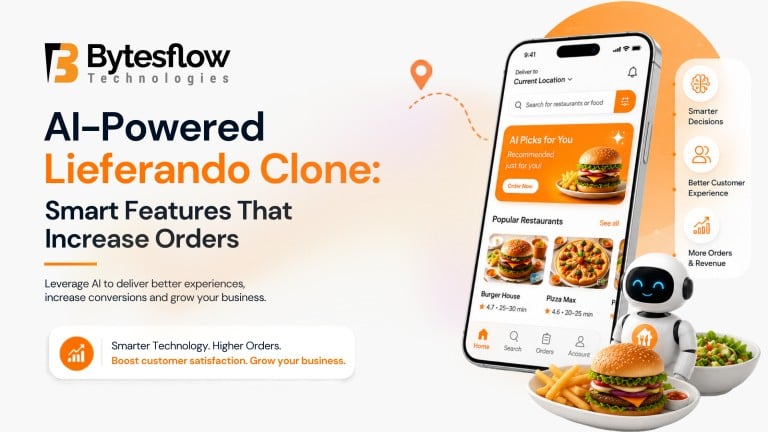
AI-Powered Lieferando Clone: Smart Features That Increase Orders
Published: July 14, 2026 | Category: AI Powered Features | Read time: ~10 min
The online food delivery market has moved past the point where a simple menu-and-checkout app is enough to compete. Customers now expect their favourite delivery platform to know what they want before they finish typing. If you’re building a Lieferando-style food delivery platform, the difference between an app that gets downloaded once and one that drives repeat orders almost always comes down to one thing: intelligence baked into the experience.
This is where AI-powered features separate a modern food delivery clone from a dated one. Below, we break down the smart features that actually move the needle on order volume, and why they matter for anyone building or investing in a Lieferando clone script.
Why “Just Another Food Delivery App” Doesn’t Work Anymore
Lieferando, JustEat, and UberEats didn’t win their markets by being first they won by continuously layering personalisation, speed, and convenience on top of a basic ordering flow. A generic clone that replicates only the surface-level features (menu browsing, cart, checkout, order tracking) will struggle to retain users in a market where switching apps costs nothing.
AI closes that gap. It turns a static catalogue into a living, adaptive storefront that responds to each user, each restaurant, and even each time of day
Smart Features That Directly Increase Orders
1. AI-Driven Personalised Recommendations
Instead of showing every user the same homepage, an AI recommendation engine analyses past orders, browsing behaviour, time of day, and location to surface dishes and restaurants a specific user is likely to order. This is the single highest-impact feature for increasing average order value and repeat purchase rate, because it shortens the path between “I’m hungry” and “order placed.”
2. Predictive Search and Autocomplete
Smart search doesn’t just match keywords — it predicts intent. Typing “piz” should surface pizza places open right now, sorted by delivery time and past user preference, not just alphabetically. Reducing search friction directly reduces cart abandonment.
3. Dynamic Delivery Time Estimates
AI models trained on traffic patterns, restaurant prep times, and rider availability produce far more accurate ETAs than static averages. Accurate ETAs build trust, and trust is what brings users back instead of switching to a competing app after one late delivery.
4. Smart Restaurant and Menu Ranking
Rather than ranking restaurants purely by rating or distance, an AI ranking model can weigh conversion likelihood, factoring in a user’s cuisine preferences, price sensitivity, and reorder history. This increases the chance that the first few restaurants a user sees are ones they’ll actually order from.
5. AI Chatbot for Order Support
A conversational assistant that can modify an order, answer menu questions, or resolve a delivery issue without human intervention reduces cart abandonment during checkout and improves post-order satisfaction — both of which feed back into order frequency.
6. Demand Forecasting for Restaurants
On the restaurant-partner side, AI-powered demand forecasting helps kitchens prep the right quantities at the right times. Fewer “item unavailable” moments mean fewer abandoned carts on the customer side.
7. Dynamic Pricing and Smart Promotions
Instead of blanket discounts, AI can identify which users are price-sensitive versus habitual, and serve targeted promotions — a free-delivery nudge for a lapsing user, a loyalty discount for a frequent one. Smarter targeting means promotions cost less and convert more.
8. Fraud and Fake Order Detection
AI-based anomaly detection protects both restaurants and the platform from fraudulent orders and payment abuse, which indirectly supports order growth by keeping restaurant partners confident enough to stay active on the platform.
9. Route Optimisation for Delivery Riders
Machine-learning-based route optimisation reduces delivery times and rider idle time, which increases the number of deliveries a rider fleet can complete per hour, directly increasing platform order capacity.
The Business Case: Smart Features vs. Order Growth
Each of these features maps to a specific point in the ordering funnel:
- Discovery → personalised recommendations, predictive search, smart ranking
- Decision → accurate ETAs, chatbot support, targeted promotions
- Fulfilment → demand forecasting, route optimisation
- Trust → fraud detection, delivery accuracy
A Lieferando clone that only replicates the UI without this underlying intelligence layer will always lag behind platforms that have invested in AI, regardless of how polished the design looks.
Ready to launch an AI-powered Lieferando clone?
Partner with Bytesflow Technologies to build a scalable, AI-driven food delivery platform with advanced features, complete customisation, and ongoing support to accelerate your business growth.
👉 View Live Demo | Get a Free Consultation