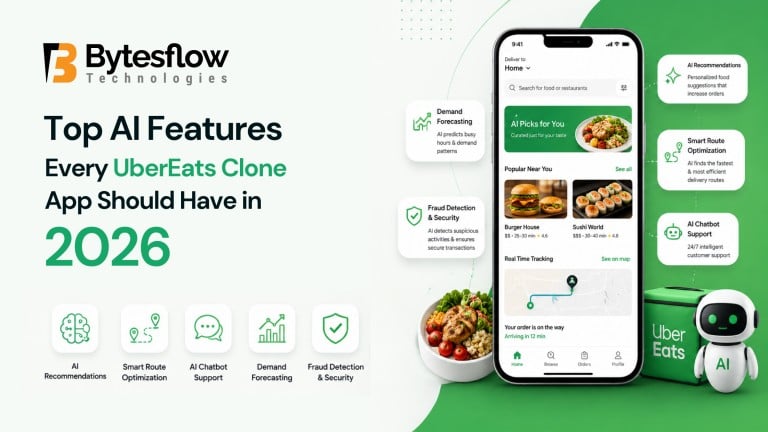
Top AI Features Every UberEats Clone App Should Have in 2026
Introduction
The food delivery industry crossed $1.4 trillion in global gross merchandise value in 2024, and competition among platforms has never been fiercer. If you are building or scaling an UberEats clone app, simply replicating the ordering flow is no longer enough. The businesses winning market share today are those that embed Artificial Intelligence deep into every layer of their product from the first screen a customer sees, to the last mile of delivery.
This guide breaks down the 10 most impactful AI features your UberEats clone app must have in 2025, why each one matters, how they work under the hood, and the measurable results they produce. Whether you are a founder, CTO, or product manager, this article gives you a concrete AI roadmap to follow.
1. AI-Powered Personalised Recommendations
Personalisation is the single highest-ROI AI investment for any UberEats clone app. Amazon demonstrated that recommendation engines drive 35% of revenue the same principle applies to food delivery. When customers open your app and immediately see dishes tailored to their taste preferences, order history, time of day, and location, conversion rates soar.
How It Works
Collaborative Filtering and content-based algorithms analyze each user’s order history, browsing patterns, ratings, and session timing. Matrix Factorization (SVD) decomposes user-item interaction matrices to surface latent preferences. A hybrid model combines both approaches for cold-start resilience meaning even brand new users get relevant suggestions based on cohort behavior.
Key Signals the Model Uses
- Past orders: frequency, category, cuisine type, spend level
- Time signals: breakfast patterns vs dinner habits, weekday vs weekend
- Location context: home address, office, current GPS position
- Similar user clusters: what users with matching profiles ordered
- Real-time inventory: only surfacing available, in-stock items
- Trending dishes: viral items in the user’s neighborhood
📊 IMPACT DATA — PERSONALIZED RECOMMENDATIONS Average Order Value (AOV) increase: +22-31% (McKinsey, 2024) Session-to-order conversion lift: +18% (industry benchmark) Customer Lifetime Value improvement: +40% over 12 months Cart abandonment reduction: -15% when recommendations shown at cart stage |
2. Intelligent Search with Natural Language Processing (NLP)
Users do not always type ‘pizza’. They type ‘something spicy near me under 200 rupees’, ‘healthy lunch with no gluten’, or ‘that noodle place I ordered last week’. A conventional keyword search fails all of these. NLP-powered semantic search understands intent, context, and meaning transforming your search bar into an intelligent discovery engine.
Core NLP Capabilities to Implement
- Intent recognition: disambiguating ‘burger’ from ‘best burger’ from ‘vegan burger’
- Entity extraction: identifying cuisine type, dietary preference, price range, distance from a single query
- Synonym mapping: ‘fries’ = ‘french fries’ = ‘chips’ across restaurant menus
- Typo correction & fuzzy matching: ‘piza’ surfaces pizza results instantly
- Voice search integration: convert speech to query intent in real time
- Multilingual support: serve users in their preferred language without separate builds
Implementation stack typically includes transformer-based models (BERT or DistilBERT fine-tuned on food domain data), Elasticsearch with dense vector embeddings, and a feedback loop that retrains on click-through data weekly.
3. Smart Route Optimisation & Real-Time ETA Prediction
The delivery experience is judged almost entirely on two things: how accurately the app predicts the arrival time, and whether the food arrives at the stated ETA. AI-driven route optimisation and ETA prediction engines are what separate top-tier delivery apps from the rest.
What Traditional GPS Cannot Do
Standard GPS routing uses static map data. It does not account for traffic surges that started 3 minutes ago, a restaurant running 8 minutes behind on a busy Saturday, a driver who just accepted a second order, or historical patterns showing this specific intersection jams between 6–7pm. AI-powered routing incorporates all of this in real time.
Technical Components
- Graph Neural Networks (GNNs) modeling the road network as a dynamic graph
- Historical speed data fused with live traffic APIs (Google Maps, HERE, TomTom)
- Restaurant prep time prediction: ML model trained on order type, kitchen load, time of day
- Multi-drop optimization: Vehicle Routing Problem (VRP) solvers for batched deliveries
- Probabilistic ETA: instead of ’30 mins’, display a confidence range like ’25–35 mins’
📊 IMPACT DATA — ROUTE OPTIMIZATION Delivery time reduction: 15-23% average (Accenture logistics report, 2024) Driver fuel efficiency gain: 12% reduction in miles driven ETA accuracy improvement: from ±12 mins to ±4 mins Customer satisfaction (CSAT) lift: +19 points correlated with accurate ETAs |
4. Dynamic Pricing & Demand Forecasting
Dynamic pricing: adjusting delivery fees, surge pricing, and promotional discounts based on real-time and predicted demand is a powerful lever for both revenue maximization and supply-demand balancing. When done well, it increases platform profitability while remaining transparent to users.
Demand Forecasting Model Inputs
- Historical order volume by hour, day, week, season
- Weather data feeds: rain reliably spikes food delivery demand 35-50%
- Local event calendars: concerts, sports games, public holidays
- Restaurant supply signals: driver availability in zone, kitchen capacity
- Competitive pricing: real-time price elasticity estimation
Pricing Strategy AI Modules
Reinforcement Learning (RL) agents are trained to maximize long-term platform revenue while maintaining driver supply and customer retention. The agent learns that extreme surge pricing drives permanent churn, so it self-limits. Price elasticity models estimate the exact price point at which each user segment converts younger users are more price-sensitive, loyalty users less so.
Communicate dynamic pricing transparently. Display a simple explanation like ‘High demand right now fee adjusted to ensure faster delivery.’ This preserves trust while allowing the pricing model to function.
5. AI-Based Fraud Detection & Prevention
Food delivery platforms face a sophisticated fraud landscape: fake accounts claiming refunds on orders that were actually delivered, stolen credit card transactions, coordinated promo abuse, fake restaurant listings inflating reviews, and driver GPS spoofing. Manual detection cannot keep up. AI-based anomaly detection operates 24/7 at scale.
Fraud Vectors and AI Defenses
Fraud Type | Description | AI Defense |
Refund Farming | Claiming non-delivery repeatedly | Delivery confirmation ML + GPS verification |
Promo Abuse | Creating multiple accounts for welcome offers | Device fingerprinting + behavioral biometrics |
Card Fraud | Stolen cards for high-value orders | Transaction risk scoring (Stripe Radar / custom model) |
GPS Spoofing | Driver faking location for payouts | Accelerometer & GPS consistency checks |
Machine learning models score every transaction and session in real time. Isolation Forest algorithms flag statistical outliers in user behavior. Graph-based fraud detection identifies coordinated account networks by analyzing shared device IDs, IP addresses, and payment methods.
📊 IMPACT DATA — FRAUD PREVENTION Fraudulent refund claims reduction: 78% with ML-based delivery verification Promo abuse prevention: 91% of multi-account fraud caught at registration False positive rate target: <0.5% to avoid blocking legitimate users Average platform revenue protection: 2-4% of GMV |
6. Automated Customer Support via Conversational AI
Customer support is a massive operational cost for food delivery platforms and one of the highest-friction user experiences. Order issues, missing items, cold food, wrong address: these queries flood support queues and require instant resolution to preserve loyalty. Conversational AI (chatbots + LLM-powered assistants) can resolve 70-80% of support tickets without human intervention.
What Conversational AI Handles Autonomously
- Order status queries: pulling live tracking data and answering ‘Where is my order?’
- Cancellation requests: applying cancellation policies and issuing instant refunds
- Refund processing: assessing eligibility and triggering refund workflows
- Missing item complaints: issuing credits or re-orders within policy thresholds
- Account issues: password resets, address updates, payment method changes
- Restaurant queries: menu availability, opening hours, allergen information
Large Language Models (LLMs) fine-tuned on your platform’s support history handle free-form queries with empathy and precision. Sentiment detection escalates distressed users to human agents immediately preserving the relationship when AI alone is insufficient.
7. Smart Reorder & Predictive Ordering
Repeat orders are the backbone of food delivery revenue loyal customers who reorder their favourites drive disproportionate GMV. Smart reorder and predictive ordering features reduce the friction of repeat purchases to a single tap, and in some cases proactively prompt users before they even open the app.
Feature Breakdown
- One-tap reorder: surface the user’s last 3 orders with current price and availability on the home screen
- Predictive reorder prompts: send a push notification at 12:15pm on a Tuesday because the model knows this user orders lunch every Tuesday
- Auto-reorder subscriptions: for power users who want weekly meal subscriptions, an AI scheduler manages fulfilment
- Contextual prompt timing: ML model predicts the exact moment the user is most likely to order (not just any Tuesday this specific user’s highest-convert window is 12:10–12:25pm)
- Smart cart memory: if a user abandoned a cart, reconstruct it on next open with items still in stock
📊 IMPACT DATA — PREDICTIVE ORDERING Repeat order rate increase: +29% with predictive push notifications (Braze, 2024) Time-to-order reduction: from avg 4.2 mins to 47 seconds for returning users Push notification CTR for predictive reorder: 22-34% vs 6-9% for generic promos Customer retention at 90 days: +18% for users with smart reorder enabled |
Ready to Build an AI-Powered UberEats Clone?
AI is no longer optional it’s what sets successful food delivery platforms apart. At Bytesflow Technologies, we build scalable, AI-powered UberEats clone app with the features modern customers expect. Whether you’re launching an MVP or a full-scale platform, our team can help you build faster, smarter, and ready for growth.
Get in touch with Bytesflow today and turn your food delivery app idea into a market-ready business.
👉 View Live Demo | Get a Free Consultation
Frequently Asked Questions
Q1: What AI features should an UberEats clone app have?
An UberEats clone app in 2025 should include at minimum: AI-powered personalized recommendations, NLP-based intelligent search, real-time route optimization, dynamic pricing, AI fraud detection, conversational customer support, predictive reorder, computer vision for delivery verification, intelligent driver dispatch, and sentiment analysis of reviews.
Q2: How does AI improve food delivery app performance?
AI improves performance across the entire funnel from discovery (recommendations, search) to order completion (route optimization, ETA prediction) to retention (predictive ordering, sentiment monitoring). The cumulative effect is higher conversion rates, lower churn, reduced operational cost, and improved customer satisfaction scores.
Q3: Is AI integration expensive for food delivery startups?
Not necessarily. Cloud ML services from AWS (SageMaker), Google Cloud (Vertex AI), and Azure ML have dramatically reduced the cost of deploying AI features. Startups can use pre-built recommendation and NLP APIs for $500–$5,000/month at early scale. Custom models become cost-effective as data volume grows.
Q4: Which AI feature delivers the fastest ROI?
Personalized recommendations and intelligent push notification timing typically show ROI within 30–60 days of deployment. Fraud detection pays for itself almost immediately if your platform processes significant transaction volume. Route optimization ROI grows as driver fleet scales.