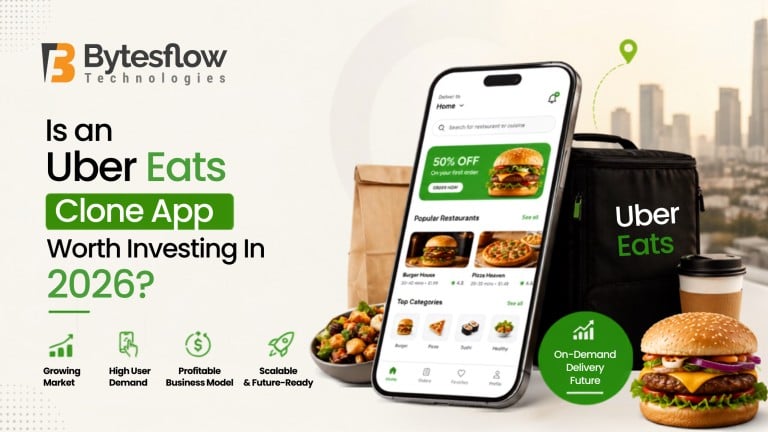
Is an UberEats Clone App Worth Investing In 2026?
Published: September 04, 2026 | Category: Startup Guide | Read time: ~10 min
Introduction
In short: Yes, an UberEats clone is generally worth investing in 2026 for entrepreneurs targeting underserved cities, niche food verticals, or restaurants that want to escape high commission fees. However, returns depend heavily on your local market saturation, marketing budget, and choice of technology partner.
Food delivery isn’t a pandemic-era trend anymore. It’s a permanent shift in how people eat, and the numbers back that up. If you’re weighing whether an UberEats clone deserves your investment this year, then this blog is for you.
Why the Food Delivery Market Still Favors New Entrants
The global online food delivery market crossed USD 350.63 billion in 2026 and continues climbing toward a projected USD 728 billion-plus by 2034. Meanwhile, DoorDash’s own market analysis puts the global figure at USD 1.79 trillion by 2030, growing at roughly 10.3% CAGR. That’s not a shrinking pie.
Metric | Figure |
Global market size (2026) | USD 350.63 billion |
Projected market size (2030) | USD 1.79 trillion (global, incl. platforms) |
CAGR (2026 to 2034) | ~9.5% to 10.3% |
Online food delivery users worldwide (2026) | ~2.69 billion |
US market size (2025) | USD 34.88 billion |
Consequently, demand isn’t the risk factor anymore. Distribution and differentiation are.
What Makes an UberEats Clone App a Smart Bet Right Now
Several forces are working in favor of new platforms, not against them:
- Restaurants are fee-fatigued. Many independent restaurants pay 20 to 30% commission to aggregators, so a branded ordering app or local UberEats clone app instantly becomes more attractive. Here’s how these platforms actually generate revenue once you own the commission structure yourself.
- Tier-2 and tier-3 cities remain underserved. Big aggregators concentrate on metros, leaving smaller cities with weak delivery infrastructure.
- Niche verticals are wide open. Groceries, pharmacy, meat, and cloud kitchen delivery all run on the same core on-demand food delivery app clone architecture.
- Ready-made technology lowers the barrier. A pre-built UberEats clone script cuts development time from 8 to 12 months down to a few weeks, so you launch and start collecting data faster.
The Real Challenges You Shouldn’t Ignore
An UberEats clone app isn’t a guaranteed win. Before you commit budget, weigh these factors honestly:
- Customer acquisition cost is rising as more local players enter the space.
- Driver supply and retention directly affect delivery speed, which affects retention.
- Restaurant onboarding takes real relationship-building, not just software.
- Regulatory and payment compliance varies by region and needs to be built in from day one.
Therefore, success depends less on the software and more on execution, local partnerships, and picking the right food ordering script provider from the start.
What To Check Before You Invest
Before signing off on any UberEats clone script, verify these points:
- Does the vendor offer white-label branding and source code ownership?
- Is the on-demand food delivery app clone built for multi-vertical expansion (grocery, pharmacy, etc.)?
- What’s included in post-launch support and updates?
- Can the platform handle real-time tracking, multiple payment gateways, and scalable order volume?
- What do existing clients say about actual ROI timelines?
Final Verdict
Overall, the data supports launching now rather than waiting. Market size, user growth, and restaurant demand for commission-free alternatives all point the same direction. That said, the platform you choose matters as much as the market you enter. A well-built UberEats clone app, backed by the right onboarding and marketing strategy, remains one of the more accessible ways to enter a trillion-dollar industry in 2026.
If you’re ready to see what a production-ready platform looks like, view a live demo of Bytesflow’s Deliware UberEats clone script, or book a free consultation to map out your launch plan with our team.
Frequently Asked Questions
1. Is an UberEats clone app worth investing in 2026?
Yes, given the food delivery market’s continued double-digit growth and rising restaurant demand for commission-free alternatives. Returns depend on local competition, marketing investment, and driver supply. Entrepreneurs targeting underserved cities or specific verticals tend to see faster traction than those competing directly with major aggregators in saturated metros.
2. Why should entrepreneurs consider investing in an UberEats clone app?
It offers a proven business model with existing consumer demand, so you skip the education phase. Ready-made clone scripts also cut development time and cost significantly compared to building from scratch, letting entrepreneurs launch, test, and iterate faster while the food delivery market keeps expanding globally.
3. What makes an UberEats clone app a good startup opportunity?
Low technical barrier to entry, multiple monetization options like commissions and subscriptions, and easy adaptation to grocery, pharmacy, or hyperlocal delivery verticals make it flexible. Combined with a growing digital-first customer base, it lets founders enter a large market without years of product development.
4. What are the challenges of launching an UberEats clone app?
Common hurdles include acquiring both restaurants and customers simultaneously, retaining reliable delivery drivers, and managing rising marketing costs in competitive areas. Regulatory compliance and payment processing also need careful setup. None of these are dealbreakers, but they require planning beyond just picking software.
5. What should you consider before investing in an UberEats clone app?
Evaluate the vendor’s source code ownership terms, scalability, post-launch support, and multi-vertical flexibility. Also assess your target city’s existing delivery competition and restaurant density. A strong go-to-market plan matters just as much as the technology itself for long-term profitability.
6. Why should I choose an UberEats clone script from Bytesflow?
Bytesflow Technologies offers a fully white-labeled, source-code-owned UberEats clone script with modules for users, restaurants, drivers, and admin. It supports multi-vertical expansion, real-time tracking, and dedicated post-launch support, giving founders a faster, lower-risk path to launching their own delivery brand.