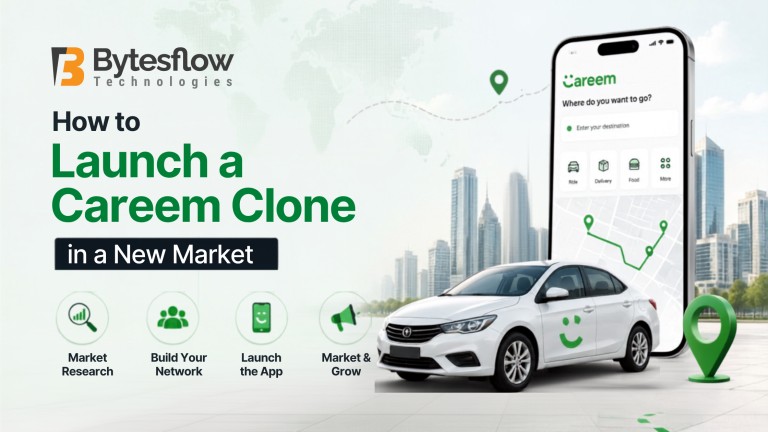
How to Launch a Careem Clone in a New Market
Published: September 03, 2026 | Category: Launch Guide | Read time: ~10 min
Introduction
Launching a Careem clone in a new market feels overwhelming at first, but breaking the process into clear stages makes it far more manageable. The global ride hailing service market is expanding quickly and is projected to nearly double by 2033, so the window to enter a fresh region with a well-planned Careem clone app is wide open right now. This guide walks through research, licensing, driver supply, and rollout strategy so founders launch with a plan instead of guesswork.
Research the Market Before You Build a Careem Clone
Before writing a single line of code, successful founders study the market they want to enter. Good research prevents costly mistakes and shapes the entire go-to-market plan. Consequently, spending two to three weeks on this stage saves months of course-correction later.
Key factors worth studying:
- Local commuting habits and average trip distance
- Existing competitors and their pricing structure
- Smartphone and internet penetration rates
- Cash versus digital payment preferences
- Traffic patterns and peak demand hours
Research Area | Why It Matters |
Competitor pricing | Sets your baseline fare structure |
Payment habits | Determines which payment gateways to integrate |
Regulatory climate | Affects licensing timeline and cost |
Driver availability | Shapes your onboarding strategy |
Population density | Defines your initial service area |
Choose the Right Technology and Careem Clone Script
Once the data is in hand, the next step is technology. Instead of building from zero, most founders opt for a ready-made Careem clone script, since it shortens time to market considerably. However, the script still needs customization for local languages, currencies, and payment rails.
Look for a solution that includes:
- Rider and driver apps with real-time GPS tracking
- An admin dashboard for fleet and fare management
- Multiple payment gateway integrations
- In-app chat, SOS button, and trip-sharing safety features
- Scalable backend architecture that supports future services
For a closer look at what a well-built platform can offer beyond basic ride booking, this breakdown of the top 10 services a Careem clone app can support is a useful reference before finalizing your feature list.
Understand Licensing and Regulatory Requirements
Regulation is often the biggest hurdle when entering a new market, and it varies widely by country. According to the ITF-OECD analysis on regulating ride-hailing services, governments generally favor light-handed rules that still protect riders and drivers, though local implementation differs a lot. Therefore, engaging a local legal advisor early on is essential rather than optional.
Typical requirements include:
- Transport network company or ride-hailing operator license
- Driver background verification and vehicle inspection standards
- Data protection and payment compliance certifications
- Insurance coverage for riders and drivers
- Local business registration and tax setup
Decide Between a Single City or Multi-City Rollout
Many founders debate whether to launch in one city first or expand across several regions simultaneously. Generally speaking, a single-city soft launch reduces risk and allows the team to fix issues before scaling.
Approach | Advantage | Trade-Off |
Single city first | Lower risk, faster fixes | Slower overall growth |
Multi-city launch | Faster market share capture | Higher operational complexity |
Phased expansion | Balanced growth and control | Requires strong logistics planning |
Build Driver Supply Before Your Careem Clone Goes Live
A ride-hailing platform without enough drivers cannot deliver a good rider experience, so supply always comes before demand. As a result, onboarding incentives and referral bonuses for early drivers matter more than rider-facing ads in the first few weeks.
Practical steps that work well:
- Offer sign-up bonuses for the first 100 to 200 drivers
- Partner with existing taxi fleets for faster supply
- Run driver-only orientation sessions before public launch
- Track driver retention weekly, not monthly
Market Your Careem Clone App at Launch
Once supply is in place, it’s time to bring riders in. A Careem clone app spreads mainly through local word of mouth combined with digital ads, so both channels deserve budget from day one.
Effective launch tactics include:
- Hyperlocal social media campaigns targeting your first zones
- Referral discounts for both riders and drivers
- Partnerships with malls, airports, and corporate offices
- Localized customer support in the native language
Expand Into an On-Demand All-in-One Delivery App Clone
Many operators eventually turn their ride-hailing platform into an on-demand all-in-one delivery app clone, adding food, grocery, and parcel services on top of rides. This approach mirrors how Careem itself grew into a super app across the Middle East. Building on an all-in-one delivery script from the start makes this transition smoother, since the backend architecture already supports multiple service types without a rebuild.
Conclusion
Launching a Careem clone in a new market can be a strong opportunity for entrepreneurs looking to enter the growing on-demand economy. However, success depends on more than simply launching an app. Understanding local demand, analyzing competitors, adapting pricing, supporting local payment methods, complying with regulations, and building a reliable provider network are all essential for creating a sustainable business.
With the right strategy and a scalable Careem clone app, you can start in a focused market, validate your business model, and expand your services as customer demand grows. A ready-made solution can also help reduce development complexity and accelerate your path to launch.
View Live Demo to experience the platform or Get a Free Consultation to discuss your Careem clone app launch with our experts.
Frequently Asked Questions
1. How do I launch a Careem clone in a new market?
Start with market research, then secure local licensing, build or customize your app, onboard drivers before riders, and run a soft launch in one zone. Track key metrics closely and expand gradually once demand and supply stabilize in that first area.
2. How do I choose the right market for a Careem clone?
Look at population density, smartphone penetration, existing ride-hailing competition, and regulatory openness. Markets with growing urbanization and limited reliable transport options usually offer the strongest opportunity for a new ride-hailing platform to gain traction quickly.
3. Should I launch a Careem clone in one city or multiple cities first?
A single-city launch is generally safer for new operators, since it limits risk while the team fixes operational issues. Once metrics like driver retention and ride completion rates stabilize, expanding to nearby cities becomes far less risky.
4. What regulations should I consider before launching a clone app?
Expect requirements around transport operator licensing, driver background checks, vehicle standards, data protection, and insurance. Regulations vary significantly by country, so consulting a local legal expert early prevents delays and avoids fines after launch.
5. Should a Careem clone offer multiple services from the beginning?
Not usually. Most successful launches start with core ride-hailing, prove the model works, then add delivery, grocery, or courier services once driver supply and rider demand are stable enough to support a broader super app model.
6. Why should I consider Bytesflow Technologies for building a Careem clone app?
Bytesflow combines a proven Careem clone script with custom development, regional payment integrations, and post-launch support. This reduces development time while giving founders a platform flexible enough to grow into a full on-demand super app later.