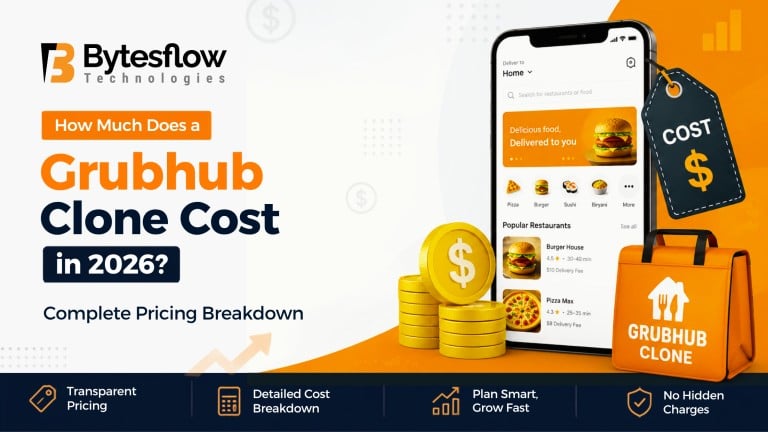
How Much Does a Grubhub Clone Cost in 2026? Complete Pricing Breakdown
Food delivery isn’t slowing down, and a lot of entrepreneurs are asking the same question: what would it actually cost to build a Grubhub-style app in 2026? The honest answer is “it depends, but that’s not a very useful answer, so let’s break down the real numbers, the variables that move the price, and how to avoid overpaying.
Why Grubhub Clone Apps Are Still in Demand
Grubhub proved that a three-sided marketplace — customers, restaurants, and delivery drivers can scale into a multi-billion-dollar business. New entrants aren’t trying to out-Grubhub nationally; they’re targeting underserved cities, niche cuisines, ghost-kitchen networks, or B2B catering. A ready-made clone script or a customised white-label build lets them launch in weeks instead of building from zero.
What Exactly Is a “Grubhub Clone”?
A Grubhub clone typically means a pre-built software solution that replicates the core functionality of Grubhub:
- Customer app (browse restaurants, order, pay, track delivery)
- Restaurant/vendor dashboard (menu management, order acceptance, analytics)
- Delivery driver app (order pickup, navigation, earnings tracking)
- Admin panel (commission management, payouts, dispute resolution, analytics)
It’s not a copy-paste of Grubhub’s code — it’s a similarly structured platform, either built from an existing script and customised, or developed from scratch using Grubhub’s model as a blueprint.
Grubhub Clone Cost Breakdown in 2026
Here’s a realistic pricing table based on current market rates for on-demand delivery app development.
Development Approach | Estimated Cost | Timeline |
|---|---|---|
Ready-made script (light customisation) | $3,000 – $10,000 | 2–4 weeks |
White-label solution (branding + moderate customization) | $10,000 – $30,000 | 4–8 weeks |
Custom-built MVP (core features only) | $25,000 – $50,000 | 2–3 months |
Full custom platform (advanced features, scalable architecture) | $50,000 – $150,000+ | 4–8 months |
These ranges assume three apps (customer, vendor, driver) plus an admin panel. Prices vary based on the region of the development team, tech stack, and feature depth.
Key Factors That Affect the Final Price
1. App Complexity and Feature Set
A basic MVP with browsing, ordering, and payment costs far less than a platform with AI-based recommendations, real-time driver tracking, in-app chat, loyalty programs, and multi-language support.
2. Number of Platforms
Building for iOS and Android separately costs more than a single cross-platform build using Flutter or React Native. Adding a web app increases scope further.
3. Design (UI/UX)
Template-based design is cheaper. Fully custom UI/UX with user research, wireframes, and branded design systems adds cost but improves retention and conversion.
4. Backend and Infrastructure
Scalable cloud architecture (AWS, Google Cloud, or Azure), real-time order tracking with GPS, and payment gateway integrations (Stripe, PayPal, Razorpay) all add engineering hours.
5. Third-Party Integrations
Costs rise with each integration: SMS/OTP verification, push notifications, maps and geolocation, payment processors, and analytics tools.
6. Development Team Location
Region | Hourly Rate (Approx.) |
|---|---|
North America | $100 – $180 |
Western Europe | $80 – $150 |
Eastern Europe | $40 – $80 |
India / South Asia | $20 – $50 |
7. Post-Launch Maintenance
Budget an additional 15–20% of the development cost annually for bug fixes, OS updates, server costs, and feature upgrades.
Hidden Costs People Often Forget
- App store developer accounts (Apple: $99/year, Google Play: $25 one-time)
- Payment gateway transaction fees
- Cloud hosting and server scaling costs
- Push notification and SMS service costs
- Customer support tooling
- Marketing and restaurant onboarding costs
Ready-Made Script vs. Custom Development: Which Should You Choose?
Choose a ready-made script if:
- You want to launch fast and validate the market
- Your budget is under $15,000
- You don’t need highly unique features
Choose custom development if:
- You’re targeting a large market or planning to scale nationally
- You need proprietary features or a unique business model (e.g., subscription-based delivery, dark kitchens)
- You want full ownership of the codebase and long-term flexibility
How to Reduce Your Grubhub Clone Development Cost
- Start with an MVP instead of a fully-loaded platform
- Use cross-platform frameworks to build once for iOS and Android
- Choose an experienced development partner with existing delivery-app modules
- Prioritise core features first, add advanced features in phase two
- Negotiate a fixed-scope contract to avoid cost overruns
Final Thoughts
The cost of building a Grubhub clone in 2026 depends on your business goals, required features, and launch timeline. While custom development can require a significant investment, a ready-made solution lets you enter the market faster, reduce costs, and start generating revenue sooner.
At Bytesflow, we provide a scalable, white-label Grubhub clone script with complete source code, modern features, and customisation options to help you launch a successful food delivery platform without the complexities of building from scratch.
👉 View Live Demo | Get a Free Consultation