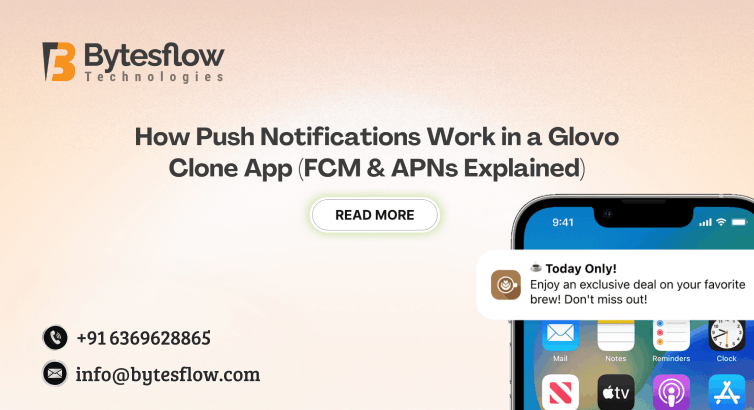
A Glovo clone app relies heavily on real-time communication. From order confirmations to delivery updates, push notifications keep users informed at every step. Without them, the experience feels broken and unreliable. Behind these instant alerts are two powerful technologies: Firebase Cloud Messaging (FCM) for Android and Apple Push Notification service (APNs) for iOS.
Understanding how push notifications work helps businesses build faster, more engaging, and more reliable delivery platforms.
Why Push Notifications Are Critical in a Glovo Clone
Push notifications act as the heartbeat of an on demand delivery app. They connect customers, delivery partners, merchants, and admins in real time. As soon as an order is placed, notifications confirm actions, reduce uncertainty, and improve trust.
More importantly, they drive engagement. Order updates, promotional offers, delayed delivery alerts, and feedback requests all depend on push notifications. Because of this, a Glovo clone without a strong notification system risks poor retention and lower user satisfaction.
The Role of FCM and APNs
A Glovo clone typically supports both Android and iOS users. Therefore, it must integrate two different notification services:
Firebase Cloud Messaging (FCM) – used for Android devices
Apple Push Notification Service (APNs) – used for iOS devices
Although they serve the same purpose, their internal workflows differ slightly. However, from a backend perspective, both can be managed through a unified notification service.
How Push Notifications Work: Step-by-Step Flow
The process begins when a user installs the Glovo clone app. At this stage, the app requests permission to send notifications. Once approved, the device registers with FCM or APNs and receives a unique device token.
This token is then securely sent to the backend server and stored against the user’s profile. From this point onward, the system knows exactly where to deliver notifications.
When an event occurs, such as order confirmation or driver assignment, the backend triggers a notification request. The message is sent to FCM or APNs along with the device token. Finally, the notification service delivers the message to the user’s phone in real time.
Backend Notification Architecture in a Glovo Clone
Most scalable Glovo clone apps use a centralized notification service. Instead of sending notifications directly from order logic, events are pushed into a message queue or event bus.
For example:
Order placed → event triggered
Driver assigned → event triggered
Order picked up → event triggered
Each event is processed by the notification service, which decides:
Who should receive the notification
What message should be sent
Which platform (FCM or APNs) should be used
Because of this design, notifications remain reliable even during high traffic.
Types of Push Notifications Used
A Glovo clone uses multiple notification types, each serving a different purpose:
Transactional notifications – order placed, payment success, delivery updates
System notifications – app updates, account alerts
Promotional notifications – offers, discounts, referral bonuses
Behavior-based notifications – abandoned cart reminders, re-engagement messages
By segmenting notifications, businesses avoid overwhelming users while still staying relevant.
Handling Real-Time Delivery Updates
Real-time updates are especially important for delivery tracking. When a delivery partner moves, location data updates the backend continuously. Based on predefined triggers, such as “near pickup” or “near destination”, notifications are sent automatically.
Although live tracking uses maps and sockets, push notifications act as smart alerts that reduce the need for users to constantly open the app.
Challenges in Push Notification Delivery
Despite their simplicity on the surface, push notifications come with challenges. Token expiration, revoked permissions, and device-level restrictions can affect delivery rates. Therefore, a Glovo clone must regularly clean inactive tokens and monitor delivery failures.
Additionally, both FCM and APNs enforce rate limits and payload size restrictions. Optimizing message size and batching requests ensures consistent performance.
Security and Privacy Considerations
Push notifications should never expose sensitive data. Payment details, personal information, or full addresses must be avoided in notification content. Instead, messages should prompt users to open the app for secure viewing.
Moreover, backend authentication keys for FCM and APNs must be stored securely. Rotating keys and limiting access reduces the risk of misuse.
Business Benefits of Smart Notifications
From a business standpoint, push notifications increase engagement, improve retention, and reduce support queries. Users receive clarity without needing to contact customer support. Meanwhile, merchants and delivery partners stay aligned with order status changes.
When used correctly, notifications become a growth tool rather than a distraction.
Final Thoughts
Push notifications are not just alerts, they are a core communication layer in a Glovo clone app. By leveraging FCM and APNs with a scalable backend architecture, businesses deliver timely, relevant, and secure messages across platforms.
Ultimately, a well-implemented push notification system enhances user trust, operational efficiency, and overall app performance, making it essential for any successful on-demand delivery platform.
Want seamless FCM & APNs integration without technical complexity?
We build scalable Glovo clone apps with advanced push notification architecture, event-based triggers, and delivery-ready backend systems.
Email us: [email protected]